

Introduction
Understanding behavior can feel like a puzzle, especially in the world of Applied Behavior Analysis (ABA). At the center of this puzzle is the concept of motivating operations (MOs). These environmental factors play a crucial role in how effective reinforcers and punishers are, ultimately influencing how individuals act.
As we dive into what motivation means in ABA therapy, you’ll discover some strategies that not only boost engagement but also promote meaningful behavioral change. It’s exciting to think about how these insights can help! But here’s the real question: how can therapists tailor these motivating operations to fit each individual’s unique needs? After all, motivation can look quite different from one person to another.
Let’s explore this together! By understanding MOs, we can better support those we care about and make a positive impact on their lives.
Define Motivating Operations in ABA
(MOs) are those important environmental factors that can temporarily affect how effective reinforcers or punishers are, which in turn influences the likelihood of certain actions. There are two main types of MOs: (EOs) and (AOs). For instance, think about hunger—this is an EO that makes food more appealing. On the flip side, when we’re satiated, that desire for food decreases, showcasing an AO at work.
Imagine a young person who’s really hungry; they’re much more likely to seek out food. This is a perfect example of how EOs can boost motivation. After a meal, however, that attraction to food diminishes, illustrating how AOs can shift our actions. Understanding these dynamics is essential for analysts, especially when they’re crafting targeted strategies to help individuals with autism using the .
Recent studies have shown just how impactful MOs are on behavior. When children have access to their favorite items before starting a task, they tend to engage more and show fewer problem behaviors. This really emphasizes the importance of incorporating MOs into intervention plans to create supportive environments that encourage positive behavioral changes.
There are also strategies like (PRT) and discrete trial teaching (DTT) that utilize MOs to boost engagement and skill development. As Jack Michael, a well-respected analyst in the field, put it, ‘Understanding the is essential for analyzing actions in Applied Behavior Analysis (ABA).’
Let’s not forget about (UMFs), which relate to our basic physiological needs like hunger and thirst. Additionally, the three types of conditioned motivating functions (CMOs)—reflexive, transitive, and surrogate—offer deeper insights into how MOs operate in real-life situations.
By empowering caregivers with knowledge of these principles and strategies, they can play an active role in their child’s growth. This collaboration not only enhances the effectiveness of interventions but also ensures that , measurable, and grounded in . Ultimately, this leads to better behavioral outcomes. We’re here to help you every step of the way!

Explain the Importance of Motivating Operations in Behavior Modification
(MOs) are an important aspect of the that shapes our actions. They significantly influence how valuable reinforcers are and how likely we are to . By understanding and strategically influencing MOs, therapists can create environments that significantly for .
For example, if a child is missing out on a favorite toy, that toy suddenly becomes much more important to them. This can lead to the child being more willing to engage in behaviors that will help them get access to it. Research supports this idea, showing that problematic behaviors can drop to an average of 20% when kids have presession access to preferred items, compared to 61% without. Plus, can soar, averaging 83% with presession access versus just 31% without it. These insights empower clinicians to design interventions that are not only effective but also tailored to meet each individual’s unique needs, ultimately leading to .
Also, did you know that 90% of individuals show when recommended therapy hours are fully implemented, especially with active caregiver participation? This really highlights how important . Caregivers who understand ABA principles and strategies are in a better position to provide the right support at home. This complements professional interventions and fosters consistency.
As one ABA therapist beautifully put it, ‘Behavior is a form of communication, and we must listen.’ This underscores the importance of behind behaviors to encourage positive change. By equipping caregivers with knowledge and skills, we can boost their confidence and ability to effectively support their child’s development. This leads to improved behavioral outcomes and informed decision-making. Let’s explore this together!

Discuss Applications of Motivating Operations in ABA Therapy
In ABA therapy, (MOs) are essential for boosting treatment effectiveness through thoughtful application. Imagine setting up an environment that makes certain reinforcers more appealing! For instance, if a young person thrives on social interaction, a therapist might design activities that encourage peer engagement. This not only increases the likelihood of but also aligns with research showing that when caregivers are actively involved in ABA therapy. It’s a wonderful reminder of how crucial our surroundings can be for success.
On the flip side, we can use abolishing operations to lessen the impact of negative reinforcers. If a child often engages in a behavior just to escape a task, a therapist could tweak that task to make it more enjoyable. This way, the child’s urge to avoid diminishes, creating a happier learning atmosphere. Research shows that can help individuals develop adaptive responses, ultimately enhancing their quality of life.
Experts emphasize that understanding and utilizing MOs allows therapists to craft to each child’s needs. By grasping how MOs influence behavior, therapists can devise targeted strategies that lead to better outcomes. For example, giving kids access to their favorite items before sessions has been proven to reduce behavioral issues and boost academic engagement. It’s a practical approach that showcases the benefits of applying MOs in therapy.
In summary, the thoughtful use of the in ABA therapy not only boosts intervention effectiveness but also helps therapists foster that encourage . By leveraging MOs, practitioners can truly enhance the therapeutic experience for young individuals with autism, paving the way for improved and a better quality of life. Let’s explore this together!

Challenges in Implementing Motivating Operations
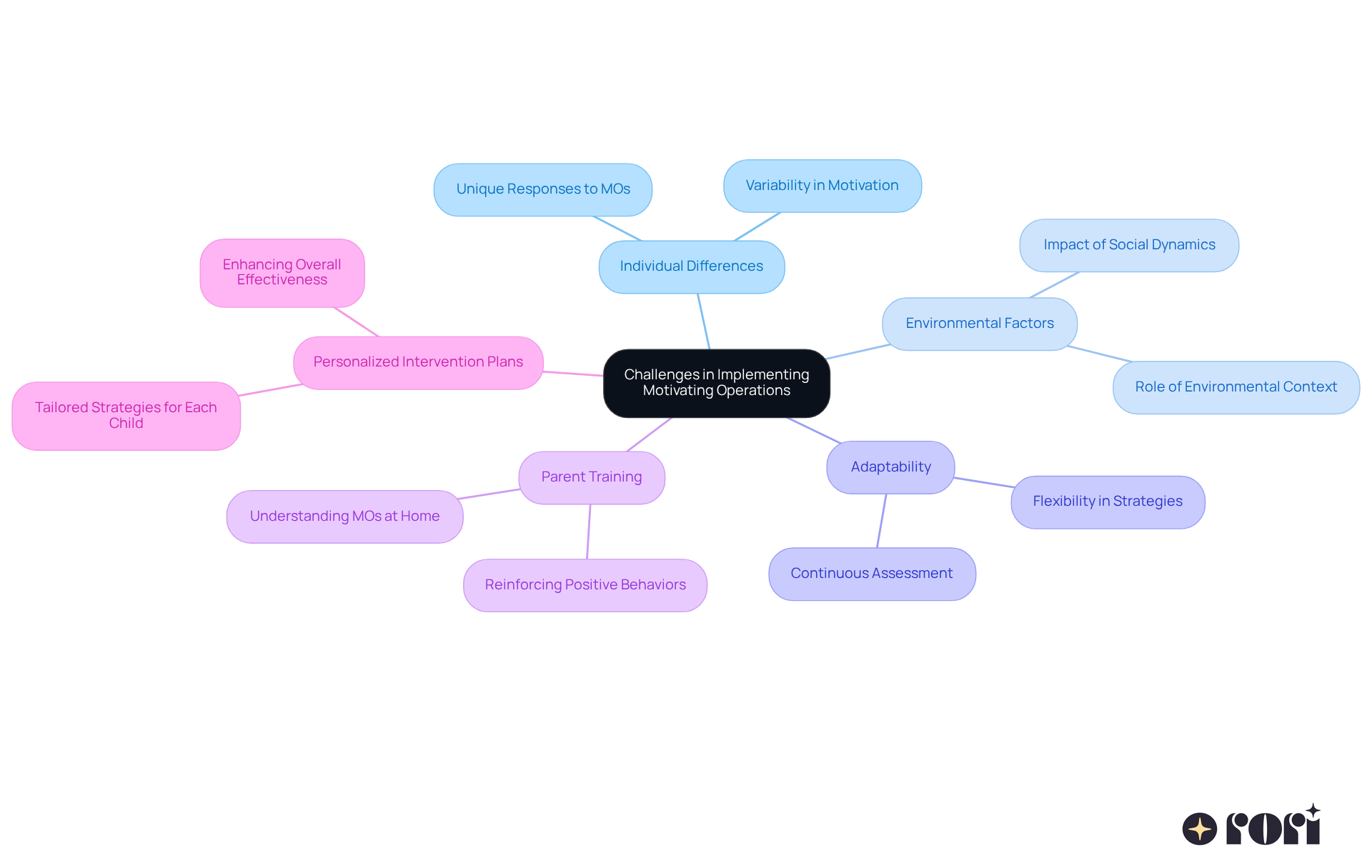
according to the , but implementing them can sometimes feel challenging. One major hurdle is that what motivates one child may not resonate with another. For example, can really change how are. It’s important for clinicians to stay alert and flexible, continually assessing and adjusting their strategies based on each child’s unique responses.
This adaptability is key! Research shows that when the is customized for the individual, the results can improve significantly. Plus, at home is essential for reinforcing . However, this can be tricky, as parents might find it hard to spot the nuances of MOs in everyday life.
By recognizing these complexities, therapists can develop more effective and that cater to each child’s unique needs. This ultimately enhances the overall effectiveness of . Let’s explore this together! We’re here to !
Conclusion
Understanding the role of motivating operations (MOs) in Applied Behavior Analysis (ABA) therapy is so important for creating effective behavioral interventions. By recognizing how environmental factors can influence the effectiveness of reinforcers and punishers, practitioners can tailor strategies that really boost motivation and engagement in individuals with autism.
As we explore this topic, key insights about the types of MOs—establishing operations (EOs) and abolishing operations (AOs)—come to light. For instance, when individuals have access to their preferred items, we often see increased engagement and a decrease in problem behaviors. Plus, the teamwork between therapists and caregivers is crucial in implementing these strategies effectively, ensuring that support is consistent across different environments.
Ultimately, we can’t underestimate the significance of understanding and applying motivating operations. By equipping both therapists and caregivers with the right knowledge and tools, we can create a more supportive and effective therapeutic environment. This collaboration not only promotes positive behavior changes but also enhances the overall quality of life for those receiving ABA therapy. Embracing this knowledge is a wonderful step towards meaningful progress in the journey of behavioral modification. Let’s explore this together!
Frequently Asked Questions
What are motivating operations (MOs) in Applied Behavior Analysis (ABA)?
Motivating operations (MOs) are environmental factors that temporarily affect the effectiveness of reinforcers or punishers, influencing the likelihood of certain behaviors.
What are the two main types of MOs?
The two main types of MOs are establishing operations (EOs), which increase the appeal of a reinforcer, and abolishing operations (AOs), which decrease that appeal.
Can you provide an example of an establishing operation (EO)?
An example of an establishing operation is hunger, which makes food more appealing and increases the likelihood of seeking food.
What is an example of an abolishing operation (AO)?
An example of an abolishing operation is satiety, which reduces the desire for food after a meal.
How do MOs impact children’s behavior in intervention settings?
Recent studies show that when children have access to their favorite items before starting a task, they tend to engage more and exhibit fewer problem behaviors, highlighting the importance of MOs in intervention plans.
What strategies utilize MOs to enhance engagement and skill development?
Strategies like pivotal response training (PRT) and discrete trial teaching (DTT) utilize MOs to boost engagement and facilitate skill development.
What are unconditioned motivating factors (UMFs)?
Unconditioned motivating factors (UMFs) relate to basic physiological needs such as hunger and thirst.
What are the three types of conditioned motivating functions (CMOs)?
The three types of conditioned motivating functions are reflexive, transitive, and surrogate, which provide deeper insights into how MOs operate in real-life situations.
How can caregivers benefit from understanding MOs?
By understanding MOs and related strategies, caregivers can actively participate in their child’s growth, enhancing the effectiveness of interventions and ensuring that behavioral plans are tailored and evidence-based.
List of Sources
- Define Motivating Operations in ABA
- Motivating Operations In ABA – Big Dreamers ABA (https://bigdreamersaba.com/blog/motivating-operations-in-aba)
- Motivating Operations In ABA: Defining And Examples (https://magnetaba.com/blog/motivating-operations-in-aba)
- pmc.ncbi.nlm.nih.gov (https://pmc.ncbi.nlm.nih.gov/articles/PMC3050471)
- THE INFLUENCE OF MOTIVATING OPERATIONS ON GENERALIZATION PROBES OF SPECIFIC MANDS BY CHILDREN WITH AUTISM – PMC (https://pmc.ncbi.nlm.nih.gov/articles/PMC3469301)
- Explain the Importance of Motivating Operations in Behavior Modification
- What Are ABA Therapy Quotes? Understanding Their Role and Importance – Rori Blog (https://rori.care/post/what-are-aba-therapy-quotes-understanding-their-role-and-importance)
- pmc.ncbi.nlm.nih.gov (https://pmc.ncbi.nlm.nih.gov/articles/PMC3050471)
- THE INFLUENCE OF MOTIVATING OPERATIONS ON GENERALIZATION PROBES OF SPECIFIC MANDS BY CHILDREN WITH AUTISM – PMC (https://pmc.ncbi.nlm.nih.gov/articles/PMC3469301)
- Inspirational ABA and Autism Quotes – Mrs. Moe’s Modifications (https://mrsmoesmodifications.com/inspirational-aba-and-autism-quotes)
- adinaaba.com (https://adinaaba.com/post/conditioned-motivating-operations-in-aba-therapy)
- Discuss Applications of Motivating Operations in ABA Therapy
- What Are ABA Therapy Quotes? Understanding Their Role and Importance – Rori Blog (https://rori.care/post/what-are-aba-therapy-quotes-understanding-their-role-and-importance)
- Inspirational ABA and Autism Quotes – Mrs. Moe’s Modifications (https://mrsmoesmodifications.com/inspirational-aba-and-autism-quotes)
- sciencedirect.com (https://sciencedirect.com/science/article/abs/pii/S0891422210002441)
- brighterstridesaba.com (https://brighterstridesaba.com/blog/motivating-operations-in-aba)
- pmc.ncbi.nlm.nih.gov (https://pmc.ncbi.nlm.nih.gov/articles/PMC3050471)
- Challenges in Implementing Motivating Operations
- pmc.ncbi.nlm.nih.gov (https://pmc.ncbi.nlm.nih.gov/articles/PMC3050471)
- The Role of Motivating Operations in ABA Therapy for Autism | Autism Therapy Services (https://hiddengemsaba.com/articles/the-role-of-motivating-operations-in-aba-therapy-for-autism)
- newdawnaba.com (https://newdawnaba.com/blog/motivating-operations-in-aba)
- adinaaba.com (https://adinaaba.com/post/conditioned-motivating-operations-in-aba-therapy)