

What Behavior Analysis Means for Autism Care
Applied Behavior Analysis, usually called ABA, applies that way of thinking through planned strategies for teaching skills and addressing behavioral challenges. An ABA plan may identify target skills, define measurable goals, and describe how teaching will take place.
ABA is not a universal prescription for every autistic child. Individualized care starts with questions about your child’s communication, daily routines, social skills, learning needs, and the situations in which a behavior occurs. The purpose is not to apply a fixed set of exercises simply because a diagnosis is present. The purpose is to decide which skills matter in your child’s daily life, how progress will be observed, and whether the approach continues to fit.
The phrase “behavior analysis” describes a broader way to understand behavior and learning. An individualized ABA service turns that understanding into a plan for your child. That distinction matters because a general explanation can help you prepare questions, but it cannot select goals or strategies for your family. We offer ABA therapy that addresses behavioral challenges and involves families in their child’s growth.
A useful way to evaluate ABA is to ask three questions: Whose goals does the plan serve? How respectfully are those goals pursued? What information will guide changes over time? The sections below connect those questions to context, teaching, data, caregiver involvement, research, and ethics.
See Behavior in Its Context
The ABC model looks at what happens before a behavior, the behavior itself, and what follows it. The model can help identify triggers associated with challenging behavior and can organize observations without treating the behavior as an isolated event.
For example, imagine that your child leaves a table during a difficult activity. An ABC-style observation would ask what happened immediately before leaving, describe the action in specific terms, and record what followed. Was the task introduced without a clear cue? Was help available? Did the activity stop after your child left? These questions do not diagnose the reason for the behavior. They create a clearer description for a care team to discuss.
Context can include the task, setting, people present, communication demands, timing, and what happens after the behavior. A plan may then focus on teaching an alternative response, changing part of the situation, or reinforcing a desired action. The ABC model describes reinforcing desired actions and teaching alternative responses as behavior-support strategies.
Use context to replace broad labels with observable questions. “Uncooperative” does not tell you what happened. “Pushed the worksheet away after the instruction” gives you something that can be discussed and measured. That difference also protects your child from being defined by a single difficult moment.
When you discuss context with a provider, bring examples from more than one setting if you can. A behavior at home may look different from a behavior during schoolwork, community activities, or therapy. The practical boundary is simple: describe what you observe, then ask the care team to help interpret patterns rather than assuming a cause from a label.
How ABA May Teach New Skills
ABA teaching strategies may include Discrete Trial Training and Natural Environment Teaching. These names describe different teaching contexts, but the useful question for you is how a strategy connects to a skill your child needs and how the team will know whether the teaching is helping.
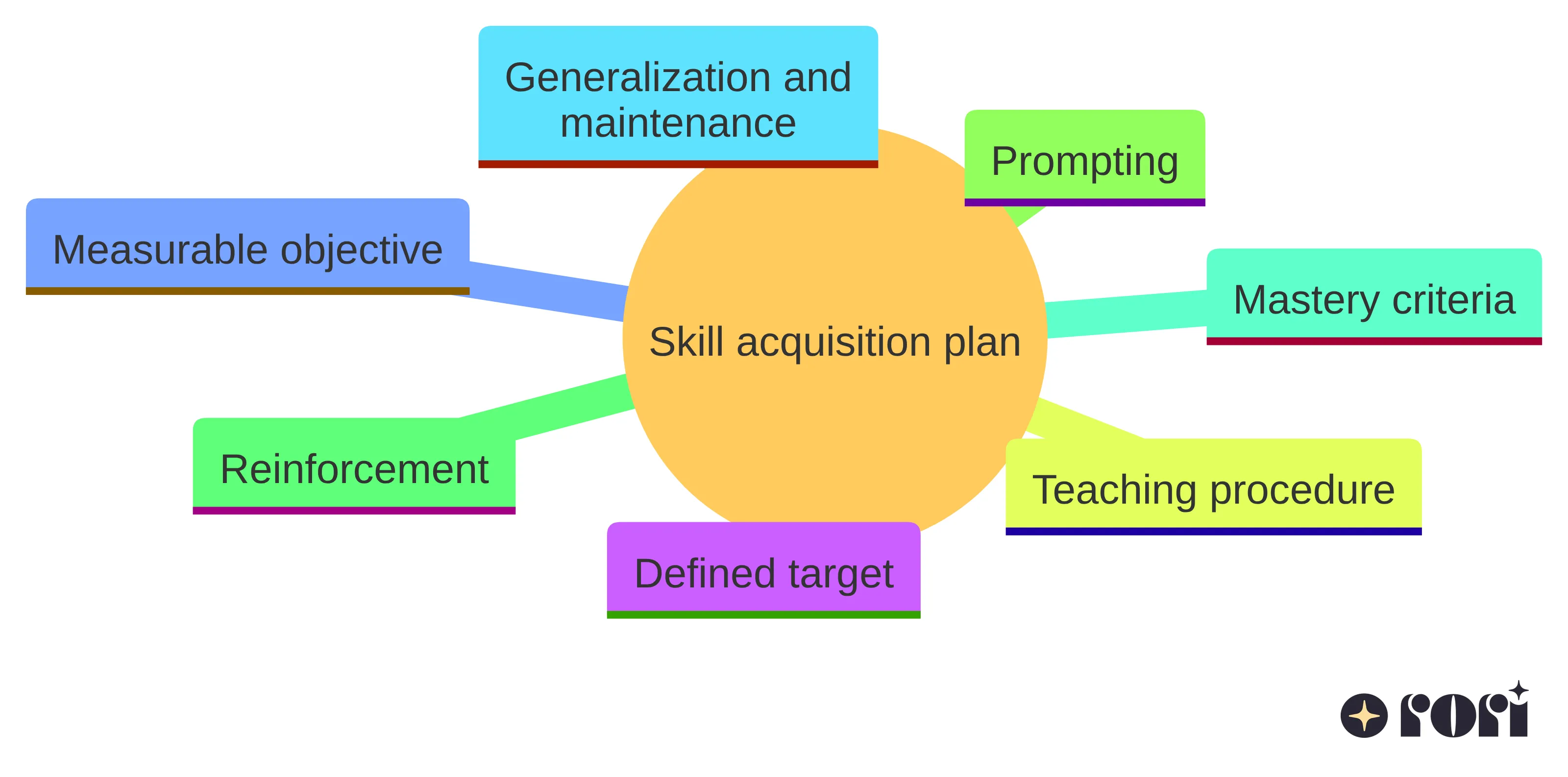
A skill-acquisition plan can include several connected parts:
- A defined target: The plan identifies a skill such as communication, daily living, or social interaction rather than using a vague goal.
- A measurable objective: Specific criteria make it possible to track what your child does over time.
- A teaching procedure: The plan explains how the skill will be introduced and practiced.
- Prompting: Prompts can guide your child through a new task. The plan may gradually reduce those prompts to support independence.
- Reinforcement: ABA reinforcement strategies may use praise or tangible rewards to encourage a desired behavior.
- Mastery criteria: The plan can define when the skill has been sufficiently learned.
- Generalization and maintenance: Strategies can help your child use a skill across settings and maintain it over time.
Prompting is not the same as completing a task for your child. Ask what support will be provided at the beginning, how the prompt will be reduced, and what independence will look like. If the plan uses praise or a tangible reward, ask how the team will determine whether that approach is appropriate and meaningful for your child.
Teaching should also connect to daily routines. A communication target may matter because your child needs a reliable way to request help, make a choice, or participate in an activity. A daily-living target may matter because your child is working toward greater participation in a routine. The plan should make that connection clear instead of treating isolated performance as the whole purpose of care.
Goals That Connect to Everyday Life
Everyday ABA goals may include communication, social skills, daily living skills, and independence. An ABA skill-acquisition plan can identify these areas as target skills, while tailored ABA strategies may support daily living skills and independence for children with autism.
A useful goal describes a practical action, not a demand to appear typical. “Uses a preferred communication method to request a break” is more informative than “behaves appropriately.” “Participates in two steps of a dressing routine with fewer prompts” gives you a clearer way to discuss support. The exact goal for your child requires individualized planning, but the wording should make its daily purpose visible.
Communication goals may involve expressing needs or engaging in conversations through structured activities using modeling, prompting, and reinforcement, as described by Rori Care. Social goals may involve participation, shared activities, or communication with other people. Daily-living goals may involve routines that support your child’s participation at home or in the community.
Progress in one setting does not automatically mean a skill is usable everywhere. Ask how the plan will address generalization across people, locations, materials, and routines. Ask how the team will distinguish a skill that your child can perform with intensive prompting from a skill your child can use with greater independence.
No goal list can promise a particular developmental or behavioral result. A goal gives you a shared target for planning and discussion. It should remain meaningful to your child’s life, measurable enough to review, and open to adjustment when circumstances or priorities change.
How Assessment and Data Shape the Plan
An individualized ABA plan uses assessment, defined goals, observation, and data to decide what to teach and what to change. The plan should begin with a clear description of the skill or behavior, the circumstances in which it occurs, and the practical reason it matters to your child.
Data collection gives the team a way to describe progress more precisely than memory alone. We emphasize data collection and data-driven decision-making in ABA therapy. In practical terms, that may mean recording whether a target skill occurred, how much prompting was needed, or whether the skill appeared in another setting. The exact measurement depends on the goal.
A plan can use measurable goals to track progress objectively and define criteria for deciding when a skill has been sufficiently mastered. It can also include strategies for using skills across settings and maintaining them over time.
Ask how the team will use the information after it is collected. Useful questions include:
- What exactly is being measured?
- How often will the measurement be reviewed?
- What would count as meaningful progress?
- What would lead the team to modify the teaching strategy?
- How will you receive understandable updates?
- How will the team check whether a skill is usable outside the teaching session?
Data does not make a plan automatic. Numbers still need context, and a measurement may not capture your child’s preferences, fatigue, communication style, or experience during an activity. Treat data as a tool for better discussion, not as a substitute for listening to your child and reviewing whether the goal remains meaningful.
A plan that never changes despite clear information may deserve questions. A plan that changes without explaining what prompted the change may also deserve questions. Ask the provider to connect each adjustment to the goal, the observations, and your child’s experience.
The Role of Caregivers and the Care Team
Caregivers and the care team each contribute information that can shape an ABA plan. An ABA plan may involve BCBAs, BCaBAs, and other professionals working as a team. Your observations add information about routines, communication, preferences, and situations that may not appear during a scheduled session.
Parent-mediated intervention involves parents learning knowledge and specific skills intended to support functioning or reduce challenging behavior. We also provide parent training as part of our described ABA intervention approach. Caregiver involvement does not mean you must become your child’s therapist. It means you can decide what information to share, learn which strategies the team recommends, and discuss whether those strategies fit your home and priorities.
A collaborative care conversation can cover:
- Which goals matter most in your child’s current routines?
- What does the team want you to observe or record?
- Which strategies can be used at home, and which require professional coaching?
- How will the team respond if a strategy increases distress or does not fit your child?
- Who makes a change to the plan, and how will that change be explained?
- How will different professionals coordinate their recommendations?
The team’s qualifications and responsibilities should be clear. A behavioral-therapy source notes that behavioral therapists may have varied educational backgrounds and may not hold a specific behavior-analysis certification. Ask who designs the plan, who supervises implementation, what each person is qualified to do, and whom you contact with concerns. Those questions are about transparency, not about assigning a single title to every member of the team.
Your participation can also help identify whether a skill transfers into real routines. Share what works, what feels difficult, and what your child communicates through words, actions, gestures, or other methods. A plan is more useful when the team can connect its targets to the life your child actually leads.
What Research Findings Can and Cannot Tell You
Research findings can describe patterns across groups, but they cannot predict exactly what will happen for your child. A 2025 meta-analysis examined ABA-based interventions across language, communication, daily living, socialization, motor, cognitive, adaptive-behavior, and autism-symptom outcomes.
A review of behavioral and educational autism interventions reported that comprehensive early intervention was effective in improving intelligence and adaptive behaviors. The same review reported improvements in social skills and communication, along with reductions in sleep, eating, and toileting problems, from intensive individualized intervention. Those reported findings do not guarantee an individual outcome.
Several limits matter when you interpret findings:
- The intervention label may cover different plans. ABA-based interventions can differ in goals, teaching strategies, intensity, setting, and caregiver involvement.
- The outcome may not match your priority. A study measure may concern language, adaptive behavior, or another domain while your immediate question concerns communication during meals or participation in a routine.
- A group finding is not an individual forecast. Your child’s communication, preferences, support needs, environment, and response to teaching all affect how a plan should be discussed.
- Reported benefit does not settle ethical questions. A measurable change can still be a poor goal if it prioritizes appearance over meaningful communication, participation, or independence.
Use research to frame questions rather than to accept a promise. Ask which part of the plan relates to the finding being discussed, what outcome will be measured for your child, and what would lead the team to continue, change, or stop a strategy. Ask for limitations in plain language.
The evidence also supports keeping the plan specific. Instead of asking whether ABA “works” in general, ask what skill is being targeted, how it will be measured, how the teaching will be delivered, and whether the goal matters in your child’s daily life. That approach gives research an appropriate role without turning it into a guarantee.
Ethical Questions Families Should Include
Ethical questions about ABA include whose priorities shape the goals and whether the teaching respects autistic ways of communicating and being. A disability-advocacy source argues that autistic people are rarely involved in creating or implementing autism services, raising questions about whose goals those services prioritize.
The same source raises ethical concerns that some ABA and similar practices may prioritize appearing non-autistic or hiding autistic traits. This concern does not mean that every ABA plan has the same goal. It does mean you have a reason to ask what a target is intended to change and who benefits from that change.
For each proposed goal, ask:
- Does this target improve communication, participation, daily living, or independence?
- Is the target addressing a barrier your child experiences, or mainly reducing behavior that other people find unusual?
- How will your child’s preferences, signals, and responses influence the plan?
- What will the team do if your child shows distress, refusal, or a need for a break?
- Can the provider explain the purpose of the target without using appearance or compliance as the only measure?
- How will the team protect time for play, rest, preferred activities, and ordinary family life?
These questions do not require you to reject every structured teaching strategy. They help you distinguish a practical skill goal from a demand to suppress harmless differences. Communication, social participation, daily living, and independence can be discussed in terms of access and choice rather than conformity.
Respect also includes revisiting goals. A target that made sense several months ago may no longer fit your child’s priorities or circumstances. Ask how your feedback enters the review process and how your child’s behavior is interpreted when it communicates discomfort, confusion, or disagreement. Ethical care needs measurable planning and room for human judgment.
Questions to Ask an ABA Provider
Questions for an ABA provider can help you compare how different practices define goals, measure progress, involve caregivers, and respond to concerns. Bring the list to an initial conversation and write down answers in language you understand.
About the plan
- What skills would you assess first, and why do they matter in my child’s daily life?
- How will you turn a broad concern into a specific, measurable goal?
- What teaching strategies might you use, and what would determine whether they continue?
- How will prompting be reduced as my child learns?
- How will you support the use of a skill across people, places, and routines?
About data and review
- What exactly will you measure?
- How often will you review the data with me?
- What would count as progress, and what would lead you to change the plan?
- How will you explain results if progress is uneven across settings?
- How will you decide when a skill has been sufficiently mastered?
About communication and respect
- How will my child communicate a choice, request a break, or show that a task is difficult?
- How do you distinguish a meaningful skill goal from a goal focused mainly on appearing typical?
- How will my child’s preferences and responses affect the plan?
- What happens if I disagree with a target or strategy?
- How do you respond when a child refuses, becomes distressed, or needs a different way to participate?
About the people providing care
- Who designs and supervises the plan?
- What does each team member do, and what training or certification does each person hold?
- Who will teach caregivers, and what support is available when a strategy is hard to use at home?
- How will the team coordinate with other professionals involved in my child’s care?
About practical arrangements
- What does the assessment and consultation process involve?
- What schedule would you recommend discussing for my child, and what factors would affect that recommendation?
- What costs, payment questions, or insurance questions should I raise before services begin?
- How can I raise a concern, request a plan review, or ask for a written explanation?
A provider does not need to give a one-size-fits-all answer to every question. A useful conversation should explain the reasoning, identify the limits of what can be known before assessment, and leave you able to describe the proposed goals and review process in your own words.
When Individualized Professional Guidance Matters
Individualized guidance becomes relevant when you need to interpret your child’s behavior, choose goals, decide how a skill will be measured, or understand whether a teaching approach fits your child. General information can help you prepare, but it cannot show how your child communicates, what happens in your home, or which priorities should come first.
Seek a care discussion when you are considering an ABA assessment, comparing proposed goals, responding to a significant change in behavior, or deciding whether a current strategy should be adjusted. Bring concrete examples: what happened before the behavior, what your child did, what followed, what support was offered, and what your child appeared to communicate. The ABC model can help organize those observations around triggers, behavior, and consequences.
Individualization also matters when a plan includes several settings or people. Ask how the team will coordinate teaching, how data will be reviewed, and how caregiver input will affect changes. ABA plans can define target skills, measurable goals, teaching strategies, prompting procedures, reinforcement strategies, mastery criteria, and generalization or maintenance strategies.
Do not treat a general article as a diagnosis, a treatment plan, or a decision about suitability. Use it to make the next conversation more specific. If a provider cannot explain the purpose of a goal, how progress will be measured, or how concerns will be handled, pause and ask for clarification before agreeing to that part of the plan.
Take the Next Step With Clearer Questions
A question list gives you a practical way to begin an ABA conversation without treating ABA as a universal answer. Focus on goals that connect to your child’s communication, participation, daily living, or independence; ask how the team will measure progress; and ask how your child’s preferences and responses will shape the plan.
Before beginning individualized care, a qualified professional should decide whether a particular service and plan fit your child’s needs. Bring your questions, your observations, and your child’s priorities to that discussion. Then use the answers to decide what you want to explore next.
Practical Questions About Behavior Analysis and ABA
What is behavior analysis in the context of autism care?
Behavior analysis examines how behavior relates to the surrounding situations and how structured teaching can support meaningful skills. Applied Behavior Analysis (ABA) applies this understanding through planned strategies for teaching skills and addressing behavioral challenges.
How does an ABA plan support individualized care for children with autism?
An ABA plan identifies target skills, defines measurable goals, and describes teaching strategies tailored to the child’s unique needs, ensuring that the approach is not a one-size-fits-all solution.
What are common goals of ABA therapy for children with autism?
Common goals may include improving communication, social skills, daily living skills, and fostering independence, with each goal being tailored to the child’s specific needs and daily life.
What questions should I ask an ABA provider before starting therapy?
You should ask about the skills to be assessed, how goals will be defined and measured, the teaching strategies used, how progress will be tracked, and how caregiver input will be incorporated into the plan.
When should I seek individualized guidance from a qualified professional regarding ABA therapy?
Individualized guidance is important when interpreting your child’s behavior, choosing goals, or deciding on the appropriateness of a teaching approach, especially if there are significant changes in behavior.
What ethical considerations should families keep in mind when discussing ABA therapy?
Families should consider whose goals are prioritized in the therapy, whether the approach respects the child’s communication style, and how the plan addresses meaningful skills rather than merely conforming to typical behavior.