

Behavior analysis and ABA are related, but they are not the same
Behavior analysis is a science concerned with describing, predicting, and influencing behavior. The field includes several distinct ideas and forms of practice, including behaviorism, experimental behavior analysis, applied behavior analysis, and professional practice guided by behavior analysis.
Applied Behavior Analysis, usually shortened to ABA, is a set of principles used in many behavioral treatments. ABA applies the science of learning and behavior to practical goals, such as increasing useful behaviors and reducing behaviors that may interfere with learning or may be harmful.
That difference matters when you are considering autism care. “Behavior analysis” names the wider scientific and professional area; “ABA therapy” describes an applied treatment approach that uses behavior-analytic principles. The terms overlap, but they do not mean exactly the same thing.
You do not need to decide whether ABA is right for your child simply because someone uses a familiar label. Start with more specific questions: What skill or behavior is being addressed? How will it be observed? What would meaningful progress look like for your child and family? How will the team change course if the approach is not helping?
Those questions move the conversation away from a universal promise and toward fit. They also help you distinguish a clear, individualized plan from a description that says little about what will actually happen.
A broad label also cannot tell you how a service will look day to day. Ask what your child will be learning, what support will be used, who will be involved, and how your family’s priorities will shape the discussion. The details matter more than the label alone.
What behavior analysis examines
Behavior analysis examines observable behavior and the circumstances surrounding it. The BCBA Task List identifies description, prediction, and influence as goals of behavior analysis as a science.
In an autism-care conversation, that can mean looking closely at questions such as:
- What happens before a behavior or response?
- What does your child do that can be observed and described clearly?
- What happens immediately afterward?
- In which settings, activities, or interactions does the response occur?
- What skill is your child trying to use, learn, or communicate?
A parent guide describes ABA techniques as examining antecedents, meaning what happens before a behavior, and consequences, meaning what happens after it. This does not reduce your child to a behavior. It gives the team a shared way to describe a concern without relying only on broad labels such as “not listening” or “difficult behavior.”
For example, “needs help with communication” can lead to a more useful discussion when you ask which communication skill matters in daily life, how that skill will be observed, and what support your child can use. The aim is not to collect information for its own sake. The aim is to connect observation with a practical question about learning, participation, or communication.
Behavior analysis can also help separate a general concern from a measurable target. A measurable target does not have to capture everything about your child. It gives you and the care team a specific point to discuss and review.
Description and interpretation are not the same. You can describe what happened without assuming why your child responded that way, then ask how the team will examine the surrounding circumstances. That distinction can make conversations more precise and reduce the risk of treating an assumption as a fact.
What ABA means in autism care
ABA in autism care means applying principles of learning and behavior to goals that matter in a child’s life. A parent guide describes ABA as a set of principles forming the basis for many behavioral treatments and says ABA therapy can be used to increase useful or desired behaviors and reduce behaviors that may interfere with learning or may be harmful.
A BACB executive summary describes ABA applications for autistic people across the lifespan. For young children, it says intensive, comprehensive intervention may target cognitive, language, social, and self-help skills.
These descriptions explain the approach without deciding what your child needs. ABA is not an autism diagnosis, and the word itself does not identify a particular schedule, setting, teaching method, or goal. Two children may both receive services described as ABA while working on different skills and using different supports.
Ask the provider to translate the label into concrete terms. You should be able to discuss the target skill, how the team will teach it, what your child’s response will look like, how progress will be recorded, and how you will participate in decisions. If the explanation stays at the level of “changing behavior” without identifying the meaningful skill or daily purpose, ask for a clearer description.
A useful conversation also makes room for limitations. ABA principles can guide an individualized treatment discussion, but the label alone cannot predict how your child will respond or whether a particular approach will fit your family.
The practical question is therefore not whether the word ABA appears in a description. Ask what the proposed service would involve for your child, which goals it would address, and how the team would review the approach over time.
The goals may include communication, learning, and daily participation
ABA may address several kinds of skills, depending on your child’s needs and the goals you set with the care team. The parent guide lists language, communication, attention, focus, social skills, memory, academics, and reducing problem behaviors among areas in which ABA therapy is used.
The BACB executive summary also describes possible targets for young children that include cognitive, language, social, and self-help skills. These categories are broad. They are not a prediction about your child and should not be treated as a checklist that every child must follow.
You can make a consultation more useful by connecting a possible goal to a real activity:
- Communication: expressing a request, responding, or using a communication system during a routine.
- Learning: participating in an activity, following an instruction, or building an academic skill.
- Social participation: joining an interaction or using a skill during a shared activity.
- Daily living: practicing a self-help skill that matters at home or in another routine.
- Behavior that interferes with learning: identifying what is happening and what support may help your child participate.
Parent-Implemented Intervention offers another way to connect support with everyday activities. AFIRM describes it as coaching parents to help their child develop skills or behaviors during routines such as meals, play, or bedtime.
A meaningful goal should have a clear purpose for your child, not merely a polished description. Ask how your child’s communication, comfort, participation, and family priorities will shape the goals.
The goal list should remain specific enough for you to understand why each item matters. Ask what the skill would look like during an ordinary routine and how your child’s own way of communicating or participating will be recognized.
How observation turns concerns into measurable questions
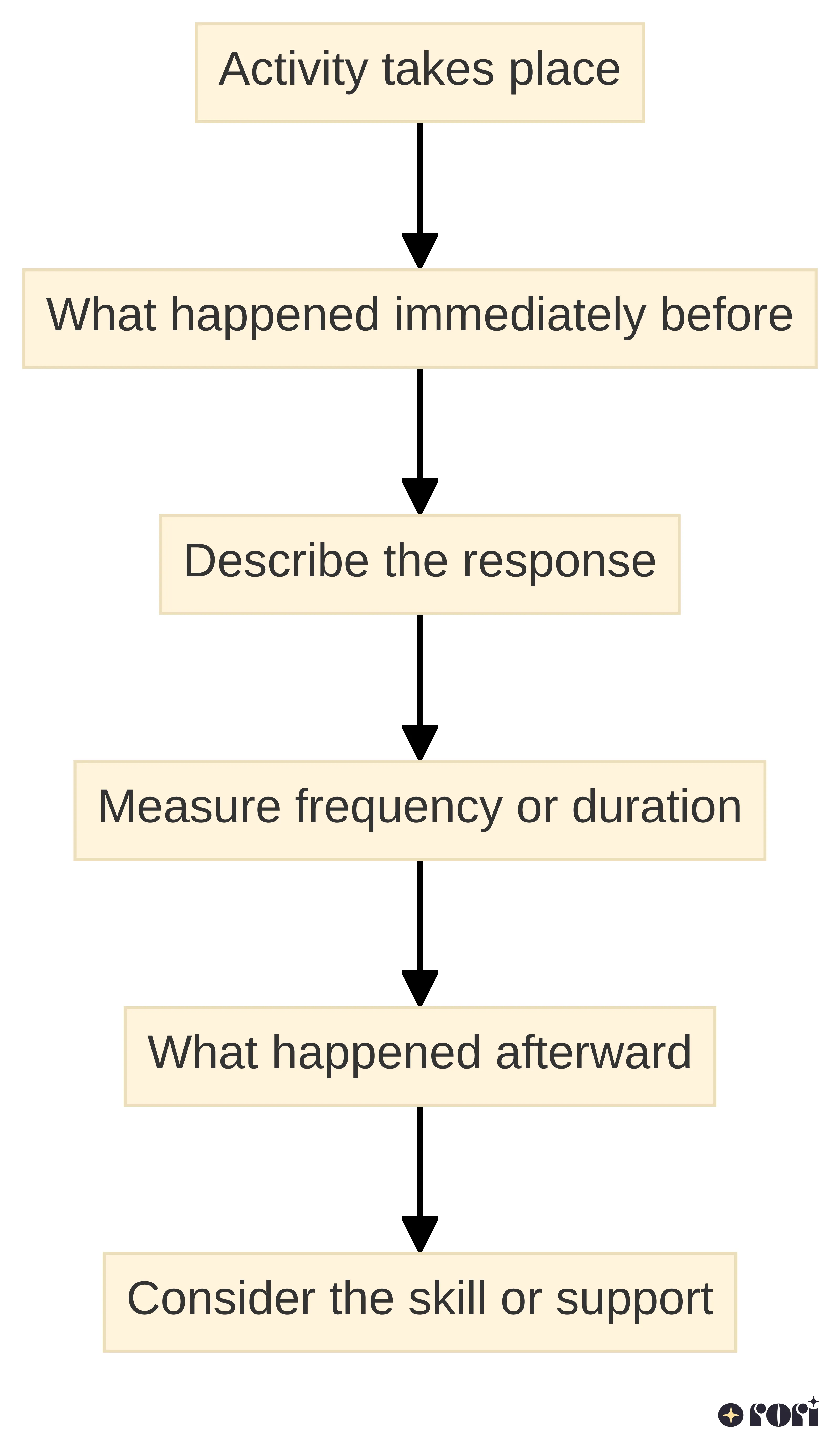
Observation turns a broad concern into a question that can be described, measured, and discussed.
Suppose your child has difficulty using a communication skill during a routine. A useful observation may ask:
- What activity was taking place?
- What happened immediately before the response?
- What did your child do that could be described without guessing at intent?
- What pattern or context is the team trying to understand?
- What happened afterward?
- What skill or support is the team considering?
The point is not to turn every moment at home into a formal record. It is to help you and the provider discuss the same situation with enough detail to make a sensible decision. A team can choose a way to describe the situation that matches the question.
Observation can also focus on a skill your child is acquiring, not only on behavior that concerns you. For example, the team may track attempts to use a communication skill or participation in an activity. The measure should match the question being asked.
If a team proposes a functional behavior assessment, ask what behavior is being assessed, how it is defined, and how the findings will affect the plan. AFIRM says that when progress is not evident, teams should review how the behavior was defined and measured and whether a functional behavior assessment was conducted.
Clear observation does not tell you everything about your child. It gives the care team a narrower question that can be reviewed rather than relying on assumptions.
How reinforcement and prompting support skill teaching
Skill teaching in behavior analysis may involve reinforcement and prompting. The BCBA Task List includes reinforcement contingencies among the concepts behavior analysts learn, and ABA applies principles of learning and behavior to increase useful behaviors.
In plain language, your consultation should explain what response your child is learning, what support will follow an attempt, and how the team will determine whether that support is helping. Ask for examples connected to your child’s actual goal rather than accepting a general statement that reinforcement will be used.
Prompting is another teaching support. AFIRM describes prompting as an evidence-based practice for children and youth on the spectrum from ages 0 through 22 that can be used in multiple settings. It is designed to reduce incorrect responses while learners acquire new skills and to minimize negative effects when target skills are not used successfully.
AFIRM also says prompting can support learner success and skill generalization, and recommends collecting data on target skills or behaviors to determine next steps. That gives you several practical questions:
- What skill is the prompt meant to support?
- What will count as a correct or useful attempt?
- How will the team record your child’s responses?
- Where will the skill be practiced?
- How will the team decide whether the approach should continue or change?
Prompting should be discussed as a support for learning, not as a reason to ignore your child’s communication or preferences. Ask how your child’s response will be interpreted and how your observations will be included. A clear explanation links the prompt, the target skill, and the data used to decide what happens next.
You can also ask how support will be adjusted as your child learns. The central issue is not simply whether a prompt is used, but how it relates to the target skill, how your child responds, and how the team decides what to do next.
Progress review should determine whether a strategy still fits
Progress review should answer a practical question: Is the current strategy helping with the identified goal, and does it still fit your child’s situation?
That process is more useful than receiving a general statement that your child is “doing better.” Ask to see how the team defines progress for the specific goal. Depending on the goal, the discussion might involve whether a skill occurs, how the activity unfolds, or whether a skill appears in more than one setting. The discussion should match the question.
If progress is not evident, AFIRM says teams should consider whether the behavior was defined clearly, whether it is observable and measurable, and whether a functional behavior assessment was conducted. You can ask:
- What does the latest information show?
- Which part of the plan is being evaluated?
- Does the goal still reflect what matters to our family?
- What will change if progress remains limited?
- How will you explain that change to us?
Data does not replace judgment or family discussion. It gives the discussion a concrete reference point. A plan that includes regular review leaves room to continue a strategy when it is helping, reconsider it when it is not, and clarify the next decision instead of treating the original plan as permanent.
A review can cover more than a number. Ask whether the skill is useful in the setting where your child needs it, whether the goal remains meaningful, and whether the way it is being taught continues to fit your child and family.
Family priorities and the child’s participation belong in the plan
Your family’s priorities should be part of the conversation about goals, routines, and support. AFIRM describes Parent-Implemented Intervention as teaching parents to support their child’s skills and behaviors during everyday activities through coached practice of research-backed strategies.
That approach may connect the plan with activities you already understand, such as meals, play, or bedtime. AFIRM says parent-implemented interventions can support children’s learning and growth during these routines while strengthening parent-child interaction.
You can ask how your observations will shape the plan and how the team will make expectations workable for your household. You can also ask how your child’s responses will be considered when a goal or teaching strategy is discussed. These questions do not require you to design treatment yourself. They make your role in communication and decision-making more visible.
A useful plan should identify a reason for each goal. “Improve behavior” is too broad to guide a meaningful discussion. A clearer conversation might identify a communication, learning, social, or self-help skill and explain why that skill matters in your child’s daily participation.
Family involvement can look different across households. You may participate through coached practice, observation, discussion, or feedback about routines. Ask what participation involves before agreeing to a plan, and say which parts of your daily life need to be considered. Your knowledge of your child’s routines can add context that a short appointment cannot provide.
You can also ask how much time a proposed activity would require and what support would be available when a routine does not go as planned. A plan is easier to discuss when the responsibilities, communication points, and opportunities for feedback are clear.
What ethical and professional safeguards to look for
Ethical and professional safeguards should be part of your provider questions, not an afterthought. The BACB Ethics Code guides the professional activities of behavior analysts within BACB jurisdiction and establishes standards intended to protect ABA consumers. The code’s jurisdiction matters, so ask which professional is responsible for the work and what role that person has.
The RBT Ethics Code defines behavior-technician services as supervised services explicitly based on behavior-analysis principles and procedures. If a behavior technician will work directly with your child, ask who provides supervision, how often supervision occurs, and how you can raise a concern about a goal or procedure.
The 2026 BCBA Handbook says each listed BCBA certification pathway requires a degree, behavior-analytic content, supervised fieldwork, and passing the certification examination. You can ask which professional is responsible for assessment, treatment planning, supervision, and communication with your family.
Professional credentials are only one part of fit. Also ask:
- How are goals selected and explained to you?
- How will your child’s participation and responses affect decisions?
- What information will you receive about progress?
- What happens if a strategy is not helping?
- Who can answer questions between scheduled meetings?
A provider should be able to describe responsibilities in ordinary language. You should know who makes decisions, who delivers services, who reviews data, and how your concerns enter the process. Clear roles give you a practical way to evaluate the consultation without treating a credential as a guarantee about the outcome.
Ask for the name and role of the person who will supervise the work, not only the title of the organization. Then ask how concerns, changes to goals, and progress information move between that person, the direct provider, and your family.
Questions that clarify whether a consultation is a good fit
A consultation should give you enough detail to judge whether the proposed approach matches your child’s needs and your family’s priorities. Bring questions that ask for a concrete goal, a way to observe it, and a plan for review.
You can ask:
- What specific skill or behavior would we address first? Ask how the goal relates to communication, learning, social participation, daily living, or another meaningful activity.
- How will you define and measure it? AFIRM recommends reviewing whether a behavior is observable and measurable when progress is not evident.
- What happens before and after the response? ABA techniques examine antecedents and consequences, so the explanation should include the surrounding situation.
- What teaching supports might you use? Ask how reinforcement or prompting relates to the target skill.
- How will you record progress? AFIRM recommends collecting data on target skills or behaviors to determine next steps.
- What would make you continue, change, or reconsider the strategy? A clear answer shows how progress review affects decisions.
- How will the skill be practiced in more than one setting? AFIRM says prompting can support skill generalization across settings.
- How can our family participate? Parent-Implemented Intervention uses coached practice during everyday activities such as meals, play, or bedtime.
- Who assesses, plans, supervises, and delivers the services? Ask each person to explain their role.
- What should we expect from the first meeting? Ask what information you should bring and what decisions will or will not be made.
You do not need every answer before asking a first question. You do need enough clarity to identify the proposed goal, the way it will be reviewed, and the people responsible for the work. If those points remain unclear, ask for them in simpler terms before deciding how to proceed.
Before the meeting, write down your family’s main priorities, the routines where you want support, and the questions you most need answered. Afterward, summarize the proposed goal, measurement, responsibilities, and review process in your own words. That gives you a clear basis for deciding whether to continue the conversation.
How California coverage questions fit into the process
California coverage questions can involve more than asking whether ABA is listed as a benefit. California Department of Health Care Services guidance describes a process in which a health plan first determines whether Behavioral Health Treatment is medically necessary. If the plan makes that determination, the child is referred to a qualified autism service provider to develop a treatment plan.
It says the proposed treatment plan is submitted to the health plan for medical-necessity review.
This process description does not determine your child’s eligibility, coverage, cost, or access. Those questions depend on your circumstances and the applicable health-plan process. You can make the conversation more specific by asking:
- What assessment or documentation is needed for the health plan’s determination?
- Who communicates the decision to your family?
- What happens after a treatment plan is developed?
- Which part of the process addresses your financial questions?
- Who should you contact if the timeline or decision is unclear?
Keep coverage questions separate from treatment-fit questions. A service may be financially accessible yet still require a careful discussion about goals, methods, supervision, and progress review. Likewise, understanding the clinical conversation does not by itself answer what a health plan will authorize.
The next step is an informed conversation about fit
Behavior analysis and ABA become easier to evaluate when you move from labels to specific goals, observable questions, family priorities, professional roles, and regular progress review. You can ask what a proposed approach is meant to support, how the team will measure it, and what will happen if it does not fit your child or household.
A qualified professional should decide individual suitability for your child. Bring these questions to an individualized conversation, and use the answers to decide whether exploring ABA services fits your child’s needs and your family’s priorities.
Questions parents often ask about behavior analysis and ABA
What is the difference between behavior analysis and Applied Behavior Analysis (ABA)?
Behavior analysis is a broad scientific field focused on describing, predicting, and influencing behavior, while Applied Behavior Analysis (ABA) is a specific application of these principles to address practical goals, such as increasing desired behaviors and reducing harmful ones.
How can behavior analysis support communication and social skills in children with autism?
Behavior analysis can help identify specific skills that need support, such as communication and social interaction, by examining observable behaviors and the contexts in which they occur, allowing for targeted interventions.
What should I expect during the first consultation for ABA therapy?
During the first consultation, you should expect to discuss specific goals for your child, how those goals will be measured, the methods that will be used, and how progress will be reviewed over time.
What ethical considerations should I be aware of when choosing an ABA provider?
It’s important to ask about the qualifications of the professionals involved, the ethical guidelines they follow, how they ensure client rights, and how they handle concerns or changes in treatment.
What questions should I ask to evaluate whether an ABA consultation is a good fit for my child?
You can ask about the specific skills being targeted, how progress will be measured, what teaching supports will be used, and how your family’s priorities will be incorporated into the treatment plan.
What role do parents play in Parent-Implemented Interventions (PII)?
In Parent-Implemented Interventions, parents learn to support their child’s skill development during everyday activities through coached practice, which strengthens parent-child interactions and connects therapy to daily routines.
What are some common goals of ABA therapy for children with autism?
Common goals of ABA therapy may include improving communication skills, enhancing social interactions, developing daily living skills, and reducing problem behaviors that interfere with learning.