

Use the care handoff to check supervision and concern handling
Choosing an ABA provider in Oakland can begin with the care handoff: how a child’s needs become a plan, how that plan is carried into day-to-day support, and how supervision stays connected to the work. Use that handoff as an accountability check during the first conversation, rather than choosing from a general description of ABA.
ABA programs can vary in how provider-directed or client-directed they are and how much parents or peers participate. Treatment dosage should reflect each client’s goals, specific needs, and response to treatment. Because ABA is individualized, it requires comparatively high levels of case supervision.
Ask who supervises the work, how much direct BCBA supervision therapists receive, and how the provider tracks progress. These questions focus the conversation on responsibilities, review, and communication without assuming that one care format suits every child.
Consider whether its answers connect the proposed support with your child’s needs and response, rather than treating a fixed schedule as the measure of fit.
During the first conversation, keep attention on accountability rather than a generic fit checklist. Note who is responsible for supervision, what training and credentials the team describes, and how caregivers participate. The purpose is to understand how the provider explains its responsibilities to your family.
Ask whether therapists are licensed or certified, what training they receive, and how much direct supervision they receive from BCBAs weekly. If an RBT will work with your child, ask whether an RBT Supervisor or RBT Requirements Coordinator is responsible for that work and how close, ongoing supervision is provided.
Ask what metrics the provider uses to measure progress and how progress will be tracked.
For insurance questions, ask what the provider accepts, then examine your specific policy. Health insurance coverage for autism assessments varies by plan and state regulations, so review limitations or exclusions and gather the assessment report, invoices, and referral letters when navigating an assessment claim. Comparing these concrete answers can help you decide whether to continue toward an initial consultation or assessment without assuming eligibility, availability, or coverage.
Trace how goals become day-to-day support
Goal setting is the first place to ask how assessment information and your observations will become practical support for your child.
Use questions that make the process concrete:
- What information will the provider use when discussing initial goals?
- Which goals address everyday participation, communication, learning, or other priorities you bring forward?
- How will you know what a goal means during an ordinary session or home routine?
- How often will the provider review the goals with you?
- What would lead the provider to adjust, continue, or reconsider a goal?
The answers should tell you whether your role is part of the planning conversation or limited to receiving updates after decisions are made. You can also ask how the provider handles disagreement about a goal. A direct answer gives you a clearer basis for deciding whether the planning process matches your expectations.
Session structure shows how a written plan may translate into the support you see each week.
You can ask the provider to walk through a sample day without treating that example as a promise about your child’s care. Ask what the therapist does, what you may observe, when you can ask questions, and how the session relates to the stated goals. If care may occur at home, ask what space, routines, or caregiver participation the provider expects. If care may occur in a clinic, ask how the setting affects your involvement and communication.
Available hours and a wait list are separate from clinical fit. Record both. A provider may answer your questions about goals well but not have a schedule that works for your household, so compare the care plan and the practical pathway separately.
Look for a real caregiver and care-team connection
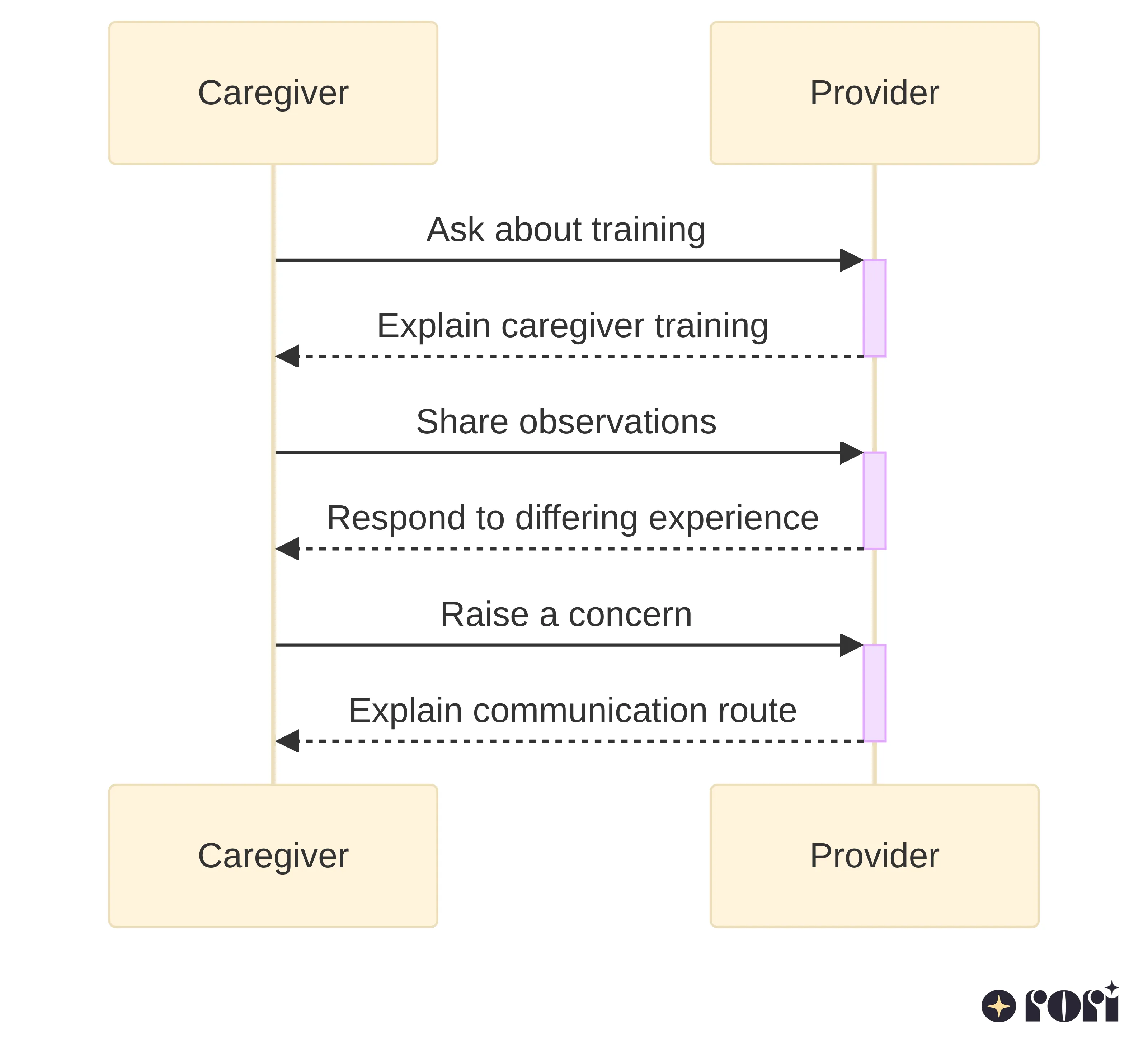
Caregiver involvement should be specific enough for you to understand what participation would look like between sessions. Parent and caregiver training usually uses a systematic, individualized curriculum, so ask how the provider would tailor that training to your child and your routines.
Useful questions include:
- What will you learn, practice, or discuss during caregiver training?
- How will the provider adapt the training to your child’s goals and your household’s routines?
- How often will you receive guidance, and who will provide it?
- How can you share observations about what happens outside sessions?
- How will the provider respond when your experience differs from what the team expected?
Programs can vary in how much parents participate in treatment delivery. Ask whether your role is primarily observation, guided practice, planning input, or a combination. The answer should be specific about your choices and responsibilities rather than using “parent involvement” as a broad label.
Care-team communication gives you a way to follow the plan without guessing what changed. Ask who will be your main contact, how updates will be shared, and how you can raise a concern between scheduled meetings. You can also ask how information from caregivers is included when goals are reviewed.
When you compare providers, ask about staff credentials, treatment philosophy, individualized planning, parent involvement, scheduling, and insurance. These questions are not separate administrative details. Together, they show whether the provider has a process for connecting the child’s sessions with the people responsible for supporting the plan.
Write down the provider’s answers and note any terms you want explained. If the provider describes several people working with your child, ask how they will coordinate their work and how you will know who to contact. A clear communication route gives you a practical way to participate in decisions and raise concerns.
Check who supervises the work
Supervision arrangements show who is responsible for guiding and reviewing the work with your child. If a provider uses RBTs, RBTs practice under close, ongoing supervision from an RBT Supervisor and/or RBT Requirements Coordinator responsible for their work.
Ask each provider:
- Which qualified professionals will participate in my child’s care?
- Who supervises the therapists working directly with my child?
- How much direct supervision do therapists receive from BCBAs each week?
- How often will the supervisor review goals, observations, and progress with me?
- How many therapists may work with my child, and how will their work stay consistent?
- Who should I contact when I have a question about the plan or a session?
You are asking about the arrangement, not simply a title. A provider should be able to describe who does the direct work, who supervises it, and how responsibility is assigned.
Credentials and training give you another focused comparison point. Ask whether therapists are licensed or certified, what training they receive, and how often that training is updated or reinforced. Ask how the provider confirms that each person’s role matches the work they perform.
In 2026, RBT applicants must complete a 40-hour training based on the 2026 eligibility requirements for RBT certification. That requirement describes an entry requirement for RBT certification; it does not answer every question about the supervision, communication, or experience you may want for your child.
Use the answers to build a simple responsibility map:
- Direct therapist: who works with your child during sessions?
- Supervisor: who oversees the work and reviews the plan?
- Caregiver contact: who explains goals and responds to your questions?
- Provider organization: who handles scheduling, staffing, and insurance questions?
The map can help you spot unanswered questions before you choose a provider.
Use progress and safety as decision checkpoints
Safety questions deserve the same direct treatment as progress questions. Ask what happens during a difficult session, who is notified, and how concerns are documented and discussed.
You can bring these questions to the first conversation:
- How do you respond when a session becomes difficult for my child?
- How can I raise a safety concern during or after a session?
- Who receives my concern, and when should I expect a response?
- How can I report a practice that I do not accept?
- How will the provider include my observations in a later review?
You are not required to resolve every concern during the first call. Record the answer, the contact person, and any part that remains unclear. Compare that process with the provider’s answers about supervision and caregiver communication.
To make the answers comparable, separate the response path into three parts: intake, review, and follow-up. Intake identifies where a concern goes; review identifies who is responsible for considering it; follow-up explains how the provider communicates what happens next. Ask the provider to walk through those parts using a hypothetical concern after a difficult session. This tests whether the organization can explain its process before you need it; it does not ask the provider to predict your child’s care or imply that a problem will occur.
Write down whether the answer names a role or contact, explains how your observations enter the review, and tells you what to do if the first contact does not resolve the question. Then compare that response route with the supervision map: the person who receives a concern may not be the person who reviews the plan. If the provider cannot connect those responsibilities, ask for clarification before moving forward.
This gives you a practical decision checkpoint: distinguish a usable process with identifiable handoffs from a general assurance that concerns are taken seriously. A clear process cannot guarantee a particular response or outcome, but it can show whether you know whom to contact and what information to request.
Separate care fit from access and insurance verification
Care fit and insurance verification answer different questions, so keep them in separate parts of your Oakland comparison record. Start with the care and access details:
- Is care home-based, clinic-based, or offered in more than one setting?
- What does a typical session look like?
- How many hours per week can the provider provide?
- Is there a wait list?
- Which therapists and supervisors may work with your child?
- How will goals, caregiver input, progress, and safety concerns be handled?
You can then ask the provider about accepted insurance and the practical billing pathway. Ask whether the organization is in network for your plan, whether authorization is required, which documents are needed, and who will explain deductibles, copayments, coinsurance, or expected out-of-pocket costs. These questions ask for information; they do not assume that your plan will approve a service or that a provider can predict your final cost.
Keep any answer about an autism assessment separate from an answer about ABA treatment. A statement about assessment coverage does not, by itself, establish coverage for treatment.
Health insurance coverage for autism assessments varies by plan and state regulations. Closely examine your specific policy to understand coverage for autism assessments, including limitations or exclusions.
Use your policy and the provider’s billing contact for different questions. Your policy can show plan terms, exclusions, cost-sharing, and any stated requirements. The provider can explain the documents or billing information it expects. Ask both sides where an answer comes from, then record the answer with the date of the conversation.
If you navigate an autism-assessment insurance claim, gather the assessment report, invoices, and referral letters. Keep those documents with the questions you asked and the responses you received. This record can help you distinguish assessment paperwork from treatment authorization and from scheduling information.
California’s provider-enrollment guidance described a change that began on November 17, 2025: subject to notice and confer requirements, California QAS Providers and CBOs could attest to listed QAS qualifications instead of reporting those individuals separately in the provider enrollment system. That enrollment detail does not establish your child’s eligibility, coverage, availability, or expected cost. Ask the provider and your plan about those matters separately.
Audit the care handoff before your first conversation
Before contacting an Oakland provider, prepare notes for a care-handoff audit. Trace how assessment-informed goals become day-to-day support by recording how caregiver participation is structured, who supervises the work, and how progress is measured.
Gather the assessment report, invoices, and referral letters when navigating an autism-assessment insurance claim. Coverage for autism assessments varies by plan and state regulations, so examine your specific policy for limitations or exclusions. Keep your policy information nearby, but treat coverage as something to investigate rather than assume. A provider’s answer about its process and your plan’s answer about coverage may address different parts of the same decision.
Contact a provider to ask about an initial consultation or assessment. Use the audit notes to record answers about setting, available hours, wait lists, and insurance, then identify details that still need verification without assuming eligibility, availability, coverage, or an outcome.