
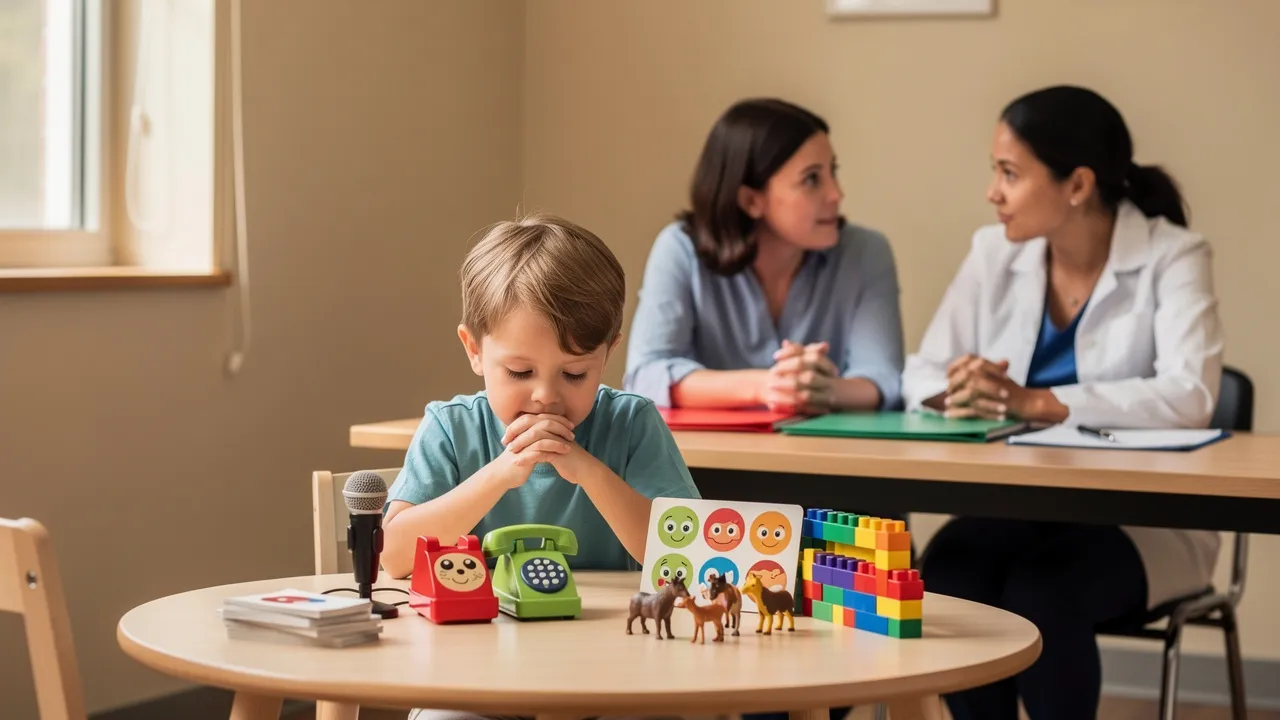
Start with the concern, not a conclusion
A concern about delayed communication is a reason to gather information, not a diagnosis. Autism and speech delay can occur together or separately, so hearing fewer words, unclear speech, or limited conversation does not answer the larger question by itself.
For families in Oakland, the useful starting point is to describe what you observe across ordinary settings: how your child communicates wants, responds to people, shares attention, plays, and understands language. Those details help a qualified professional decide which evaluation conversations may be appropriate. They also keep a single milestone or difficult moment from carrying more meaning than it can support.
This comparison separates three questions that are easy to blend together:
- What is happening with speech or language? You may notice fewer spoken words, speech that is difficult to understand, or difficulty expressing or understanding messages.
- What is happening with social communication? You may notice differences in gestures, eye contact, shared attention, responding to a name, or showing interests to other people.
- What evaluation would clarify the pattern? A pediatric conversation, speech-language evaluation, autism-focused assessment, or more than one of these may be considered.
These observations can guide a conversation, but they cannot establish or rule out autism on their own. The aim is to choose an informed next discussion rather than label your child from a checklist.
Start by separating what you saw from what you think it means. “My child pointed to the dog, looked at me, and then laughed” is more useful for an evaluation than “my child has good social skills.” The first statement gives a professional a behavior and a setting to explore.
A short record can include the date or routine, who was present, what your child did, how you responded, and whether the same pattern appeared elsewhere. You do not need to observe every situation or make the notes perfect. A few ordinary examples can make the first conversation more specific.
What speech delay describes
For children aged 24 months or older, concerning presentations can include speaking fewer than 50 words, speech that is difficult to understand, or notable deficits on age-specific testing. Those examples identify reasons to seek evaluation; they do not identify the cause of the delay or establish autism.
A speech or language concern can be the main issue you notice. It can also occur alongside broader developmental differences. That is why the next step should examine communication as a whole rather than treating one word count as an answer.
Speech-language pathologists assess, diagnose, plan, and treat communication, language, speech, and related language-based behaviors. Their work can help clarify what your child understands, how your child communicates, which parts of speech or language are difficult, and what support may be discussed.
Audiology may also be part of the evaluation pathway for a child with speech or language concerns. Hearing information can matter when professionals are trying to understand communication development, so ask how both speech-language and hearing assessment fit the concern you have observed.
A useful description includes more than “my child is behind.” Bring examples of words used, sounds attempted, ways your child communicates without words, and situations in which communication is easier or harder. Concrete examples give the evaluating professional something specific to examine.
You can sort the concern into several parts before an appointment:
- Speech production: How clearly does your child make sounds or words?
- Language expression: How does your child communicate needs, ideas, or experiences?
- Language understanding: How does your child respond to familiar words, questions, or directions?
- Communication use: How does your child use words, sounds, gestures, or other signals with another person?
The same child may have strengths in one area and difficulties in another. A speech-language evaluation can examine these areas together rather than treating “late talking” as one uniform problem.

What autism adds to the comparison
Autism adds a broader social-communication question to the comparison. In autism, speech delay may occur alongside difficulties with social communication, joint attention, gestures, or eye contact.
Social communication includes how your child uses communication with other people, not only how many words your child says. Joint attention refers to coordinating attention with someone else around an object, activity, or event. Gestures, eye contact, and other nonverbal signals can help show how communication is being used in interaction.
A child may have delayed spoken language and still show strong interest in people and effective nonverbal communication. Another child may have speech delay alongside differences in these social-communication areas. Both patterns deserve careful attention, and neither pattern can be settled by one observation.
Speech delay describes a communication difficulty; autism is considered through a wider developmental pattern that may include social-communication differences. The comparison therefore asks how communication works, not only whether speech is late.
You can organize your observations around questions such as:
- Does your child try to involve you in an activity or show you something interesting?
- Does your child use gestures, sounds, words, or physical guidance to communicate?
- Does your child respond to social interaction in ways that seem consistent across settings?
- Does your child seek connection, share enjoyment, or participate in back-and-forth interaction?
These questions are prompts for a professional discussion. They are not a home diagnostic test, and a “yes” or “no” answer to any one question does not determine what is happening.
The context around a behavior matters. Looking toward you once, avoiding eye contact during a noisy activity, or using a gesture at home may each be meaningful details, but none can carry the whole interpretation by itself. A professional will want to understand how often the behavior occurs, what communication purpose it serves, and whether it appears across ordinary interactions.
Describe both abilities and difficulties. Telling the evaluating professional that your child shares excitement during play but rarely points to request help gives a more useful picture than listing only one concern.
Compare spoken language with broader communication
Spoken language and broader communication can show different patterns, which is why professionals look beyond vocabulary alone. Children with isolated speech delays usually show social interest, eye contact, and effective nonverbal communication even when spoken language lags.
A child with an isolated speech concern may still point to share attention, look toward you during interaction, use facial expressions or gestures, and seek help or enjoyment with other people. The spoken message may be limited or hard to understand while the social purpose of communication remains apparent.
A broader social-communication pattern may be part of the question when differences also involve interaction, joint attention, gestures, or eye contact. That combination can make interaction itself part of the evaluation question. The distinction is not whether your child has any one behavior; it is how communication, social connection, and development fit together over time.
A comparison can help you describe the concern without turning observations into a conclusion.
| Area to describe | Speech concern may be more noticeable in | Broader pattern worth discussing with a professional |
|---|---|---|
| Spoken language | Few words, unclear speech, or difficulty expressing a message | Speech delay alongside differences in social communication |
| Nonverbal communication | Gestures, eye contact, and other signals may remain effective | Gestures or eye contact may be difficult to use during interaction |
| Shared attention | Your child may still show, point to, or seek help with interesting things | Coordinating attention with another person may be less consistent |
| Social interest | Your child may seek people and interaction even when speech lags | Social communication and connection may need broader evaluation |
This table is a description aid, not a scoring system. Use it to prepare examples, then let a qualified professional interpret the pattern.
Your next useful action is to record one or two ordinary examples for each area: what happened, how your child communicated, how you responded, and what happened next. Examples from home, childcare, play, and community settings can show whether the pattern changes with people or environments.
A speech-language evaluation can address communication, language, and speech. A broader concern about social communication can be discussed with a pediatrician or qualified professional who can explain whether autism-focused assessment should also be considered.
Strengths belong in the comparison too. Note what your child does to connect, request help, share enjoyment, imitate another person, or participate in a routine. These details do not rule a condition in or out, but they help the professional understand communication as a pattern of abilities and challenges rather than as a list of missing milestones.
Look beyond spoken words
Communication includes more than spoken words. When discussing developmental concerns, ask about gestures, responding to a name, sharing interests, and pretend play.
These areas give you practical ways to describe interaction. For example, you can note whether your child points to request something, points to share something enjoyable, turns toward their name, brings an object to show you, imitates play, or joins a pretend activity. The purpose is not to decide whether each behavior is present; it is to give the professional a clearer picture of communication in daily life.
The setting matters too. A child may communicate differently with a familiar parent, a sibling, a childcare provider, or an unfamiliar adult. Include both what you see often and what you see occasionally.
You can use this short observation list before an appointment:
- Gestures: What gestures does your child use to request, refuse, greet, point, or share?
- Response to name: In what situations does your child turn, look, or otherwise respond when called?
- Shared interests: Does your child show you an object or activity simply to share enjoyment or attention?
- Pretend play: How does your child use toys, imitate familiar routines, or take part in make-believe play?
- Interaction: How does your child start, continue, or end an exchange with another person?
Autism screening looks for common early signs, but not every listed sign needs to be present. A missing behavior does not settle the question, and a single observed behavior does not confirm autism. Bring the pattern and the context to the professional conversation.
Keep the observation record concrete and brief. For each example, write:
- The setting and people involved.
- What happened before your child communicated or responded.
- The words, sounds, gestures, or actions your child used.
- How another person responded.
- Whether your child continued, changed, or ended the interaction.
This format gives the professional context without requiring you to interpret the behavior. If another caregiver sees a different pattern, include that observation rather than choosing one account.
Consider the broader developmental pattern
Organize your notes by pattern rather than by a list of alarming moments:
- Communication: What does your child understand, express, or communicate without speech?
- Social connection: How does your child respond to people, share attention, and participate in interaction?
- Play: What happens during imitation, pretend play, turn-taking, and independent play?
- Behavior and sensory observations: Alongside communication and social connection, record repeated actions or sensory responses, including whether they affect play, routines, or interaction.
- Development over time: What changed, what stayed consistent, and what concerns you now?
This organization does not diagnose your child. It makes the consultation more specific and helps you discuss whether one evaluation or several perspectives may be useful.
When you describe repeated actions or sensory responses, focus on the situation rather than assigning a label. Explain what your child did, how often you noticed it, what seemed to precede it, and whether it affected communication, play, routines, or interaction. The evaluating team can decide how that information fits with the other developmental areas.
The same principle applies to changes over time. Note what developed, what became harder to understand, and what circumstances were present. A developmental history can show how concerns fit together without requiring you to decide why they occurred.
Why speech delay alone is not an autism diagnosis
Speech delay alone is not an autism diagnosis because autism and speech delay can occur together or separately. A late first word, a small vocabulary, unclear speech, or a difficult interaction can justify a conversation without deciding the cause.
The same boundary applies to screening. Screening looks for common early signs of autism, and not every listed sign needs to be present. A screening result can help determine whether more discussion or assessment is appropriate, but it does not replace a comprehensive evaluation or turn one result into a diagnosis.
Avoid two opposite shortcuts:
- “Speech delay means autism.” This treats one communication concern as proof of a broader developmental condition.
- “Speech delay rules out autism.” This treats spoken language as the only relevant area and overlooks social communication or other developmental patterns.
A more useful question is: what does your child’s communication look like across speech, gestures, shared attention, social interest, play, and everyday settings? Write down that broader pattern and bring it to a qualified professional. The goal is clarity, not a label based on a single sign.
A screening checklist is best treated as a prompt for discussion. It can draw attention to areas that deserve questions, but it cannot describe every way a child communicates or every setting in which a behavior appears. Likewise, a child may show some listed signs without having the condition being considered.
Use the result as one part of a larger conversation. Ask what the screening addressed, what remains unclear, and whether the next step should include speech-language, hearing, developmental, or autism-focused evaluation.
Start with screening and a pediatric conversation
A pediatrician usually conducts autism screening during a routine well-child checkup. Screening may include observing your child and asking you about behavior at home and during interactions with other children.
Screening is an early step for identifying common signs, not the same as a comprehensive autism evaluation. It can create a reason for further discussion, especially when your observations extend across communication, social interaction, play, or development. It should not be used as a stand-alone answer about your child.
Bring a concise description of your concern to the pediatric conversation. Include what you notice, when you first noticed it, whether it appears in more than one setting, and whether your child uses other ways to communicate.
A pediatric appointment can begin with these practical questions:
- What does the screening examine, and what will the result tell us?
- Should we discuss speech, language, hearing, social communication, or more than one area?
- What observations from home or childcare would help you understand the concern?
- Would a speech-language evaluation or autism-focused evaluation be appropriate to discuss next?
- What should we do if the concern continues while we arrange an evaluation?
Your pediatrician can help connect the concern to an evaluation pathway. A screening conversation does not require you to decide the diagnosis in advance.
Think of the pediatric conversation as a place to connect observations with professional roles. You can raise the speech concern, describe social-communication observations, ask about hearing, and ask whether a broader evaluation should be discussed. You do not have to present a finished explanation before asking for guidance.
Take any prior developmental notes, reports, or hearing information that you already have. If no earlier evaluation exists, your observations are still a useful starting point. The professional can explain which information is needed next.
When a speech-language evaluation fits the concern
A speech-language evaluation fits a concern about speech, language, or communication, including speech that is difficult to understand, limited spoken language, or difficulty expressing or understanding messages. Children with speech or language concerns should be referred to speech-language pathology and audiology for diagnostic and management purposes.
Speech-language pathologists provide assessment, diagnosis, planning, and treatment for communication, language, speech, and related language-based behaviors. Their assessment can examine more than the number of words your child uses. It can consider how your child understands messages, communicates needs, uses sounds or words, participates in language-based play, and interacts through communication.
The evaluation can also help clarify whether the concern appears focused on speech or language or whether broader communication questions should be discussed with another professional. It does not require you to choose between speech-language care and an autism conversation when both concerns are present.
For children younger than three years, parents and caretakers may self-refer to early intervention programs for speech and language evaluation and management. Ask what early-intervention route applies to your situation and how it relates to any pediatric or specialist conversation.
A practical speech-language appointment checklist includes:
- Examples of words, sounds, gestures, and other communication methods
- Situations in which your child understands or communicates more easily
- Concerns about speech clarity, comprehension, expression, or interaction
- Information about hearing history or previous hearing evaluation
- Questions about what the evaluation will assess and what recommendations may follow
The immediate action is straightforward: raise the speech or language concern with a pediatrician, speech-language pathologist, audiologist, or applicable early-intervention program.
A speech-language evaluation can answer focused questions about communication, language, and speech. It may help describe what your child understands, how your child expresses meaning, how clear speech is, and how language is used during play or interaction. Audiology addresses the hearing part of the pathway.
Those roles can be useful even when autism is also being discussed. Raising a broader social-communication concern does not make the speech-language evaluation unnecessary, and pursuing speech-language support does not settle the broader developmental question.
When to discuss an autism-focused evaluation
An autism-focused evaluation is worth discussing when speech or language concerns appear alongside broader social-communication or developmental differences. Examples may include concerns about gestures, joint attention, eye contact, responding to a name, sharing interests, or participating in social interaction.
The relevant question is not whether your child has one sign. It is whether several observations form a pattern that you want a qualified professional to examine. You can also raise the question when your child’s communication seems difficult to understand across settings, when play or interaction raises concerns, or when the developmental history contains changes that need context.
A professional may consider speech-language evaluation, cognitive testing, and screening for co-occurring conditions as part of an autism assessment. That combination reflects the need to understand the broader developmental profile, not a conclusion that autism is present.
Use these discussion routes without treating them as diagnoses:
- Speech is the main concern, while social interest and nonverbal communication seem effective: Begin by discussing speech-language and hearing evaluation, while mentioning any broader concerns to the pediatrician.
- Speech concerns occur with differences in social communication or joint attention: Ask whether an autism-focused evaluation should be considered alongside speech-language assessment.
- You are unsure what the pattern means: Bring observations to a pediatrician or qualified professional and ask which evaluation pathway would clarify the concern.
The supported action in every branch is to describe the broader pattern rather than wait for one sign to answer the question.
You can raise both pathways in the same conversation when the concern spans spoken language and social communication. Tell the professional which observations led you to each question, then ask what each evaluation is designed to clarify. This keeps the decision tied to the pattern you observe rather than to a choice between labels.
If the concern is still unclear, uncertainty is a reason to ask for a structured discussion, not a reason to wait for a single defining behavior. Bring examples from more than one setting and ask how developmental history, observation, and related evaluations will be considered.
What a comprehensive autism evaluation examines
A comprehensive autism evaluation typically includes developmental history, behavioral observation, standardized assessments, and input from multiple specialists. The process is broader than a single interaction or questionnaire because professionals need information about development and behavior in context.
An autism evaluation may involve questionnaires, play-based assessments, and detailed interviews, and it may take two to four hours. The exact structure depends on the evaluating service and the information needed, so ask how the appointment is organized before you attend.
The evaluation may also include speech-language evaluation, cognitive testing, and screening for co-occurring conditions. Each part addresses a different aspect of the developmental picture. The result should be discussed as an integrated assessment rather than reduced to one task, score, or moment.
You can expect the evaluation team to gather information in several ways:
- Developmental history: The team asks about early development, communication, play, behavior, and changes over time.
- Behavioral observation: The team observes how your child communicates, interacts, responds, and plays during the appointment.
- Standardized assessments: Structured tools may provide a consistent way to examine selected developmental areas.
- Multiple perspectives: Input from parents and multiple specialists can add information from different settings and professional roles.
- Related evaluations: Speech-language, cognitive, or co-occurring-condition assessments may be included when they help create a fuller profile.
These components answer different questions. A structured observation cannot replace developmental history, and a developmental history cannot replace direct assessment. Ask how the pieces will be combined and explained.
A useful preparation goal is not to make your child perform a particular behavior. Bring ordinary examples and allow the evaluating team to observe the child as part of the scheduled process.
Ask what you should bring, how long the appointment may take, whether questionnaires need to be completed beforehand, and when the team will discuss findings. These are process questions, not attempts to predict the result. They can make the appointment easier to understand and help you participate with relevant information.
The parts of an evaluation should be read together. A questionnaire records answers about development or behavior, an observation shows how your child responds in one appointment, and a developmental history adds information from everyday life. None of these pieces should be treated as the entire explanation by itself.
Ask how the evaluating team will explain areas of agreement, uncertainty, and recommended next steps. If the assessment includes speech-language evaluation, cognitive testing, or screening for co-occurring conditions, ask what question each component addresses.
Prepare the developmental history
A developmental history gives the evaluating team information that a single appointment cannot show. Parents can contribute detailed developmental history and examples of their child’s behavior in natural settings during an autism evaluation.
Prepare a short timeline rather than trying to remember everything in the room. Include when you noticed changes or concerns, how communication developed, which ways your child communicates now, and what happens during familiar routines. Mention both strengths and difficulties so the team can understand the whole pattern.
Natural-setting examples can cover home, childcare, family gatherings, playgrounds, meals, dressing, and transitions. Describe what you saw without assigning a cause: what happened before the behavior, what your child did, how another person responded, and what happened afterward.
A compact preparation note can include:
- Words, sounds, gestures, signs, or other ways your child communicates
- Understanding of requests, routines, questions, and familiar language
- Responses to name, attempts to share attention, and ways your child seeks help
- Play preferences, imitation, pretend play, and interaction with children or adults
- Repeated actions, sensory responses, or situations that are especially difficult
- Examples from more than one setting and information from other caregivers
The goal is useful context, not a perfect record. Bring the note, add questions, and let the professional decide which details require further assessment.
A simple timeline can use four headings:
- Earlier development: What communication, play, and interaction looked like before the current concern.
- First concern: What you noticed, when you noticed it, and who else observed it.
- Current pattern: What happens now across familiar and less familiar settings.
- Questions: What you want the evaluation to clarify.
Include information from another caregiver when it adds a different setting or routine. Differences between home and childcare are useful information, not a reason to discard one account.
Questions to bring to the consultation
A consultation becomes more useful when your questions connect the concern to a specific evaluation role. Use the checklist below and select the questions that match what you have observed.
About communication and language
- What should we describe about understanding, expressing, speech clarity, and communication without words?
- Should a speech-language pathologist assess communication, language, speech, and language-based play?
- Should hearing or audiology assessment be part of the next step?
About social communication
- How should we describe gestures, responding to a name, sharing interests, eye contact, and joint attention?
- Which examples of interaction or pretend play would help you understand the concern?
- How much does the pattern change between home, childcare, and other settings?
About the broader developmental picture
- Should we discuss an autism-focused evaluation as well as speech-language evaluation?
- Which developmental history details would be most helpful?
- Are there behaviors, sensory responses, play patterns, or other concerns that should be documented?
Questions about the evaluation process can help you understand what each professional can and cannot answer:
- What will this evaluation assess, and what will it not determine?
- Who will participate, and how will information from different professionals be combined?
- Will the process include developmental history, observation, standardized assessment, or questionnaires?
- Could the assessment include speech-language evaluation, cognitive testing, or screening for co-occurring conditions?
- How should we prepare examples from natural settings?
- When and how will findings and recommended next steps be explained?
These questions keep the roles distinct. A speech-language pathologist addresses communication, language, speech, and related language-based behaviors. An autism-focused evaluation examines a broader developmental pattern through multiple sources of information.
Bring your questions in writing, along with a few specific examples rather than a long list of labels. Start with the concern that prompted you to seek help, then explain what you see in communication, social interaction, play, and everyday settings.
If you are deciding between a speech-language evaluation, an autism-focused evaluation, or both, ask the professional to explain what each route would clarify. You do not need to settle that choice from an online comparison. Your task is to make the concern clear enough for the appropriate professional conversation to begin.
If time is limited, take these five questions first:
- What part of my child’s communication should be assessed first?
- Should speech-language pathology and audiology be included?
- Do the social-communication observations support discussing an autism-focused evaluation?
- What developmental history or examples should I bring?
- What will each evaluation clarify, and what questions will remain afterward?
These questions turn a broad worry into a sequence of conversations. Write down the answers and the next action discussed so you can keep the pathways clear.

Choose the next conversation in Oakland
Your observations can point toward the right questions without answering them in advance. If spoken language is the main concern, ask about speech-language and hearing evaluation. If speech concerns occur with differences in social communication, shared attention, gestures, play, or other developmental areas, ask whether an autism-focused evaluation should be discussed as well.
Bring a short timeline, a few examples from ordinary settings, and the questions that matter most to your family. In Oakland, begin with the pediatric or qualified local evaluation conversation that can connect those details to an appropriate next step.
Questions parents may still have about autism or speech delay
Can a child have both autism and a speech delay?
Yes. Autism and speech delay can occur together or separately. A child may have delayed spoken language with relatively effective social communication, or speech and language concerns alongside differences in gestures, joint attention, eye contact, or social interaction. Only a qualified evaluation can interpret the overall developmental pattern.
Should a child with speech or language concerns have a hearing evaluation?
Hearing assessment may be an important part of the evaluation pathway. Discuss speech-language and audiology evaluation with the child’s pediatrician or another qualified professional, especially when speech is limited, unclear, or difficult to understand. Hearing information can help clarify communication development.
What is the difference between autism screening and an autism evaluation?
Screening is an initial check for common signs and may involve observation and questions about behavior in different settings. It does not diagnose autism or rule it out. A comprehensive evaluation typically combines developmental history, behavioral observation, standardized assessments, and professional input; it may also include speech-language or cognitive assessment.
What should parents bring to an autism or speech-language evaluation?
Bring a brief developmental timeline, examples of communication at home and in other settings, prior reports or hearing information, and notes about strengths as well as concerns. Describe what happened, where it occurred, how your child communicated, and how others responded. Ask what each evaluation will assess and what questions may remain afterward.
Can parents seek early-intervention help for a child younger than three with speech concerns?
Parents and caregivers may self-refer children younger than three to early-intervention programs for speech and language evaluation and management. You can also discuss the concern with the child’s pediatrician and ask how early intervention, speech-language assessment, audiology, and any broader developmental evaluation fit together.