
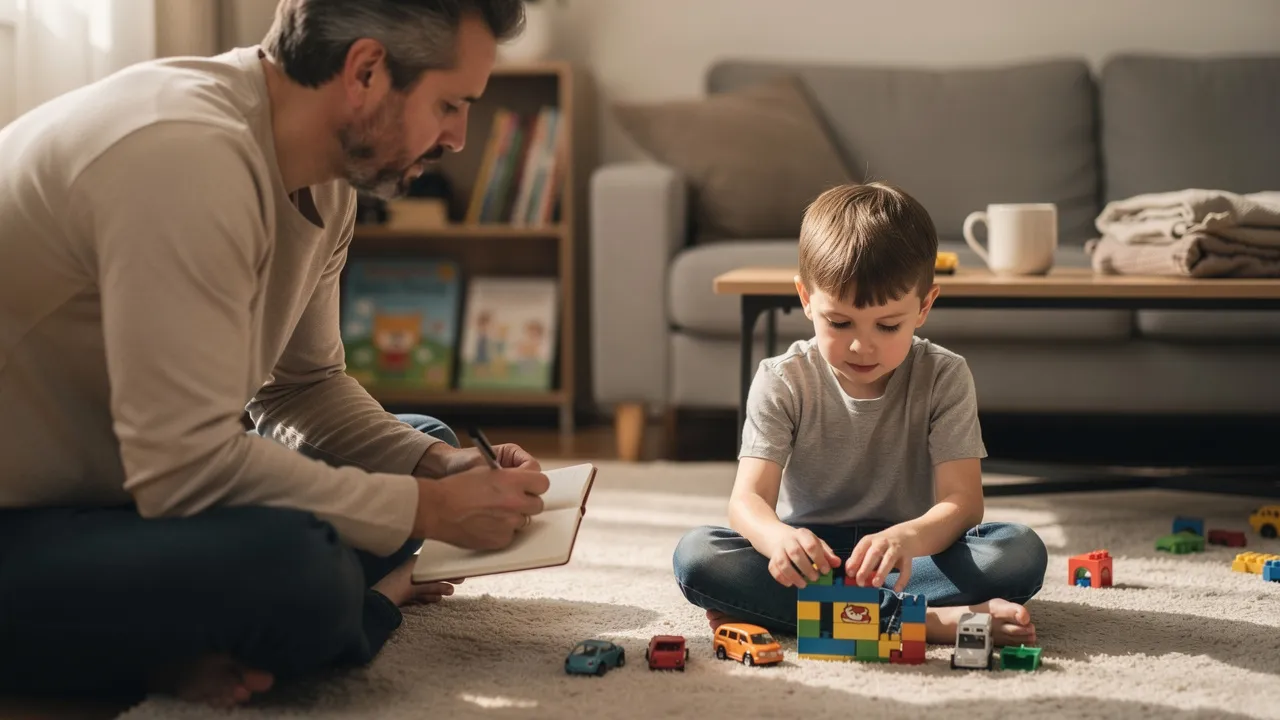
Start with what “mild autism” may mean
The phrase “mild autism” is informal language, not a precise diagnosis. People often use it when a child appears to need less obvious support in some situations, but autism-related traits and support needs can look different across children, settings, tasks, ages, and times of day. You may also hear autism called autism spectrum disorder, or ASD.
Autism spectrum disorder is a developmental disability caused by differences in the brain. Autism can affect communication, understanding, learning, attention, and responses to sensory experiences. These points describe autism broadly; they cannot tell you whether your child is autistic.
The useful question is not whether a single behavior looks mild or severe. The useful question is whether a pattern affects social communication, interaction, flexibility, sensory experiences, play, learning, or everyday demands, and whether that pattern appears in more than one setting.
Possible autism-related signs often involve social communication and interaction alongside restricted or repetitive behaviors or interests. A child may have clear strengths, close relationships, and areas of independence at the same time as meaningful difficulties. Use the observations in this guide as topics to discuss, not as a way to label your child.
Look at the whole child, not one behavior
Your child’s overall pattern matters more than one noticeable behavior. Children on the autism spectrum may have difficulties with social engagement, communication, sensory processing, and restricted, repetitive, or ritualistic behaviors and interests. Those differences may become easier to notice during group play, transitions, conversation, schoolwork, family routines, or unfamiliar activities.
Autistic children may also have difficulty with back-and-forth social interaction, relationship building, or the demands of everyday life. The same child may communicate comfortably about a favorite topic yet struggle to enter a peer’s game, follow an unspoken rule, or explain what went wrong during a change in plans. Look for the combination and context rather than treating one strong skill as proof that no evaluation is needed.
Strengths belong in the record too. Autistic children may have remarkable strengths and talents and loving relationships, and some autistic people have a learning disability while others have average or above-average intelligence. A strength does not cancel a difficulty, and a difficulty does not define your child.
Write down what your child enjoys, communicates well, notices quickly, or does independently. Then record where support appears necessary. This balanced picture gives a qualified professional more useful information than a list made only of problems.
Notice social communication in real interactions
Social communication is easiest to observe during real interactions, not only when your child answers a direct question. Possible social signs include difficulty with back-and-forth conversation, sharing interests or emotions, and initiating or responding to social interactions.
You might notice that your child:
- Talks at length without checking whether another person is following or interested.
- Rarely brings you an object, points something out, or shares excitement spontaneously.
- Answers questions but does not continue the exchange or ask about your experience.
- Has difficulty starting a conversation, joining a game, or responding when another child approaches.
- Finds it hard to adjust behavior when speaking with a sibling, teacher, peer, or unfamiliar adult.
These examples are prompts for observation. They are not a checklist that can determine a diagnosis.
Nonverbal communication adds another part of the picture. Possible differences include eye contact, body language, facial expression, and understanding or use of gestures. Eye contact alone should not carry the interpretation: some autistic people are comfortable making eye contact, while a child may communicate socially in other ways.
Observe what happens with gestures, facial expressions, personal space, tone, and shared attention. Does your child point to show you something interesting, notice your expression, understand a wave, or recognize when someone wants to stop? Record the situation and the response instead of assigning a meaning on the spot.
Relationships and imaginative play can show how social understanding works in everyday life. Possible relationship-related signs include difficulty adjusting behavior to different social contexts, sharing imaginative play, or making friends. Some children focus on features of a toy or repeat simple play without acting out more complex stories.
Watch a familiar play routine, free play with peers, and pretend play at home. Note whether your child copies a script exactly, accepts another child’s idea, develops a shared story, or prefers to play alone. A child can enjoy company and still need help with the flexible, back-and-forth parts of friendship.
Social communication may look different with a familiar caregiver, a sibling, a teacher, or a peer. Compare the same type of interaction across those settings rather than relying on one conversation.
For each example, note who started the exchange, how your child responded, whether the interaction continued, and what made participation easier or harder. A child who speaks freely with family but rarely joins peer play may be showing a context-specific difference worth discussing. The observation is useful without requiring you to decide what caused it.
Use developmental milestones as prompts, not verdicts
Developmental milestones can help you choose what to discuss with a professional. They cannot tell you by themselves whether your child is autistic. The CDC lists several possible signs associated with autism at particular ages, including:
- By 9 months: not responding to a name or not showing facial expressions such as happiness, sadness, anger, or surprise.
- By 12 months: using few or no gestures, such as not waving goodbye.
- By 15 months: not sharing interests with you.
- By 18 months: not pointing to show you something interesting.
A milestone concern deserves context. Note what you observed, how often it happened, and whether your child communicates the same way with different people.
The CDC also lists possible signs at later developmental ages. These include not noticing when someone is hurt or upset by 24 months, not noticing other children and joining them in play by 36 months, not pretending to be something else during play by 48 months, or not singing, dancing, or acting for a caregiver by 60 months.
Milestones are prompts for a conversation, not pass-or-fail tests. Children develop unevenly, and an isolated missed behavior does not establish autism. Bring the age, setting, and surrounding developmental history to a qualified professional instead of comparing your child with a single online list.
Observe communication beyond spoken words
Communication includes how your child understands, responds, gestures, takes turns, and shares meaning—not only how many words your child uses. Possible developmental signs include delayed or disordered speech, no speech, difficulty responding when spoken to, and difficulty understanding or using gestures.
You may notice that your child:
- Uses repeated phrases or memorized language without adapting it to the conversation.
- Responds inconsistently when spoken to, especially during play or a busy routine.
- Talks at people rather than building a shared exchange.
- Uses fewer gestures than expected for the child’s age or relies on another way to request something.
- Communicates successfully in one familiar routine but struggles when the interaction changes.
Record what your child communicates successfully as well as what becomes difficult.
Communication can look different across people and places. Compare a quiet conversation at home with a noisy classroom, a preferred activity with a nonpreferred task, and an exchange with a familiar caregiver with an interaction involving peers. Possible signs may include reduced talking, less pretend play, repetitive movements, or difficulty responding to a name.
Write down the exact words or gestures when you can. Include what you asked, what your child appeared to understand, how your child responded, and whether the interaction improved with extra time or a familiar routine. This detail helps a professional distinguish a broad pattern from a situation-specific difficulty.
Watch play, interests, routines, and repetition
Play and interests can reveal how your child uses flexibility, imagination, and shared attention. Some autistic children focus on a toy’s features, such as its wheels or the box, rather than the object’s broader purpose. Other children repeat the same simple sequence without building a more complex story.
Some autistic children also develop interests in an intense way. A child may spend long periods on one topic, return to it during many conversations, or become frustrated when another activity interrupts it. An intense interest can be enjoyable and meaningful; record its effect on interaction, transitions, sleep, school participation, or friendships rather than treating the interest itself as a problem.
Routines and repetition are another area to observe. Possible signs include repetitive behavior, difficulty understanding social rules, noticing small details or patterns, liking to plan carefully, preferring familiar routines, or becoming distressed when routines change. Repetitive movements may include hand flapping or rocking.
Describe the change and the response precisely. “The schedule changed” is less useful than “The usual route to school changed, and my child cried, repeated the same question, and needed fifteen minutes before leaving the car.” Include what helped, if anything, without assuming that the reaction has one specific cause.
The practical question is how play, interests, routines, and repetition connect with daily life. Does a preferred topic prevent a conversation from becoming mutual? Does a repeated play sequence make it hard to join peers? Does an unexpected change affect eating, school attendance, family activities, or getting dressed?
These observations describe support needs without deciding why they occur. Bring examples from both easy and difficult moments so the evaluation can consider the full pattern.
A favorite activity is not automatically a concern. Pay attention to flexibility and participation: can your child pause the activity, accept another person’s idea, move to a new task, or return to the activity later? Record what happens before and after the transition, including whether preparation or a predictable routine changes the response.
The same interest may support connection in one setting and interfere with interaction in another. Write both examples down. This keeps the observation focused on context and daily demands rather than judging the interest itself.
Include sensory responses and daily context
Sensory responses can affect how your child manages ordinary places and routines. Autism can affect responses to light, sounds, smells, tastes, and touch, and a possible sensory sign is becoming very upset by a particular taste, smell, or sound.
Look for patterns such as covering ears in a crowded room, refusing a food because of texture or smell, avoiding certain clothing, becoming distressed by touch, or seeking repeated movement. Record the sensory experience, the setting, the intensity of the response, and the time needed to recover. Do not assume that every strong reaction is autism-related.
Daily context helps explain what a behavior means for your child. Autism can affect learning and attention as well as communication and sensory experiences, while the demands of everyday life may be harder in one setting than another. A child might manage a familiar bedtime routine but struggle with an unpredictable lunchroom, a substitute teacher, or a crowded birthday party.
Compare settings without ranking them. Note who was present, what the task required, how much preparation your child had, and whether the same pattern appeared at home, school, childcare, or in the community. A difference between settings is useful information, not a reason to dismiss the concern.
Separate possible signs from a diagnosis
Individual signs do not establish autism. Some people without autism may also show some characteristics associated with autism, and similar behaviors can arise from different developmental, emotional, communication, sensory, or environmental circumstances.
An online checklist can help you name a concern, but it cannot determine the cause. A brief visit can miss important behavior too, especially when a child does not show the same pattern in an unfamiliar office. Treat a checklist result as a reason to ask a question, not as an answer.
A diagnosis usually relies on caregivers’ descriptions of a child’s development and a professional’s observation of the child’s behavior. Developmental surveillance includes asking about caregiver concerns, informal observation, and monitoring symptoms during routine health supervision, but surveillance alone is not sufficient to identify every child who needs further evaluation.
Your role is to describe what you see over time. The evaluator’s role is to interpret the developmental history and observed behavior within a qualified assessment. Keeping those roles separate protects you from having to reach a diagnosis from everyday observations.
Turn observations into a useful record
An observation record turns scattered worries into specific examples. Developmental surveillance includes asking caregivers about concerns, informal observation, and monitoring symptoms during routine health supervision.
Use one short entry for each meaningful observation. Include:
- Date and setting: Write when and where it happened, such as home, school, a playground, or a family gathering.
- Activity or demand: Describe what your child was expected to do.
- What came before: Note a transition, noise, request, social approach, change, or sensory experience.
- Observable response: Record words, gestures, movements, play, facial expression, or withdrawal without guessing at the cause.
- Duration and effect: Note how long it lasted and whether it affected communication, play, learning, eating, sleep, or leaving the setting.
- What helped: Record extra time, a visual cue, a familiar routine, reduced noise, or another change that preceded recovery.
A useful record compares patterns across people, places, and activities. Add examples of successful communication and enjoyable interactions alongside difficult moments. Ask a teacher, childcare professional, or another regular caregiver for concrete observations, while keeping each person’s description separate.
Bring the record to the appointment in a form you can scan quickly. A small set of detailed examples is more useful than a long list of labels such as “socially behind” or “overly sensitive.” The goal is to show what happens, when it happens, and what daily demands are affected.
A simple entry can follow this order: When and where → what was expected → what happened before → what you observed → how long it lasted → what happened next. For example, you might record a change in the usual morning routine, the request to get dressed, repeated questions and crying, the length of the response, and whether returning to the familiar sequence changed the interaction.
Keep your wording descriptive. “Did not cooperate” hides the information a professional needs, while “pushed the shirt away, said ‘no’ three times, and left the room after the request” identifies the observable response. Add a separate note about what your child did well in the same setting.

Know what screening and surveillance can do
Developmental surveillance, screening, and diagnostic evaluation are related but different steps. Surveillance is an ongoing conversation about development and behavior. Screening uses a standardized tool or questionnaire to identify potential symptoms. Diagnostic evaluation uses a qualified professional’s assessment of developmental history and behavior to determine whether diagnostic criteria are met.
A standardized autism screening tool can help families identify potential symptoms. Developmental screening can be done by a doctor, nurse, or another healthcare, community, or school professional and may include a questionnaire. A screening result does not by itself establish autism or rule it out.
Brief observation has limits. Developmental surveillance alone is not sufficient to identify every child who needs further evaluation because children may not show characteristic behaviors during a short office visit. Your detailed examples can therefore add important context to a conversation about screening or evaluation.
Ask about developmental screening if you or your doctor have a concern, if your child is at high risk for autism, or if behaviors sometimes associated with autism are present. If concerns continue after screening, ask what further evaluation would address them. A screening conversation is a next step, not a final label.
Use the distinction to choose your next question. If you want to raise a developmental concern, begin by sharing your observations with a doctor, nurse, healthcare professional, community professional, or school professional who can discuss screening. If a screening tool identifies potential symptoms, ask what evaluation is appropriate rather than treating the result as a diagnosis. If a screening result does not settle the concern but the pattern continues, bring the record back and ask what should happen next.
This path keeps the roles clear: screening can identify potential symptoms, while a qualified evaluation considers developmental history and observed behavior in context.
Consider other or co-occurring explanations
A qualified autism evaluation should consider alternative or co-existing conditions. An assessment may consider language, developmental, attention, mood, anxiety, hearing, vision, selective mutism, and other conditions that can affect how a child communicates or behaves.
That does not mean you need to investigate each possibility yourself. Record the behavior and its context, then let a qualified professional decide which questions require further assessment. Share hearing concerns, changes in mood, anxiety, attention differences, language history, developmental changes, and school observations when they are relevant.
Anxiety can be associated with repetitive behavior, so a qualified professional may need to distinguish its pattern from autism-related behavior. The distinction may depend on timing, triggers, distress, social understanding, developmental history, and what happens across settings.
The same visible action can therefore require different questions. Repeating a phrase, avoiding a group, refusing a texture, or becoming upset by a change does not identify the cause on its own. Describe the sequence and surrounding circumstances instead of deciding which explanation fits.
The information you bring can help a professional consider the broader picture. Include when the concern began, whether development changed over time, how communication works in different settings, and whether attention, anxiety, mood, hearing, vision, or language has also raised questions. School or childcare observations may add a different setting to the developmental history.
You do not need to sort these observations into separate diagnoses. Keep the descriptions together and let the qualified provider decide which assessments are relevant.

Discuss an evaluation when patterns warrant it
Bring focused questions to the appointment. You can ask:
- Which parts of my child’s developmental history are most relevant to the concern?
- Should we begin with developmental screening, or is a fuller autism evaluation appropriate?
- Which settings or caregivers would add useful observations?
- Could language, attention, anxiety, hearing, vision, or another condition affect the presentation?
- What information should I track while we decide on the next step?
Use the answers to understand what is known, what remains uncertain, and what assessment would address the uncertainty.
A practical decision path can keep the next step manageable:
- If you have a concern but few written examples: begin a short observation record and share the concern with a qualified healthcare or school professional. Ask whether developmental screening is appropriate.
- If you have recurring examples across settings: bring the record, include observations from other regular caregivers, and ask whether a fuller autism evaluation should be discussed.
- If one setting reports a concern while another does not: bring both descriptions. The contrast is part of the developmental history; it does not settle the question by itself.
- If an online checklist worries you: use the result to prepare questions, then seek professional screening or evaluation rather than applying the checklist as a diagnosis.
Each branch leads back to the same useful action: describe the pattern clearly and ask a qualified professional what assessment fits.
Bring a focused next step to a qualified provider
Your next step is to bring a focused observation record and specific questions to a qualified pediatrician, healthcare professional, school professional, or autism evaluation provider in Oakland. Describe the pattern across settings, include strengths and difficulties, and ask whether screening or a professional evaluation fits the concern. Online information can help you prepare, but a qualified professional must decide individual suitability and diagnosis.