
Start with what the schedule makes visible
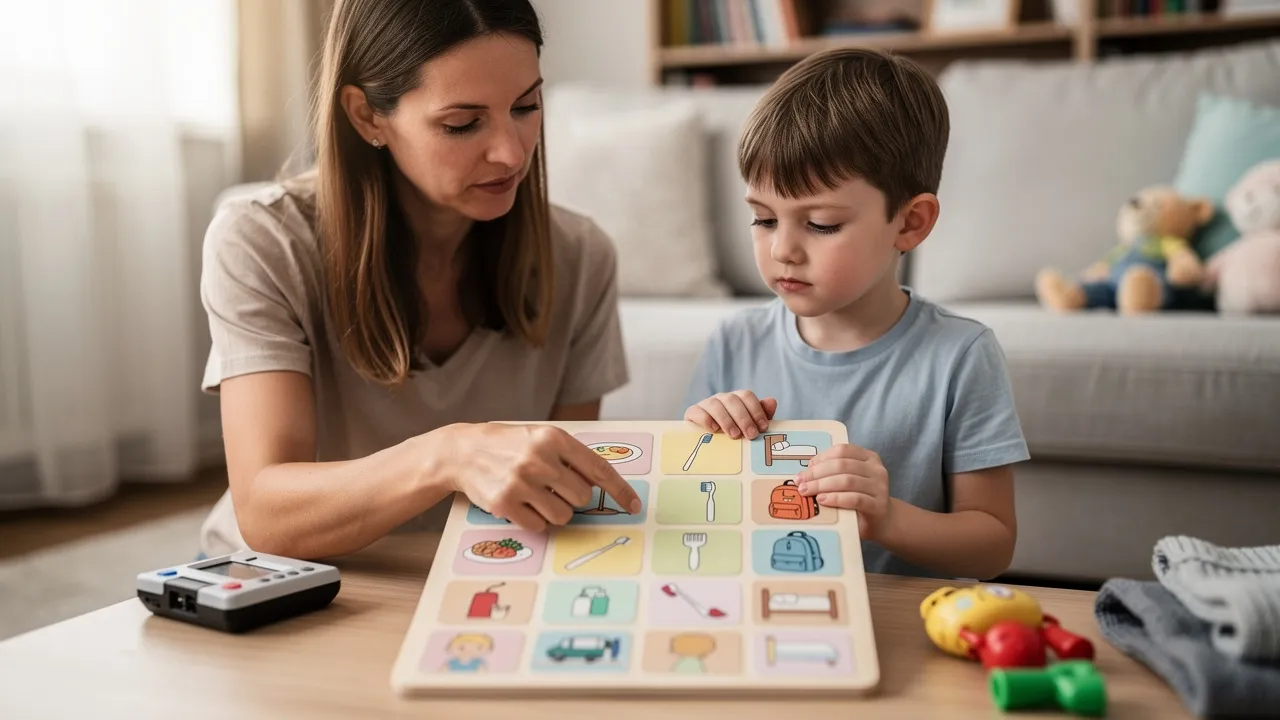
A visual schedule shows a sequence of activities or steps using pictures, photographs, written words, or objects. It gives your child a visible way to see what is happening now, what comes next, and how the parts of a routine or day fit together.
You can use a schedule at different levels of detail. It might represent the whole day, a single routine such as getting ready for school, or the steps within an activity such as taking a shower. Start with the part of the day where a clear sequence would be most useful to your child.
A schedule does not need to look the same for every child. The useful question is whether your child can understand and use the representation.
There is no minimum age for starting a visual schedule. Simple first-then boards can be introduced with children as young as 2 or 3, while more detailed schedules typically work best from age 3 or 4 onward. Those age ranges are starting points, not a test your child must pass.
Choose the amount of information your child can use right now. A two-step board may be more useful than a full-day display if your child is beginning to understand visual sequences. You can build toward a broader schedule as the routine becomes familiar.
Age is only part of the decision. Your child’s communication style, comprehension, attention, and ability to interact with the display should guide the first version.
Use it before the transition
A visual schedule is a support you present before an activity or transition, not only after difficulty begins. Showing the next step in advance can make the sequence more predictable and direct your child’s attention toward information that matters.
Transitions and changes in routine can be stressful, and uncertainty may contribute to anxiety, resistance, or interfering behavior. A visible sequence gives you something concrete to point to when spoken directions would be lengthy or easy to forget.
Visual supports provide information through objects, photographs, drawings, or print and can help learners focus on key elements. The AFIRM professional guide describes visual supports as a foundational evidence-based practice for children and youth on the spectrum from 0 to 22 years old; it also identifies visual supports as potentially increasing on-task behavior and fostering independence.
Visual supports can represent routines such as going to bed, getting ready for school, taking a shower, or going to the bathroom. Pick a routine with a clear beginning and end, then show only the information your child needs to move through it.
For example, a bedtime schedule might show putting on pajamas, brushing teeth, choosing a book, and getting into bed. The point is not to display every detail of the evening. The point is to make the next useful step visible.
A schedule can also represent a transition between places or activities. You might show “shoes,” “car,” and “school,” or “clean up,” “bathroom,” and “bed.” Begin with the sequence that creates the clearest practical need.
Match the format to understanding
The right visual schedule format depends more on your child’s developmental level and communication style than on exact age. Choose the representation your child understands most easily, and change it if the current version causes confusion.
Use the comparison below as a starting point rather than a fixed ladder. The format that looks simplest may be the most useful if it gives your child information they can recognize and act on.
| Format | May fit when | How to begin |
|---|---|---|
| Objects | Your child needs concrete cues or does not yet connect pictures with meaning | Use a real item that represents the activity, such as a spoon for snack time |
| Photos or pictures | Your child recognizes familiar images or symbols | Use one clear image for each activity or step |
| First-then board | Your child is beginning with a short sequence or a single difficult transition | Show the immediate activity first and the following activity second |
| Written schedule | Your child reads fluently and can use written information | Present a short list or checklist that your child can mark as completed |
| Combined picture-and-written schedule | Your child uses both visual and written information | Pair a familiar image with a short word or phrase and observe which part your child follows |
Object schedules can suit children who need concrete cues or do not yet connect pictures to meaning. Picture or photo schedules can show activity steps across a wide range of ability levels, while written schedules suit children who read fluently and can support independence and self-monitoring.
Some children may benefit from a combination of picture-based and written schedules, depending on comprehension and communication skills. If your child seems confused, try a more familiar photograph, a real object, fewer details, or a combination of formats. Keep the change tied to what your child can understand, not to what seems most advanced.
If you are deciding between two formats, test each with a familiar activity rather than an unfamiliar one. Notice whether your child looks toward the representation, identifies the activity, and can use it to move to the next step. That observation gives you more useful information than the appearance of the schedule.
Choose a physical or digital setup
The physical or digital setup should make the schedule easy for your child to reach, see, and use at the moment it is needed. A physical display may be a better starting point when concrete interaction matters; a digital display may be useful when portability, editing, or timers matter.
| Setup | Practical strengths | Consider using it when |
|---|---|---|
| Physical schedule | More concrete and independent of device availability | Your child benefits from handling objects or cards, or the schedule stays in one familiar place |
| Digital schedule | Portable, easier to edit, and able to offer built-in timers | Your child uses a device comfortably, moves between settings, or needs a schedule that changes often |
| Combination | Keeps a familiar home display while adding portability elsewhere | Your child uses a physical schedule at home and a digital schedule on a tablet |
Physical schedules are usually more concrete for younger children and do not depend on device availability. Digital schedules offer portability, built-in timers, and easier editing and are often better suited to older children and teens.
The device itself is not the goal. If the screen competes with the sequence for your child’s attention, use a physical strip, pockets, cards, or a ring instead. If a fixed display is difficult to carry between activities, a portable ring or digital version may be easier to keep available.
Choose the setup your child can use in the setting where the routine happens. A schedule that stays in another room or requires an unavailable device cannot provide information at the moment it is needed.
Begin with one manageable sequence
Begin with a “now” and “next” board, then build toward morning and afternoon blocks and eventually a full-day schedule as your child becomes confident. This progression keeps the first version small enough to teach and gives you a clear way to add information later.
Choose a single routine or transition rather than redesigning the entire day. For example, you might start with “wash hands, then snack,” “shoes, then leave,” or “toys away, then book.” Use activities your child already knows so the first challenge is learning the schedule, not learning every activity at once.
When your child can use the smaller sequence with less help, add a step or a routine block. If the larger version becomes confusing, return to the shorter sequence and build again more gradually.
Keep the first goal observable. You might look for your child to find the current picture, complete the activity, or move the finished card. A small, clear goal makes it easier to decide what to teach next.
Build the schedule around one routine
A useful schedule begins with the routine, your child, and the setting in mind. Before assembling anything, consider these points:
- Relevant skills: Consider your child’s reading level, fine motor skills, attention span, and sensory needs.
- Scope: Decide whether you are showing a transition, a routine, part of the day, or the whole day.
- Recognizable representation: Select objects, photos, symbols, or words your child already understands or is ready to learn.
- Clarity: Use one clear image per activity and avoid unnecessary background detail.
- Completion method: Decide how your child will move, remove, turn over, or check each finished item.
- Location: Choose a place where your child can see and reach the schedule before the routine begins.
This planning step prevents the display from carrying more information than your child can use. A short, familiar sequence is a workable place to begin.
A schedule can be assembled as a strip, a set of pockets, a portable ring, or an app, with a system for moving each card when the activity is complete. Choose the arrangement that fits your child’s reach, movement, and routine.
For a physical version, you might place cards in a line from top to bottom, use a “done” pocket, or create a second area where finished cards are moved. Leave enough space for your child to interact with the display without having to handle several cards at once.
For a digital version, keep the same basic sequence: your child sees the current activity, identifies what follows, and marks or moves the completed item. A different format should not change the routine you are teaching.
Make the completion action clear before you introduce the schedule. Moving a card, placing it in a finished pocket, or checking a box should visibly show that the activity is over and the next item is available.
A simple morning schedule might include only the steps that create difficulty:
- Get dressed.
- Eat breakfast.
- Brush teeth.
- Put on shoes.
- Leave.
Use a photo, picture, object, or written word for each step according to what your child understands. If five steps are too many, start with “get dressed” and “then breakfast,” and add the next step after the first sequence is familiar.
You can also make the schedule narrower by showing only the point where the routine usually breaks down. If getting dressed is manageable but leaving is difficult, begin with “shoes” and “leave” rather than displaying the complete morning.

Teach the check-and-complete routine
Your child needs to learn how to use the schedule, not only look at it. Teaching usually starts with you guiding your child to check the schedule, complete the activity, and move to the next item; you then fade prompts as your child becomes more fluent.
Use the same short routine each time:
- Bring your child to the schedule before the activity or transition.
- Point to the current item and use a brief cue such as “Check schedule.”
- Guide your child toward the activity shown.
- After the activity, help your child move the finished item to a “done” pocket or check off the step.
- Point to the next item and move into that activity.
Moving a finished item or checking off a step can help your child track progress. Keep your support connected to the display so the schedule, rather than a long series of spoken directions, becomes part of the routine.
Begin with the amount of guidance your child needs to complete the sequence. As your child starts checking the schedule more independently, reduce your help gradually: move from guiding, to pointing, to a brief verbal cue, and then to waiting.
Do not remove every prompt at once if your child loses the sequence. Return to the smallest amount of help that allows participation, then try fading again after the routine is more familiar. The aim is for the schedule to provide information without requiring you to narrate every step.
Keep your cue short and consistent. A repeated phrase such as “Check schedule” gives your child the same starting signal each time, while pointing connects the words to the relevant visual.
Use it consistently through changes
Present the schedule before a transition, use one consistent short phrase such as “Check schedule,” and point toward the picture rather than relying on long verbal instructions. The same brief cue from the adults involved can make the routine easier to recognize.
Use the schedule when the routine is going well as well as when a transition is difficult. That gives your child repeated practice with checking, completing, and moving on instead of making the display feel like a response to trouble only.
Keep the schedule where your child can reach it and where you can point to it before the next activity. If the display stays out of sight, it cannot provide information at the moment your child needs it.
Give your child time to look or act after you point. Repeating several instructions immediately can make it harder to tell whether the visual itself is helping.
A schedule can show a plan without promising that every plan will stay unchanged. If plans change, communicate the change visually to prepare your child for the adjustment while leaving room for spontaneity.
You might replace an activity card, add a change symbol, or show a question mark when the next event is not yet fully known. Pair the visual change with a short explanation, then point to the updated sequence. The purpose is to make the change visible, not to force the day into a rigid pattern.
Practice small, understandable changes when the routine is calm. If a planned activity is unavailable, show what is changing and what comes next rather than continuing to point to an outdated card.
When schedule-following is new, reinforce your child immediately after they successfully complete the routine. The reinforcement can be something your child responds to, such as praise, a high five, a preferred activity, or another small reinforcer identified in your routine.
As your child shows consistent success, reduce how often you provide extra reinforcement and use more natural responses, such as specific verbal praise. Keep your attention on participation in the routine rather than on making the schedule look perfect.
If a particular activity remains difficult, notice whether reinforcement follows the completed routine promptly enough for your child to connect the action with the response. Keep the schedule itself simple while you adjust how you support completion.
Let observation drive adjustment
Your child’s response gives you information about fit. Observe what happens at the point where the schedule stops being useful, then make one change at a time so you can see what helps.
- Your child ignores the schedule: Make the visuals clearer and easier to see, move the display into the routine area, and add gentle prompts.
- The schedule feels too long: Break the routine into separate parts, such as morning and bedtime rather than a full-day display.
- There are too many steps: Simplify the visuals or use a first-then board.
- A transition remains difficult: Add a countdown or timer to show that the change is approaching.
- Motivation is low: Pair the visuals with praise or small reinforcers.
Each adjustment should answer a specific problem. Avoid changing the format, length, location, and reinforcement all at once because you will have less information about which change mattered.
Track simple observations rather than trying to judge the entire routine at once. You might note whether your child looked at the schedule, needed a prompt, completed the activity, moved the finished card, or became confused at a particular step.
Use those observations to decide whether to shorten, clarify, expand, or replace the schedule. If your child understands photos but not symbols, keep the sequence and change the representation. If your child manages two steps but not six, keep the format and reduce the scope. If your child follows the schedule but struggles when plans change, practice showing visual changes rather than adding more routine steps.
Look at more than whether the routine was completed. Also notice how much help your child needed, whether the schedule was consulted before the transition, and whether the visual remained understandable when the setting changed. Those observations help separate a format problem from a scope or teaching problem.

Use the response to choose the next step
Visual schedules can support communication, transitions, predictability, and independence, but each child may require a different approach and visual strategy. A schedule may be useful for showing the next step while other supports are needed for communication, sensory needs, learning, or behavior.
The AFIRM guide identifies visual supports as usable across areas such as adaptive or self-help skills, communication, play, school readiness, social participation, and vocational skills. That broad range describes possible applications of visual supports; it does not mean a single schedule addresses every area for your child.
Use the schedule for the function it can provide: representing what is happening, what follows, or how an activity is organized. If your child needs help expressing a request, tolerating a sensory experience, learning a task, or responding to persistent distress, the visual may be only one part of the support.
A visual schedule alone may not reduce problem behavior during a transition from a preferred activity to a nonpreferred activity. A reported comparison found that problem behavior decreased when additional behavioral components were introduced, whether or not visual schedules were also used. Visual-support interventions may improve academic-related on-task behaviors, but visual supports alone may not be enough and may require other components.
Treat a schedule as one part of a support plan when the difficulty continues. If your child understands the display but still cannot move from one activity to another, the next question is not simply whether to add more pictures. Consider whether the routine needs a different teaching approach or additional individualized support.
Visual supports are recommended in autism spectrum disorder clinical guidelines, but evidence about visual supports used at home is limited. A scoping review reported findings from 34 studies and qualitative data from questionnaires involving 101 people, along with focus groups; the reviewed work included varied participants, methods, settings, and outcome measures.
That context supports a measured approach at home: try a clear, child-matched routine, observe what happens, and adjust based on your child’s response. A schedule can be helpful without producing the same response across every child, routine, or setting.
Use a successful response as information about fit rather than as proof that the same design will work everywhere. A change in routine, setting, representation, or level of adult help may call for another adjustment.
Seek individualized professional guidance when needed
Families can use visual schedules at home, and a behavior analyst can help design schedules for difficult routines, coach the family in using them, and adjust them as needed. Consider that support when you have tried a reasonable, child-matched version and still cannot determine whether the barrier is the format, the routine, the teaching approach, or another need.
Individualized guidance may be useful when:
- your child cannot understand or interact with several formats;
- a routine remains highly difficult despite shortening and clarifying the schedule;
- transitions involve persistent distress or interfering behavior;
- your child needs support that goes beyond showing what happens next; or
- adults across home, school, or therapy settings need a consistent approach.
Bring the routine itself to the conversation. Explain what the schedule shows, how you introduced it, what prompts you used, where your child became stuck, and what changes you tried. Those details help a qualified professional focus on the actual situation rather than on a generic schedule design.
A visual schedule is a support for representing activities and transitions.
If a routine involves persistent distress, safety concerns, or behavior that you cannot support with general strategies, pause the experiment and seek individualized guidance. The appropriate professional can help determine what the routine requires and whether a visual schedule belongs in a broader plan.
Choose the next support step
Choose a single routine, start with the smallest sequence your child can use, and let each response guide the next adjustment. A qualified professional can decide whether individualized support is appropriate for your child and what that support should include.
Practical questions about using a visual schedule
Is a visual schedule the same as a choice board?
No. A schedule shows what will happen and in what order, while a choice board lets your child select among options. Keeping them separate can make each tool’s purpose clearer.
Can a visual schedule help if my child does not read or use spoken language?
It can, if the representation matches what your child understands. Try real objects for children who need concrete cues, or familiar photos and pictures for children who recognize images. Spoken language is not required, but your child may need teaching and prompts to learn how to use the schedule.
What should I do if my child follows the schedule but still has difficult transitions?
Treat the schedule as one support rather than a complete behavior plan. Check whether the sequence is understandable, then consider simplifying it, adding a countdown or timer, and seeking individualized guidance if distress or interfering behavior continues.
How can I tell whether a visual schedule is helping at home?
Track simple observations such as whether your child checks the display, completes the activity, moves the finished item, and how much prompting is needed. If the schedule is not useful, change one factor at a time—such as the format, number of steps, location, or prompts—so you can see what improves the fit.
When should I ask a professional to help with a visual schedule?
Seek individualized guidance when your child cannot use several formats, a routine remains highly difficult after you shorten and clarify the schedule, or transitions involve persistent distress or interfering behavior. Professional support may also help when the child needs more than information about what happens next or when adults across settings need a consistent approach.