

Build a goal-by-goal provider fit record
Before a consultation, open one record for each proposed goal and ask four fit questions: Is the goal meaningful in the child’s everyday life? Can the child participate and withdraw assent during the relevant teaching or interaction? What information supports the starting point? Can the proposed therapy amount and caregiver role work for the household? Mark each question explained, unclear, or not discussed. This creates goal-by-goal follow-ups rather than a universal verdict about ABA or a conclusion about a particular child’s care.
ABA is a therapy based on the science of learning and behavior. It may use structured approaches such as Discrete Trial Training or naturalistic teaching through play and everyday activities, and the appropriate intervention should depend on the individual child.
Capture the provider’s answer in the record and note what remains unclear. Keep the consultation focused on the child’s goals, participation, information, and family circumstances.
Fill one record using the same prompts each time:
- Goals: What everyday activity, communication, participation, or independence would each proposed goal support?
- Teaching: Which approach and setting would be used, and how could the child participate?
- Assessment: What information would shape the starting plan, and in which settings?
- Progress review: What is recorded, who reviews it, and what could lead to a change?
- Participation: How are assent, withdrawal of assent, choices, and prompting handled?
- Family demands: What therapy amount and caregiver involvement are being proposed, and how would they fit the household?
For every field, write the answer in the provider’s own terms and add one follow-up question. A blank or unclear field is not a verdict about the programme; it is a reason to seek clarification before comparing it with another option.
Record what each programme includes
Begin each record with the shared definition: Applied Behavior Analysis is a therapy based on the science of learning and behavior. Then note how the provider would apply those principles—through highly structured teaching, naturalistic activities such as play and everyday routines, or a combination.
The word “programme” is a practical label for how those principles are used with a child. Its meaning depends on the goals, teaching context, and review arrangements the provider proposes, so the label alone cannot complete the comparison.
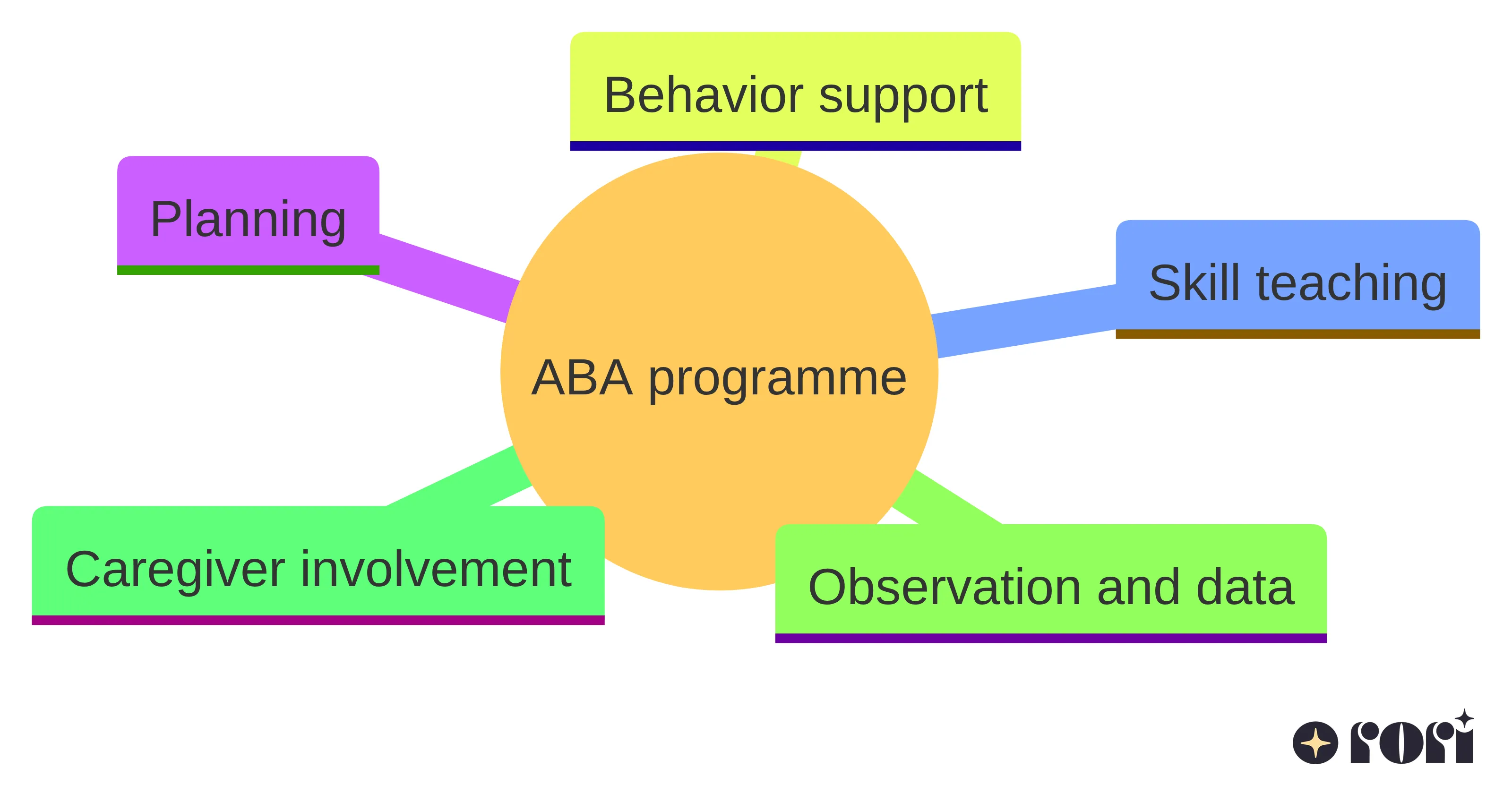
Use the next part of the record to capture what the provider proposes:
- Purpose and goals: Which skills or behaviors are being addressed, and how do they relate to the child’s circumstances?
- Teaching activities: Would learning occur through structured opportunities, play, everyday routines, or more than one approach?
- Behavior support: What context will the team examine, including what happens before and after a behavior and what function it may serve?
- Information collected: What observations or data will be used to discuss performance or behavior?
- Caregiver role: What strategies might parents learn to help a child use skills in everyday situations?
- Setting: Would activities take place at home, in a center, at school, or across settings?
Leave the provider’s answer beside each field. This makes it possible to compare proposed arrangements without assuming that a familiar method or a larger amount of therapy means the same thing for every child.
An ABA programme should not be treated as one standard package. A structured method such as Discrete Trial Training may suit some teaching situations, while naturalistic teaching through play and everyday activities may suit others. The relevant question is how the team chooses among approaches for your child, not whether the programme uses one label consistently.
Turn everyday goals into comparison entries
Your child’s goals should describe useful participation, communication, or independence rather than a vague promise to change behavior. Possible goals in behavioral interventions include communicating wants and needs, using an augmentative communication device, getting dressed independently, taking part in school, developing vocational skills, tolerating a medical procedure, or replacing dangerous behavior with a safer and more effective form of communication.
These examples are not a checklist for every child. Use them to ask what the programme is trying to make easier, more understandable, or more accessible in your child’s daily life.
A practical goal line in the record should contain five notes:
- Daily situation: Where would the skill matter at home, school, or in the community?
- Communication: How will the child’s preferred communication method be included?
- Participation: What would progress look like in an ordinary routine?
- Behavior context: If a behavior is difficult or dangerous, what need or function might it be expressing?
- Follow-up: What will the provider observe and discuss if the context changes?
Functional assessment may examine a behavior’s frequency, intensity, antecedents, consequences, and possible function using direct observational data. Add the provider’s explanation of how that information would shape the goal. This keeps the record focused on what the goal is meant to support rather than on a behavior described in isolation.
Ask the provider to explain the purpose of every proposed goal in plain language. If a goal cannot be connected to your child’s communication, safety, independence, learning, participation, or well-being, ask why it belongs in the plan before agreeing to it.
Log how teaching would fit the child
Teaching approaches can differ within ABA. Modern behavioral interventions may also draw on developmental and communication science.
Those descriptions tell you how teaching may be organized, not which approach your child should receive. A method may be appropriate for one goal and less suitable for another.
For each proposed goal, add a teaching entry to the record:
- Which approach would be used—highly structured teaching, naturalistic activities, or a combination?
- Where would the activity occur, and how could it connect with play or everyday routines?
- How would the child communicate, participate, or show distress or disengagement?
- What would the team change if the activity did not fit the child or goal?
- What part, if any, would parents practise between visits, and does that fit the household?
Parents may be taught strategies that help a child use skills learned in therapy in everyday life. Keep the provider’s example next to the proposed goal, rather than comparing method names on their own.
Choose clarity over a method label. Ask the provider to describe one proposed activity, the skill it targets, how your child can participate, and what would prompt the team to change the activity.
Record how assessment sets the starting point
Assessment gives the starting plan its context. An initial skills-training process may include an in-depth parent interview and an assessment measure such as the Assessment of Basic Language and Learning Skills-Revised or the Verbal Behavior Assessment and Placement Program. These are possible components, not requirements that apply to every programme.
Ask what information the team needs from you before goals are chosen. Your observations can describe communication, routines, strengths, difficult situations, successful supports, and priorities that may not appear during a brief appointment.
Functional assessment may focus on a particular behavior in its setting. The process can include describing frequency and intensity, identifying what happens before and after the behavior, forming a hypothesis about its function, and collecting direct observational data to test that hypothesis.
You can ask whether the proposed assessment will examine the situations that concern you, rather than treating the behavior as the same in every setting. Ask how the findings will affect the goals, teaching activities, and behavior-support plan.
Complete the assessment field by recording:
- What the provider will assess and in which settings.
- Whether information will come from your observations, direct observation by the team, or both.
- What the assessment is intended to show about communication, daily skills, or behavior in context.
- How the findings will connect to written goals and teaching activities.
- When the starting assumptions will be revisited.
An initial process may include an in-depth parent interview and an assessment measure such as ABLLS-R or VB-MAPP; ask the provider what assessment it uses. For behavior support, functional assessment may examine frequency, intensity, antecedents, consequences, and possible function using direct observational data. Keep these answers in the record so you can see whether the proposed starting plan follows from the information gathered.
Trace how information could change the plan
Progress review should connect the information collected during care to decisions about the plan. Treatment effects should be monitored, and alternative approaches may need to be considered if an approach is ineffective. A provider guide also recommends asking who implements the treatment plan and who collects or analyzes data.
You do not need to accept a general statement that data are collected. Ask what information is recorded, how it relates to each goal, and how the team will explain what the information means.
For the progress-review field, write down five answers:
- Measure: What information is recorded for each goal or behavior?
- Reviewer: Who collects, analyzes, and explains it, and how can caregivers add observations?
- Decision: What change would the team consider if an approach is ineffective?
- Update: When and how will the provider explain the information?
- Example: Can the provider show how a result has changed a plan?
A provider guide recommends asking who implements the treatment plan and who collects or analyzes data. Place the answers beside the other fields. If the provider cannot explain what information would affect a decision, mark that gap for follow-up rather than treating data collection as sufficient.
Ask for a concrete example of how a past result changed a plan. If the provider cannot explain how ineffective approaches are reconsidered, pause the decision and request a clearer process.
Record participation, consent, and assent
Your child’s participation deserves specific attention throughout care. Assent may need to be considered separately for interaction, skill instruction, physical prompting, and entering a treatment space. A child’s willingness to approach a therapist or join one activity should not automatically be treated as willingness to accept every other part of treatment.
Ask how the team recognizes assent, how it recognizes withdrawal of assent, and how those signs affect the plan. Ask how the team responds when your child communicates refusal through words, gestures, movement, changes in behavior, or other signals.
Complete the participation field with the provider’s answers:
- How will the team distinguish assent to interaction, skill instruction, physical prompting, and entering a treatment space?
- How will it recognize withdrawal of assent and update that understanding?
- What choices can the child make during activities?
- Which decisions require parent consent, and how will the child’s participation be sought during each part of care?
- How will refusal or distress be communicated to the family and treatment team?
- How could the child’s signals change an activity, prompting approach, or proposed plan?
Assent can differ across parts of treatment; willingness to join one activity should not automatically be treated as willingness to accept every other part. Keep these answers next to the proposed goals and methods. That side-by-side record makes participation part of the comparison rather than a separate promise about respect.
A respectful answer should describe an ongoing process rather than a single agreement at the beginning. Ask the provider to show how your child’s signals can change the activity, the prompting approach, or the treatment plan.
Balance possible benefits with limits in the evidence
ABA-based care may address communication, adaptive skills, cognitive skills, social participation, self-help, or safer ways to communicate. A BACB fact sheet describes intensive, comprehensive intervention for young children with developmental disabilities as targeting cognitive, language, social, and self-help skills. These are possible areas of focus, not guaranteed results for your child.
A 2025 meta-analysis reported improvements in receptive language but not expressive language or motor skills in the children it analyzed. The same analysis reported publication-bias concerns for some outcomes. That combination matters: a broad claim about “progress” can hide differences between goals and between types of skills.
ABA also has a history that deserves an honest place in your decision. Critics point to historical concerns about autonomy, well-being, masking, psychological harm, and the exclusion of autistic voices from treatment goals and outcome measures. Those concerns make the programme’s goals and participation practices important questions, not side issues.
The evidence does not turn a population-level finding into an individual forecast. Ask which outcome the provider is discussing, how it will be observed, and how your child’s experience will influence the plan. Ask what the team considers a meaningful improvement and what it will do if a target does not benefit your child.
Balance means asking about both possible usefulness and possible cost. A programme that can describe skill goals, monitor outcomes, respond to distress, include autistic perspectives, and update its approach gives you more information for judging fit. A programme that treats a published outcome or a familiar label as enough reason to continue deserves further questions before you agree.
Do not use hours as a shortcut for programme quality
The number of hours does not answer whether a programme fits your child. The amount of therapy and caregiver involvement can vary according to a child’s specific needs. Some skills-training programmes require several hours each day, and one provider guide gives 20–40 hours per week as an example for some center-based early-intervention programmes. That example is not a universal schedule.
Treat intensity as a plan to understand, not a number to pursue. Ask what each part of the schedule is intended to accomplish and how the team will know whether the arrangement remains workable.
Ask these schedule questions:
- What goals require this amount of time?
- How is the schedule connected to my child’s age, needs, communication, and daily routines?
- What will caregiver participation look like between sessions?
- Which settings will be included?
- How will fatigue, distress, missed activities, or family constraints be handled?
A clear answer should explain the relationship between time, goals, participation, and review. If the only reason offered is that more hours are standard, ask how the plan is individualized.
Use a consultation checklist focused on fit
Assessment and goals
- What assessment will you use, and what will it examine?
- How will my observations and my child’s communication shape the starting plan?
- Which goals connect to daily routines, learning, communication, independence, or participation?
- How will you explain the purpose of each goal?
Teaching approach
- Which approaches might be used for each goal?
- When would teaching happen through play or ordinary activities?
- How will the team adapt activities to my child’s communication and preferences?
Progress review
- What information will be collected for each goal?
- Who implements the plan, and who collects or analyzes the data?
- How will you explain progress to me?
- What would lead you to change or replace an approach?
Participation and assent
- How will you recognize assent and withdrawal of assent?
- How will interaction, instruction, physical prompting, and entering the treatment space be considered separately?
- How can my child communicate a preference or refusal during an activity?
- What will happen when my child shows distress or disengagement?
Caregiver role and schedule
- What will I be asked to learn or practice at home?
- How much time will caregiver participation require?
- Why is the proposed schedule connected to my child’s goals?
- How will family routines and changes in circumstances be handled?
Fit and next decision
- What would make you reconsider the starting plan?
- How will my child’s experience be included in decisions?
- What information should I take away before deciding whether to proceed?
You do not need to ask every question in one conversation. Start with the areas that matter most to your family, then request a specific answer whenever a response stays too general.
Use the answers to identify a clear next step: request more detail, compare another programme, or continue the conversation with focused questions. Do not decide from the schedule or service label alone.
Take your questions to a qualified professional
An ABA programme may be worth exploring when its goals connect to your child’s everyday life, its methods are explained clearly, your child’s participation is respected, and progress review can change the plan. The right decision depends on your child’s circumstances and your family’s priorities, so discuss individual suitability with a qualified professional and bring your written questions to that conversation.
If you are exploring care in San Jose, use the checklist to compare the answers you receive and identify the next conversation that gives you enough detail to decide.
Questions parents may still have before exploring an ABA programme
How can I determine if an ABA programme is suitable for my child?
To assess suitability, consider whether the programme’s goals align with your child’s daily life, how the teaching methods respect your child’s preferences, and how progress will be monitored and adjusted.
What types of goals might an ABA programme focus on?
Goals in an ABA programme may include improving communication, social skills, independence, and participation in daily activities, rather than vague behavior changes.
What should I ask about the assessment process for an ABA programme?
Inquire about what assessments will be conducted, how your observations will inform the starting plan, and how the findings will shape the goals and teaching activities.
What role do parents play in an ABA programme?
Parents may be involved in learning strategies to support their child’s skill application in everyday situations, and their participation level can vary based on the programme’s requirements.
What ethical considerations should I be aware of regarding ABA therapy?
It’s important to discuss how the programme respects your child’s autonomy and preferences, and to be aware of historical concerns regarding the treatment of autistic individuals.