

What an ASD evaluation is designed to clarify
An ASD evaluation is a structured, multistep process for understanding a child’s development, behavior, communication, and support needs. It usually brings together more than one kind of information, such as developmental history, direct observation, standardized assessments, and, depending on the setting, input from multiple specialists.
The purpose is to build a fuller picture than you could get from a short conversation or a single questionnaire. An evaluation may examine developmental and behavioral features relevant to recognized autism diagnostic criteria while also considering how your child functions in everyday settings.
A diagnostic assessment also gives you an opportunity to explain what prompted your concerns. Evaluators may ask about your child’s experiences at home, in school, and in other care settings, then combine those details with what they observe during the appointment.
The exact process can vary by child and clinical setting. You can approach the appointment as a conversation and information-gathering process, not as a test you or your child must prepare to pass.
Screening is a starting point, not a complete evaluation
An autism screening questionnaire is designed to identify whether a child may be at risk or may need further evaluation; it is not the same as a comprehensive diagnostic evaluation. Screening can help bring a concern into focus, but it does not provide the complete developmental, behavioral, and medical picture used in a broader assessment.
The Modified Checklist for Autism in Toddlers, commonly called the M-CHAT, is one example of a parent-completed questionnaire used to identify autism risk in the general population. Completing a tool like this can give you useful questions to discuss, but the score should not be treated as a diagnosis.
A single observation is also only one piece of the process. A full evaluation considers developmental history, direct observation, and possible conditions that may resemble or accompany autism rather than relying on one moment or one explanation alone.
If a screening result raises concern, use it as a reason to ask about a complete evaluation. Bring the questionnaire or its result to the discussion and ask what additional information the evaluator needs.
The evaluation begins with concerns and developmental history
Parent and caregiver concerns are a central starting point in an ASD evaluation. Evaluators may ask what you have noticed, when you first noticed it, how it affects daily life, and whether the same pattern appears across settings. When appropriate, they may also ask about the child’s own concerns or experiences.
Concrete examples help make those concerns easier to understand. Describe what happens at home, during school or care activities, and in social situations rather than trying to summarize your child with a single label.
A developmental history focuses on developmental and behavioral features relevant to recognized autism diagnostic criteria. The conversation may cover communication, social development, behavior, and changes across childhood, along with the context in which those features appear.
A developmental history is not limited to what happened during the appointment. Your observations can show how your child communicates, responds, plays, adapts, and manages everyday situations over time.
Your role in the evaluation is to provide the history and everyday examples that an appointment cannot capture by itself. Write down a few specific situations before the visit, including what happened, where it happened, and what your child did next.
You do not need to produce a perfect summary. Aim for a clear, honest picture of your concerns and your child’s strengths as well as challenges.
One useful way to organize notes is to separate what you observed from your interpretation. For each example, record the setting, what happened before, what your child did, what happened next, and any change in support or context that seemed relevant. This gives the evaluator concrete information to consider alongside the history and direct observation gathered during the visit.
A simple timeline can also show whether a concern was present earlier, changed over time, or appears mainly in particular situations. If reports differ between home and school, keep both descriptions. The difference itself provides context for questions about how your child communicates and responds across settings.
How evaluators may observe and interact with your child
Direct interaction and observation allow an evaluator to look at social communication skills and behaviors relevant to autism criteria. The evaluator may engage your child in activities or conversation, observe how your child responds, and connect those observations with the developmental history you provide.
The appointment is one setting, so the observed behavior is interpreted alongside information from home, school, and other care environments. That broader context helps the evaluator understand whether a behavior is part of a consistent pattern or appears only under particular circumstances.
Your child may communicate or participate differently depending on the people, activity, demands, or setting. That does not make one observation invalid; it is a reason to explain what you typically see elsewhere and which conditions seem to change the response. Examples from home, school, or care can help the evaluator interpret the appointment rather than treating it as a complete picture by itself.
When you describe a difference across settings, focus on the situation and the observable response. This gives the evaluator a clearer basis for asking whether the difference reflects context, a broader pattern, or an area that needs more information.
Some pediatric assessment descriptions include questionnaires, play-based assessment, and detailed interviews. One clinical description gives an example of an evaluation lasting about 2–4 hours, but actual timing can vary with the child, the setting, and the components included.
Ask in advance how the appointment will be organized, who will participate, whether you will be interviewed separately, and what your child may be asked to do. Those answers can help you explain the visit in simple, honest terms without presenting it as a pass-or-fail test.
Why the assessment considers the broader developmental picture
An ASD evaluation may include medical history because development and behavior can be affected by more than one factor. Relevant information may include prenatal history, birth history, family history, and past and current health conditions.
Depending on the clinical setting, the assessment may also include a physical examination. Ask which parts of the medical history and examination are part of the planned appointment so you know what information to gather.
An evaluation should consider other conditions that may resemble or accompany autism rather than relying on one explanation alone. Depending on your child’s presentation, clinicians may consider concerns such as anxiety, language or developmental delay, ADHD, or vision or hearing differences.
This broader review does not mean that every child will receive every possible test or consultation. It means the evaluator is looking at the developmental picture in context and considering which explanations or coexisting conditions are relevant to your child.
A comprehensive evaluation may also involve standardized assessments or input from specialists when those additions are appropriate. The resulting profile can include strengths, skills, challenges, and support needs across family and educational contexts.
Ask how each part of the assessment contributes to the overall picture. A clear explanation can help you understand why the team is gathering information beyond a screening questionnaire.
What to gather before an ASD evaluation
Preparing for an ASD evaluation means gathering information from the settings where your child lives, learns, and receives care. Parent observations are especially useful because they show how your child behaves in natural situations, not only during an appointment.
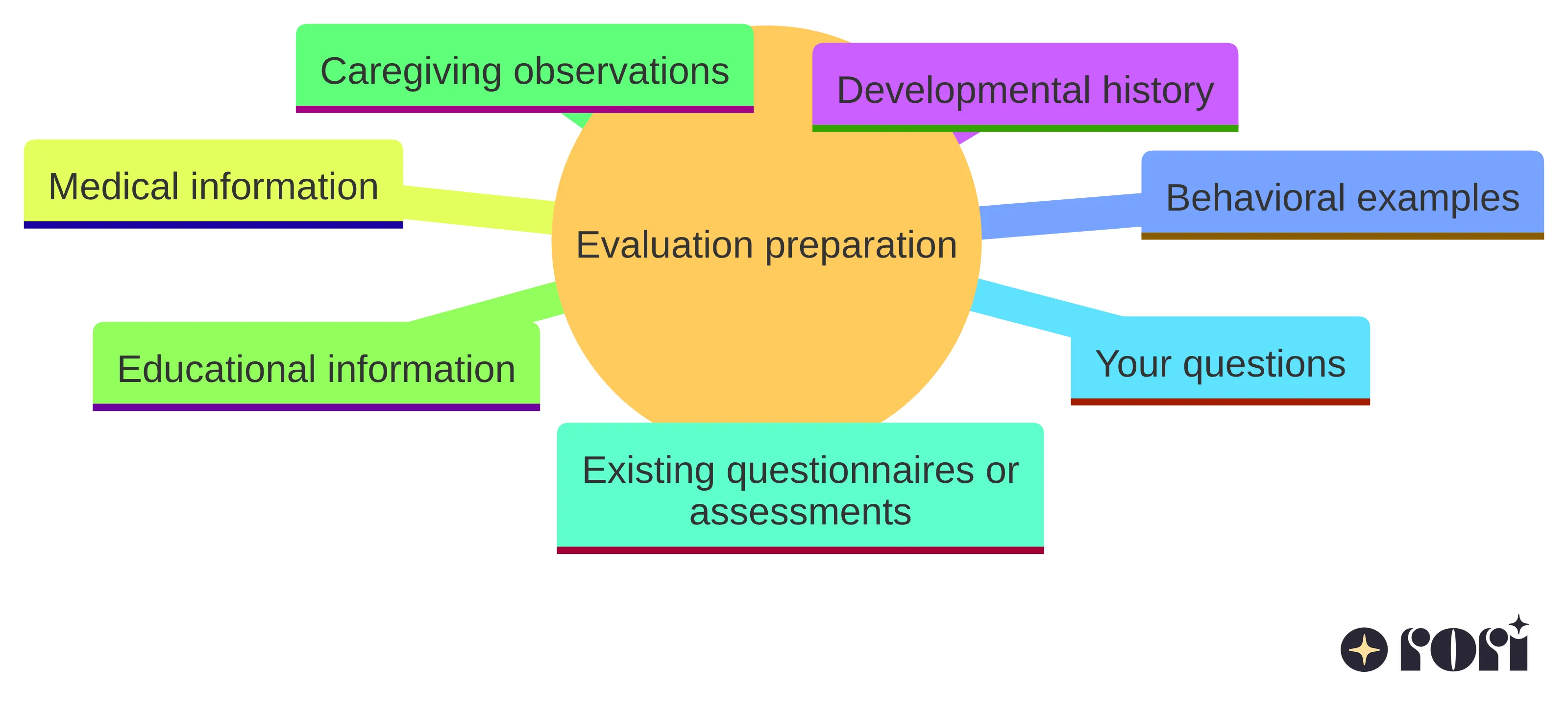
Use this short checklist to organize what you already know:
- Developmental history: Note milestones, early communication, social development, and changes you remember across childhood.
- Behavioral examples: Write down specific situations involving communication, interaction, routines, behavior, or sensory responses, including what happened before and after.
- Medical information: Gather relevant prenatal, birth, family, past health, and current health information.
- Educational information: Include what you know about your child’s experiences in school, preschool, daycare, or other learning settings. If teachers or caregivers have shared observations or reports, ask whether they would be useful.
- Caregiving observations: Record patterns you see during meals, dressing, play, transitions, sleep routines, community activities, or other everyday situations.
- Existing questionnaires or assessments: Bring completed screening forms, prior evaluations, or other documents that the assessment provider has requested.
- Your questions: Keep a written list so you can ask about the process, timing, participants, results, and possible follow-up.
Organized notes can help you remember details, but you should not change your child’s routine or coach responses for the appointment. Describe both abilities and difficulties, including situations in which your child communicates well or manages an activity successfully.
If you are unsure whether a document or observation matters, bring it to the appointment or ask in advance whether the evaluator would like it. The goal is to give the assessment team a balanced picture, not to create a case for a particular result.
For each example, keep the description concrete and note the surrounding context.
If two caregivers or settings describe the same situation differently, do not try to choose one account in advance. Bring both perspectives and explain where they came from. Comparing information across home, school, and care settings is part of building the broader developmental picture.
Questions to ask about the evaluation process
Questions about the evaluation process can help you understand how your information, your child’s behavior, and any formal assessments will be considered together. Take the list with you and choose the questions that match your concerns.
- What parts of the evaluation are planned, and what does each part assess?
- Who will meet with my child, and what role will each professional have?
- How will you use information from home, school, and other care settings?
- Which developmental, medical, or educational records would be helpful?
- Will you use a screening questionnaire, a standardized assessment, direct observation, or several of these?
- How can I share examples of behavior that may not appear during the appointment?
- What other conditions or developmental concerns will you consider if they are relevant?
- How and when will you discuss the findings with me?
- Will I receive a written explanation of the findings, recommendations, or support needs?
- If more information is needed, what would the next assessment or consultation address?
- Which referrals or supports might be appropriate to discuss after the results?
Ask for plain-language explanations of terms you do not recognize. If the evaluator uses a diagnostic criterion, assessment score, or clinical phrase, ask what it means for your child’s profile and what it does not mean.
You can also ask how your concerns will be included in the final discussion. A useful evaluation conversation should leave you knowing which information shaped the interpretation and which questions remain open.
Questions can also clarify how the evaluator will combine information when reports differ across settings, which parts of the picture remain uncertain, and whether additional history, observation, or consultation would help. This shifts the discussion from focusing on one score to understanding how the different pieces inform the overall profile.
What evaluation results may describe
ASD evaluation results can help describe a child’s strengths, skills, challenges, and support needs in the context of family and education. The findings may bring together your developmental history, the child’s observed social communication and behavior, medical information, and information from other settings.
A clinician may also explain how developmental and behavioral features relate to recognized autism diagnostic criteria. Ask the evaluator to connect each conclusion to the type of information that supports it, rather than relying on a score or label without context.
To make the report easier to use, ask the evaluator to distinguish among information you supplied, behavior observed during the visit, standardized assessment findings, and the clinician’s interpretation. Then ask which questions remain open and whether any conclusion depends on information from another setting or a later consultation.
This distinction helps you understand that a report can contain several kinds of information at once. It also gives you a clearer way to discuss the findings with people who know your child in different parts of daily life.
Results may also identify questions about conditions that can resemble or coexist with autism. Depending on the child, those considerations may include anxiety, language or developmental delay, ADHD, or vision or hearing differences.
That broader description can help separate several issues that families often have to discuss at once: what your child does well, where support may be needed, which concerns relate to autism criteria, and whether another evaluation or consultation should be considered.
When you receive findings, ask how they apply across the settings that matter to your child. A profile that includes family and educational context can be more useful for planning conversations about support than a result presented without examples.
If a result is unclear, ask the evaluator to explain the conclusion, its limits, and the practical questions it is intended to answer.
What an ASD evaluation cannot establish by itself
An ASD evaluation cannot be replaced by a screening score, a single questionnaire, or one brief observation. A screening questionnaire can indicate that further evaluation may be appropriate, but a complete assessment considers history, observation, and possible alternative or coexisting conditions.
The same boundary applies to an informal observation. What you notice at home can be valuable information, but it is one part of the broader process rather than a diagnostic conclusion by itself.
Findings describe the information considered in that assessment; they do not promise how every later decision about support will be made.
Evaluation procedures, professionals involved, timing, and follow-up can vary by child and setting. Ask what the findings answer, what they leave open, and what additional information would be needed for the next decision.
A diagnosis-related discussion is only one part of understanding your child. The evaluation may describe needs and possible areas for support, but your questions about school, health, communication, behavior, and daily life may still require separate conversations.
How to discuss findings and possible next steps
Discussing findings means connecting the assessment profile to practical questions about your child’s daily life. Ask the evaluator to explain the main findings, the strengths and challenges described, the concerns that may need more information, and the recommendations that follow from the assessment.
You can ask for clarification on four points:
- What did the evaluation determine about the concerns that led to the appointment?
- Which observations, history details, or assessments shaped that interpretation?
- What questions remain unanswered?
- What should you discuss next with your child’s healthcare, school, or support team?
Possible next steps may include discussing referrals, additional assessments, or supports when those options fit the child’s needs. Clinical guidance describes using the child’s profile of strengths, skills, challenges, and needs to inform a needs-based plan, while primary-care guidance connects diagnosis with consideration of appropriate autism supports and services.
The next step may be different for each family. Ask which recommendation addresses which need, who should provide it, and whether another professional should be involved.
Before leaving the discussion, connect each suggested next step to the concern it addresses. Ask whether it is meant to clarify an unanswered assessment question, respond to a described support need, or explore a possible coexisting condition. This keeps follow-up tied to the profile and makes it easier to know what information to bring to the next conversation.
If several recommendations are discussed, ask which question or need each one addresses and how the professionals involved will communicate their findings. That can help you separate immediate questions from issues that may be considered in a later assessment or support discussion.
Keep a copy of the findings and write down questions that arise after the discussion. If your child’s behavior or needs look different across home, school, and care settings, share those differences rather than trying to reconcile them on your own.
A follow-up conversation can help you understand how the evaluation relates to everyday support without treating the report as the only source of information about your child.
Use the evaluation roadmap to plan your inquiry
An ASD evaluation is best approached as a structured way to gather and interpret information about your child across development and daily settings. Before you inquire about an assessment in San Jose, prepare your observations, medical and developmental history, school or care information, and questions about how the process works.
Remember the central boundary: a screening tool or isolated observation cannot replace a fuller evaluation, and an evaluation does not guarantee a particular service or outcome.
Use your initial inquiry to ask what the assessment includes, what information you should bring, how findings will be discussed, and which follow-up questions the evaluation is intended to answer.