

Start with what an ASD diagnosis can—and cannot—answer
An ASD diagnosis is a clinical determination about whether a child’s developmental pattern fits recognized autism spectrum disorder criteria. The criteria focus on two core domains: persistent differences in social communication and social interaction, plus restricted or repetitive patterns of behavior, interests, or activities.
The diagnosis also considers timing and day-to-day impact. Symptoms must begin in the early developmental period, may become clearer when social demands increase, and must cause clinically significant difficulty in important areas of current functioning. Clinicians also consider whether intellectual disability or global developmental delay better explains the pattern, while recognizing that those conditions can occur alongside ASD.
That means a diagnosis can give you a clearer explanation for a pattern of development and a starting point for planning. It cannot, by itself, describe every strength, challenge, support need, classroom experience, or family priority your child has. Those details still matter after the diagnostic question is addressed.
If you are concerned about your child in Oakland, start by separating three questions: what you have observed, what a screening tool suggests, and what a full evaluation concludes. Keeping those questions separate makes the process easier to follow and helps you bring useful information to the right appointment.
Separate screening, assessment, and diagnosis
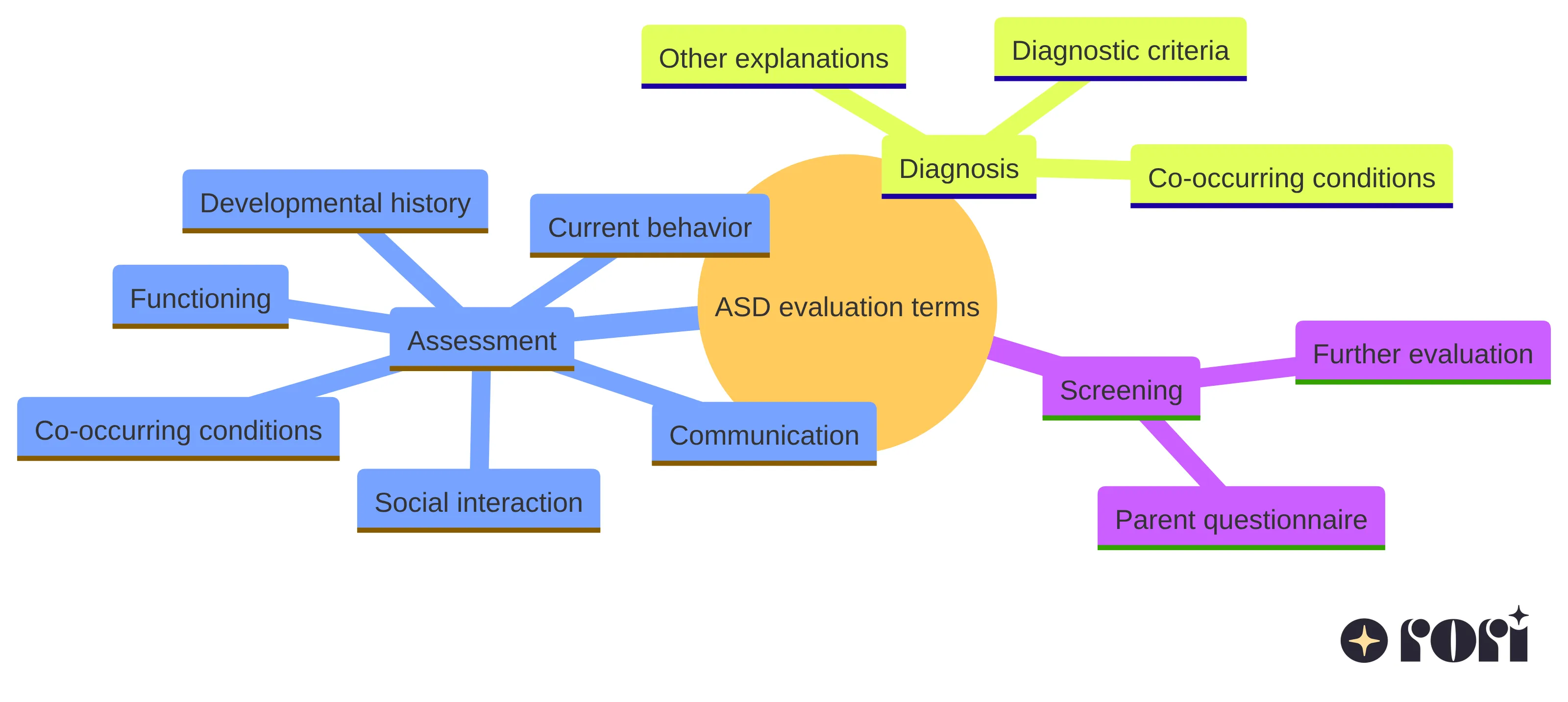
Screening is an initial check for developmental or autism-related signs. It may use a parent questionnaire or another standardized tool to identify whether further evaluation is appropriate. Examples include the parent-completed M-CHAT, the ASQ, the CSBS Infant-Toddler Checklist, and PEDS. A screening result points toward a next question; it does not settle the diagnostic question.
Assessment is the broader information-gathering process. It also considers possible co-occurring or alternative conditions. The American Academy of Pediatrics advises primary-care providers to understand ASD criteria, conduct appropriate evaluation, and consider medical and behavioral conditions that may affect the child.
Diagnosis is the clinical conclusion reached after the relevant information has been considered against the diagnostic criteria. It is not the same as completing a questionnaire, recognizing a familiar behavior, or receiving a referral. The three terms describe different points in the process:
- Screening: identifies whether autism or another developmental concern deserves closer attention.
- Assessment: gathers and examines the developmental, behavioral, communication, social, and health information needed for that closer look.
- Diagnosis: determines whether the full pattern meets ASD criteria and whether another explanation, a co-occurring condition, or both need consideration.
When you hear one of these terms, ask which stage is being discussed. That single question can prevent a screening result from being mistaken for a final answer.
Why a screening result is not a diagnosis
A screening tool is designed to identify risk or the need for further evaluation, not to establish ASD. For example, the parent-completed M-CHAT is designed to identify children at risk for autism in the general population. It is useful for deciding what deserves attention, but its result does not replace a diagnostic evaluation.
The American Academy of Pediatrics recommends standardized ASD screening at 18 and 24 months together with ongoing developmental surveillance. That recommendation makes screening part of early developmental care; it does not change the separate role of a comprehensive evaluation.
A concerning screening result gives you a reason to ask what happens next. It does not tell you which diagnostic criteria your child meets, whether another condition is contributing, or what level of support would be appropriate. A result that does not raise concern also does not answer every developmental question you may have, especially if your observations continue to concern you.
Use the result as a conversation starter. Write down the specific behaviors or developmental changes that led to your concern, then bring those examples to a primary-care appointment or an evaluation conversation. Concrete examples are more useful than trying to interpret the questionnaire by yourself.
What professionals consider during an ASD evaluation
An ASD evaluation considers a pattern rather than a single behavior. DSM-5 describes the central pattern through social communication and social interaction, together with restricted or repetitive behavior, interests, or activities. The evaluation also considers whether the pattern has been present across relevant contexts and whether it affects current functioning.
Developmental history helps establish when differences appeared and how they changed over time. Since ASD symptoms must be present in the early developmental period, details about early communication, play, social responses, routines, and developmental milestones can help place current observations in context. Later recognition does not automatically rule out ASD because some signs may become clearer as social expectations grow.
Communication and social interaction are considered together, not as isolated skills. The evaluation may examine how your child communicates needs, responds to other people, shares attention or interests, and manages social exchanges. Behavior and current functioning also matter, including whether repetitive patterns, restricted interests, or related differences create meaningful difficulty in everyday settings.
The evaluation also places the developmental pattern beside other health, behavioral, and learning information. The AAP advises consideration of co-occurring medical and behavioral conditions, while primary-care guidance emphasizes understanding diagnostic criteria and carrying out appropriate evaluation. Ask which areas the appointment will address so you know what information to bring.
Why professionals consider other explanations too
An autism evaluation considers other possible or co-occurring conditions because similar concerns can arise from more than one source. The American Academy of Pediatrics lists anxiety, language delay, global developmental delay, ADHD, vision impairment, and hearing impairment among conditions that may be present instead of or alongside autism.
The diagnostic criteria also require consideration of intellectual disability and global developmental delay. Those conditions can occur with ASD, so the question is not always whether one label must replace another. The question is how the full developmental pattern is best understood.
This part of the process does not mean your concern was misplaced. It means the evaluation is looking for an explanation that accounts for the information as a whole. A child may have autism, another condition, more than one condition, or a developmental pattern that does not meet ASD criteria.
You can help by describing what you see without trying to assign a label. Explain when the behavior occurs, what happens before and after it, how your child communicates, and whether the pattern appears at home, school, childcare, or in other settings. Those details help keep the discussion focused on your child’s actual development.
Prepare a parent-ready evaluation packet
A parent-ready evaluation packet is a short, organized set of information you can use during the appointment. Its purpose is practical: it keeps developmental history, current examples, and your questions together so you can describe the pattern clearly.
Include these items:
- A developmental timeline: note major communication, social, play, movement, and adaptive milestones as well as changes that concerned you.
- Specific examples: write what happened, where it happened, how often you notice it, and how it affects daily activities.
- Information from other settings: add observations from school, childcare, relatives, or other regular caregivers when they describe your child in a different environment.
- Relevant records: gather prior screening results, developmental reports, school notes, and health information that may help explain the timeline.
- Your questions: list what you want to understand about the evaluation, possible next steps, and how results will be explained.
Keep descriptions concrete. Instead of writing only “social problems,” note whether your child responds to a name, shares interests, uses gestures, joins play, or communicates in another way. Instead of writing only “repetitive behavior,” describe the pattern, the situation, and the effect on current functioning. These examples connect your observations to the areas an evaluation considers.
You do not need to prove a diagnosis before the appointment. Your task is to organize what you have seen and what you want clarified. Bring the packet in the format that is easiest for you to use: a brief timeline, a few pages of notes, or a simple list on your phone.
Use the appointment to clarify what happens next
An evaluation appointment should give you a clearer sense of which questions are being examined and what information is still needed. You can ask the provider to explain the process in plain language before you begin, especially if the appointment is a screening visit, a diagnostic evaluation, or a follow-up discussion.
Useful questions include:
- Which parts of my child’s development and current functioning will you consider?
- How will you gather information about communication, social interaction, behavior, and developmental history?
- Are there other conditions or health concerns that should be considered alongside autism?
- What information from home, school, or childcare would be useful?
- When and how will you explain the results?
- If the evaluation does not answer every question, what is the next assessment or referral to discuss?
Listen for whether the explanation addresses the whole pattern rather than one isolated symptom. A useful discussion should connect developmental timing, social communication, social interaction, restricted or repetitive behavior, current functioning, and possible alternative or co-occurring conditions.
Before leaving, write down the next action in your own words. It may be to provide another record, schedule a follow-up discussion, pursue another developmental evaluation, or ask about supports connected to the findings. A written note helps you keep the process moving without relying on memory after a demanding appointment.
A practical next-step pathway for Oakland families
If you live in Oakland and are deciding what to do next, use a simple sequence. The path below is a planning framework, not a statement about local availability, prices, coverage, or wait times.
- Write down the concern. Record the behaviors, developmental changes, or everyday difficulties that prompted you to seek help.
- Start a primary-care conversation. Ask about developmental surveillance, screening, and whether a formal autism evaluation is appropriate. The AAP advises primary-care providers to understand ASD criteria and conduct appropriate evaluation.
- Ask about the evaluation route. Clarify whether the next appointment is screening, assessment, or diagnosis, who will conduct it, what records are needed, and how results will be discussed.
- Prepare your information. Bring the developmental timeline, examples from daily life, information from other settings, prior records, and your questions.
- Record the next step. After the appointment, write down any additional evaluation, follow-up discussion, or support conversation that was recommended.
If the first conversation raises another concern, keep that concern in the plan rather than treating it as a reason to abandon the autism question. Primary-care guidance specifically calls for attention to possible conditions such as language delay, anxiety, ADHD, hearing impairment, vision impairment, and developmental delay. Ask how those questions will be addressed and which appointment should come next.
For an Oakland family, the immediate action is straightforward: organize your observations and contact the appropriate primary-care or evaluation pathway available to you. Ask practical process questions before the appointment, then use the visit to clarify what information is needed and what happens after the evaluation. Do not use a local search result or an online checklist as a substitute for that conversation.
How to interpret information about diagnosis timing
Timing information needs context. The American Academy of Pediatrics report reaffirmed in October 2025 recommends standardized ASD screening at 18 and 24 months with ongoing developmental surveillance, and it states that ASD can be diagnosed as young as 18 months. That does not create a single age at which every child will be diagnosed.
One statewide Early Autism Evaluation Hub study evaluated 2,076 children ages 18 to 48 months from 2012 through 2018. The children had a mean age of 30 months, the median evaluation wait was 62 days, and 33% received an ASD diagnosis. Those figures describe that study’s population and period; they are not current wait-time or diagnosis-rate estimates for Oakland.
A study average and the earliest possible age answer different questions. An average describes the group studied, while an early-diagnosis statement describes when diagnosis can occur for some children. Neither figure predicts your child’s result or the time required for an evaluation.
If you have a developmental concern, ask about screening or evaluation rather than waiting for a particular age. The AAP’s recommendation for ongoing developmental surveillance supports raising concerns as they arise. Your observations, the developmental history, and the evaluation findings matter more than matching an average age.
Move from concern to a prepared assessment conversation
The clearest next step is to turn uncertainty into organized information. Write a short developmental timeline, collect examples from the settings where your child spends time, separate screening from diagnosis, and prepare questions about the evaluation process.
An ASD evaluation considers developmental timing, social communication, social interaction, restricted or repetitive patterns, current functioning, and other possible or co-occurring conditions. A qualified professional must determine whether your child meets diagnostic criteria and what individual next steps are appropriate. Use your notes to support that conversation, not to make the diagnosis yourself.
For an Oakland family, arranging the appropriate primary-care or evaluation conversation is a practical place to begin. Bring your questions, ask which stage of the process you are entering, and leave with one clearly written next action.
Practical questions parents may still have about ASD diagnosis
What are the main areas considered in an autism evaluation?
An autism evaluation typically considers developmental history, current behavior, communication skills, social interaction, and functioning. It also examines whether any co-occurring conditions may be present.
How can I prepare for my child's autism evaluation?
To prepare for an autism evaluation, create a developmental timeline noting key milestones, gather specific examples of behaviors that concern you, collect relevant records, and prepare a list of questions you want to ask during the appointment.
What is the difference between screening, assessment, and diagnosis in autism care?
Screening is an initial check for developmental signs, assessment is a comprehensive information-gathering process, and diagnosis is the clinical conclusion based on the evaluation against established criteria.
What should I expect during the autism evaluation appointment?
During the evaluation appointment, you can expect discussions about your child’s development, observations of their behavior, and questions about their communication and social interactions. The provider will explain the evaluation process and what information is needed.
What steps should I take if I suspect my child may be autistic?
If you suspect your child may be autistic, start by documenting your concerns, schedule a conversation with your primary care provider about developmental surveillance and screening, and prepare for a potential evaluation.
How can I use screening results in the evaluation process?
Screening results can guide the next steps in the evaluation process. Use them as a conversation starter with your healthcare provider to discuss further evaluation needs and clarify any concerns.