

Four Questions for Understanding an ABA Plan
The initials ABA refer to Applied Behavior Analysis. In plain language, For a family trying to understand an ABA plan, four questions make the label more concrete: What skill or behavior is the focus? What teaching supports are proposed? How will progress be observed and measured? How will family priorities shape the goals?
Applied Behavior Analysis is not a single exercise or a fixed lesson plan. The approach can include identifying a skill, breaking it into teachable parts, practicing it, using prompts or other supports, and observing what happens over time. The specific goals depend on the child, the family’s priorities, and the setting in which the skill matters.
[ABA in autism care may support communication, language, social interaction, self-help, cognitive, and other functional skills.](https://rori.care/how-to-choose-an-aba-therapist-for-your-child-in-oakland/) For an older child, a goal might relate to functioning at home, school, or in the community; for a younger child, the plan may focus on early communication, daily routines, or participation in activities.
The phrase “ABA therapy” does not tell you what a particular program will look like. Two providers may use the same abbreviation while choosing different goals, teaching methods, schedules, and ways to involve families. That is why understanding the plan matters more than relying on the label alone.
How Behavior and Its Context Guide Teaching
Behavior analysis examines how behavior relates to surrounding circumstances, including what happens immediately afterward. Behavioral approaches also look at what happens before a behavior and what follows it. Those observations can guide decisions about how to teach a skill or respond to a behavior.
This context-based view can change the question you ask. Instead of asking only, “How do we stop this behavior?” you can ask, “What is happening before it, what does my child communicate through it, and what support could teach a more useful response?” A provider may use those observations to choose teaching steps and adjust the plan.
Positive reinforcement is one ABA technique. ABA-informed teaching may build a skill by reinforcing a behavior that helps your child communicate, participate, or complete a task, while changing the social consequences surrounding an existing behavior. The purpose and method should be explained in terms you can understand.
Progress tracking gives this process an observational basis. A provider can record whether a target behavior or skill occurs and use measurements to discuss what is changing. You should be able to ask what the team is observing, why that observation matters, and how the information will affect teaching.
The BACB describes behavior analysis as involving the goals of describing, predicting, and controlling behavior, while distinguishing Applied Behavior Analysis from other related fields and practices. In everyday care, that framework means the team should describe the behavior clearly, consider the circumstances around it, and connect its teaching decisions to an identified goal.
A clear description is more useful than a vague label. “Has trouble with communication” could refer to many different situations, while “does not yet use a reliable way to request a break during a difficult activity” points toward a more specific teaching question. Your provider should explain that level of detail without turning your child into a collection of behaviors.
Skills ABA May Support in Autism Care
ABA may support several areas of development and daily functioning in autism care. The relevant question is not whether every child should work on every area. The relevant question is which skills matter to your child’s communication, participation, independence, and daily experience.
Common areas may include:
- Some ABA-based approaches are used to help autistic children develop skills and reduce harmful behaviors, including self-injury. This is a general description, not a recommendation for your child..
A communication goal might involve learning a reliable way to request help. An independence goal might involve completing more steps of a familiar task. A social goal might involve taking part in a shared activity. These examples describe possible directions, not recommendations for your child.
ABA-informed care may also address a behavior that makes learning or daily participation harder. Understanding the circumstances around that behavior can help the team decide whether to teach a communication response, change part of the activity, reinforce another response, or use a different support. The plan should connect the chosen strategy to a clearly stated goal rather than treating every visible difference as a problem.
Common ABA-Informed Teaching Tools
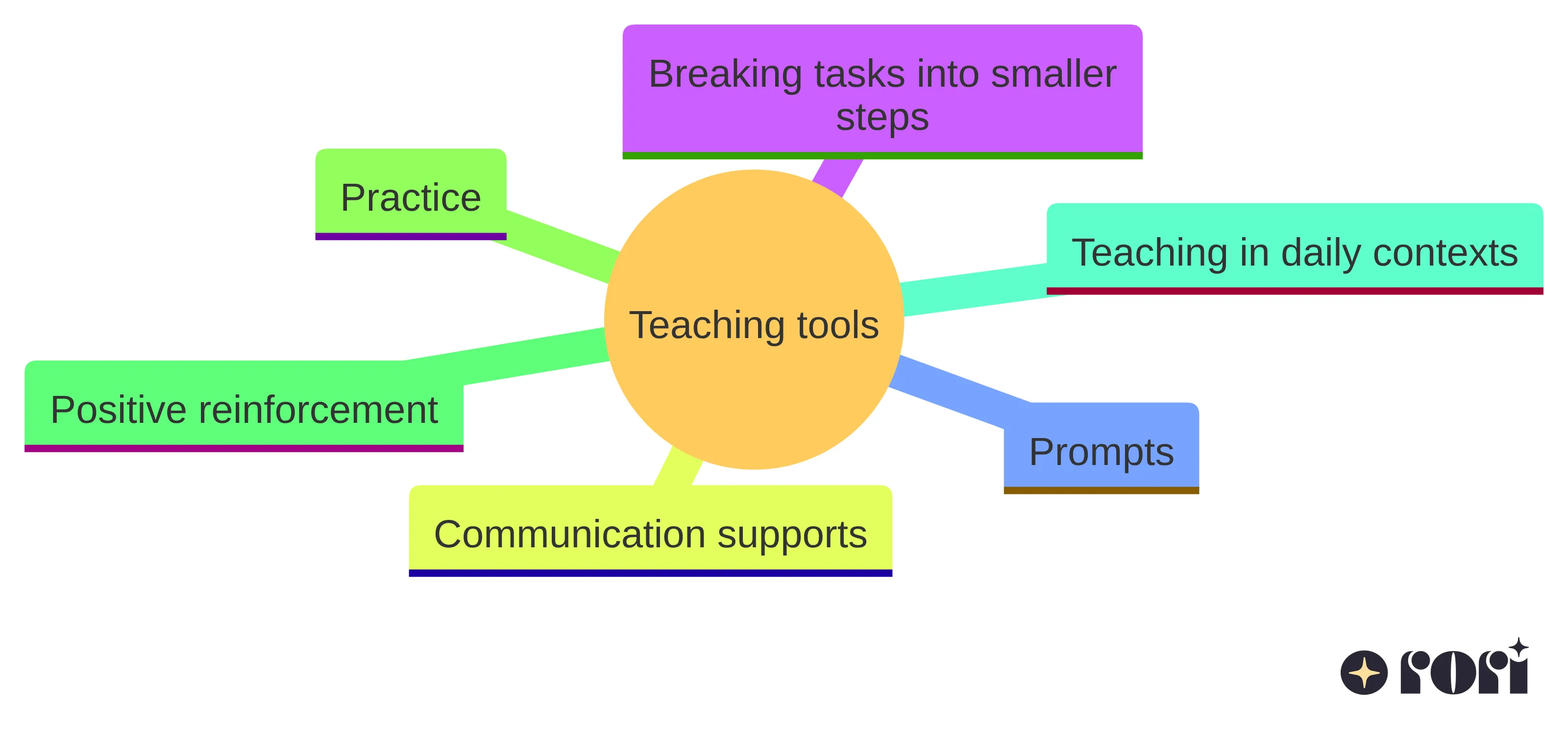
ABA-informed teaching may use several practical tools during structured activities, play, and daily routines. The provider should explain what each tool is meant to teach and how your child’s responses will guide its use.
Common tools include:
- Breaking tasks into smaller steps: A complex activity can be described as a sequence of simpler steps so the team can teach one part at a time.
- Prompts: Verbal, visual, or physical prompts may help your child begin or complete a step when needed.
- Communication supports: Picture prompts or other communication supports may show what comes next or provide another way to express a need.
- Practice: Repeating an activity can give your child opportunities to use a developing skill.
- Positive reinforcement: A provider may reinforce a behavior that supports the identified goal.
- Teaching in daily contexts: Structured teaching may be combined with play and everyday routines rather than separated from ordinary activities.
Family participation can make the teaching plan easier to understand and discuss. You can ask the provider to demonstrate the prompt, communication support, or practice routine and explain when it should be used. You can also ask what your child’s response means for the next teaching step.
A useful conversation includes the reason for each tool. If a provider suggests breaking a task into smaller steps, ask which step is the current focus. If a provider uses reinforcement, ask which behavior is being reinforced and how that choice relates to your child’s goal. If a provider teaches during play or a daily routine, ask how the activity connects with your child’s priorities outside the session.
How Progress Can Be Observed and Measured
Progress in ABA may be tracked and measured through observations of the target skill or behavior. Measurement gives the provider and family a shared way to discuss whether a goal is occurring, under which circumstances, and what teaching changes may be worth considering.
The measurement should match the goal. A communication goal, a self-help goal, and a behavior that interferes with participation may require different observations. You do not need to interpret the data yourself, but you should receive an understandable explanation of what the team is tracking and what the information means for your child’s plan.
Ask the provider four practical questions about measurement:
- What specific skill or behavior are you tracking?
- Why was this goal selected?
- How will you explain progress to our family?
- When will you review the goal or adjust the plan?
Ongoing data review and meaningful goals are among the topics to discuss with a provider. A provider who cannot explain how progress is measured, rarely reviews goals, or avoids reasonable questions gives you a reason to ask for more detail before moving forward.
Why ABA Goals Should Be Individualized
ABA goals should be individualized through assessment and your family’s priorities rather than selected from a one-size-fits-all curriculum. An evaluation helps the provider understand the skills your child has, the situations that are difficult, the supports that may help, and the outcomes your family wants to discuss.
Individualization does not mean that every goal must be invented from scratch. It means the provider should explain why a goal fits your child and how the goal connects with daily life. A plan for communication may look different from a plan for self-help, even when both plans use prompts, practice, reinforcement, and measurement.
Your family can ask how the provider will include your priorities in treatment planning. You can also ask how caregiver involvement works, who provides clinical oversight, how staff are supervised, and how goals are reviewed over time.
Those signs do not tell you everything about a program, but they give you clear follow-up questions to ask before accepting its plan.
Considering Quality of Life and Ethical Concerns
Ethical questions about ABA often concern which goals are chosen and whose priorities shape the intervention. One autistic-advocacy source criticizes some ABA practices for prioritizing normalization or hiding autistic traits; that critique is not a description of every ABA program. It does, however, give families a reason to ask whether goals focus on useful communication, coping, participation, independence, and self-advocacy rather than appearance alone.
A provider should be able to explain the purpose of each goal in ordinary language. Ask whether the goal helps your child communicate, access an activity, develop a daily skill, participate with other people, or express a preference. Ask what happens if your child shows distress, and ask how the team considers your child’s responses when reviewing the plan.
The same autistic-advocacy source reports an association between hiding autistic traits and worse mental-health outcomes and increased suicidality in autistic adults. That report does not establish the association for children or prove causation, so you should not apply that finding directly to your child.
The practical boundary is clear: appearance should not be the only measure of progress. A thoughtful conversation can distinguish between teaching a skill that supports communication or independence and pressuring a child to conceal autistic traits without a clear functional purpose.
Provider explanations deserve closer examination when a program makes broad promises about changing autism itself, focuses heavily on compliance without explaining its purpose, offers little caregiver involvement, or cannot explain how skills will generalize beyond the clinic. You can ask what the goal is, how it will be measured, and how your child’s preferences or responses will affect the plan.
Ethical care also requires room for questions. You should be able to raise concerns about goals, methods, supervision, measurement, and your child’s experience without being dismissed.
Questions to Ask Before Exploring ABA Services
Questions for an ABA provider can help you understand whether the proposed service matches your child’s needs and your family’s priorities. Bring the following list to an introductory conversation:
- How will you individualize my child’s plan? Ask how assessment findings and family priorities will shape the goals instead of a standard curriculum.
- What goals would you suggest, and why? Ask what each goal supports in daily life and how your child’s preferences or responses will be considered.
- What does a typical session look like? Ask how structured teaching, play, and daily routines may be used.
- How do you use positive reinforcement? Ask which skills or behaviors are being reinforced and how the approach relates to the stated goal.
- How do you understand challenging behavior? Ask what information is gathered about the circumstances around the behavior and whether an assessment, such as a functional behavior assessment, informs the plan.
- How do you measure progress? Ask what is tracked, how the results are explained, and when goals are reviewed or adjusted.
- How will skills generalize beyond the clinic? Ask how the team will connect teaching with home, school, community, play, or other settings that matter to your child.
- Who provides clinical oversight, and how are staff supervised? Ask how the care team communicates with you and how caregivers can participate.
- How do you approach self-advocacy and autistic identity? Ask whether the goals support communication, coping, independence, participation, or self-advocacy rather than aiming only for a less visibly autistic presentation.
The answers matter more than polished descriptions. A provider should be able to explain meaningful goals, clinical oversight, staff supervision, caregiver involvement, data review, and the connection between clinic teaching and everyday settings.
Consider asking follow-up questions if a provider cannot explain why a goal was selected, how progress will be measured, how goals are adjusted, or how your family can raise concerns. You can pause the conversation until the plan is clear enough for you to understand what your child would be working on and why.
Use These Questions to Choose Your Next Conversation
ABA means Applied Behavior Analysis, a therapy based on learning and behavior that may support communication, social, self-help, and other functional skills. The approach becomes meaningful when its goals are connected to your child’s priorities, its teaching methods are explained, and its progress measures are reviewed with your family.
Use the questions in this guide to prepare for a conversation with a qualified provider. Your next step can be a focused discussion about goals, methods, oversight, measurement, caregiver involvement, and how the plan respects your child’s quality of life.
What Should Families Clarify With a Provider First?
How does ABA support children with autism?
ABA may support various areas of development in autism care, including communication, social skills, self-help, and cognitive skills. The specific goals depend on the child’s needs and the family’s priorities.
What are some common tools used in ABA therapy?
Common tools in ABA therapy include breaking tasks into smaller steps, using prompts, providing communication supports, practicing skills, and applying positive reinforcement during structured activities and daily routines.
How can families ensure that ABA goals are individualized?
Families should ask how the provider will tailor goals based on assessment findings and family priorities, rather than using a one-size-fits-all approach.
What questions should I ask an ABA provider before starting services?
Consider asking about how they individualize plans, what goals they suggest and why, how they measure progress, and how they involve caregivers in the process.
What ethical concerns are associated with ABA practices?
Some ethical concerns involve whether goals prioritize normalization or hiding autistic traits rather than focusing on useful communication and self-advocacy. Families should inquire about the purpose of each goal.
How is progress measured in ABA therapy?
Progress in ABA is tracked through observations of target skills or behaviors. Families should receive clear explanations of what is being measured and how it relates to the child’s goals.