

Begin with the next therapy decision
Autistic therapy decisions can become clearer when you begin with your child’s needs instead of choosing a service label first. Autistic people’s abilities and needs can vary and change over time, and support needs differ from person to person. That variation means a service that fits one child’s goals may not answer another child’s priorities.
Evidence-based psychosocial interventions can improve communication and social skills and may support the well-being and quality of life of autistic people and their caregivers. The practical question is not whether one therapy name sounds right in general. The practical question is which professional conversation can clarify your child’s goals, the service’s role, how you would participate, and what access would require.
Your first conversation can connect concern, evaluation, and access without committing you to a treatment plan. Parents can ask their pediatric provider about screening, timely diagnosis, and prompt access to evidence-based interventions when concerns arise.
Use that conversation to separate three decisions:
- What does your child need help with at home, school, or in other daily settings?
- Which professional can evaluate those needs and explain possible services?
- What information does your insurer require before an assessment or treatment conversation can move forward?
A screening result, an insurance discussion, and a therapy recommendation answer different questions. Keep them separate so a coverage question does not become a clinical conclusion, or so a therapy description does not become a diagnosis.
A possible next step is a prepared conversation about fit. Before contacting a provider, write down the situations that concern you, the skills your child is trying to develop, and the settings in which support may matter. You do not need to translate those observations into a diagnosis or choose a modality on your own.
Bring four questions to the next professional conversation:
- Which goals should be clarified first?
- Which service or combination of services may address those goals?
- How would the plan involve you and information from home or school?
- What clinical and insurance steps would come before treatment begins?
Start with the goal and setting, not the therapy label
Autism therapy conversations can cover different priorities rather than one universal need. Communication, social participation, academic needs, behavior, daily living, and caregiver support may all be relevant, depending on the child’s circumstances.
Evidence-based psychosocial interventions can improve communication and social skills and may support the well-being and quality of life of autistic people and their caregivers. Pediatric guidance describes services addressing social, academic, and behavioral needs across home and school settings. Start the comparison by recording the priority you want to discuss and the setting where it matters.
That starting point keeps the question open: which service role addresses that priority, who would participate, and what access questions still require a separate answer?
ABA is one possible approach within that wider picture, not a universal answer. ABA programs can differ in how providers, children, peers, and parents participate in treatment, so compare the proposed role and participants rather than relying on the label alone.
Occupational therapy and ABA may address different goals: occupational therapy often targets daily living skills, while ABA for children often focuses on behavior. Record those descriptions beside your child’s priority and setting, then ask a qualified professional how the proposed goals would be defined.
Your child’s therapy plan should have a clear role for each service under discussion. Ask whether the proposed service is meant to address behavior, daily living, communication, social participation, school-related needs, or another defined priority. Then ask how progress in that area would relate to everyday routines.
A service may be worth discussing when its stated focus matches a need you have identified. A service still requires individual clinical judgment before it becomes part of your child’s plan. Keep the comparison centered on goals, setting, family participation, and review rather than on the therapy label alone.
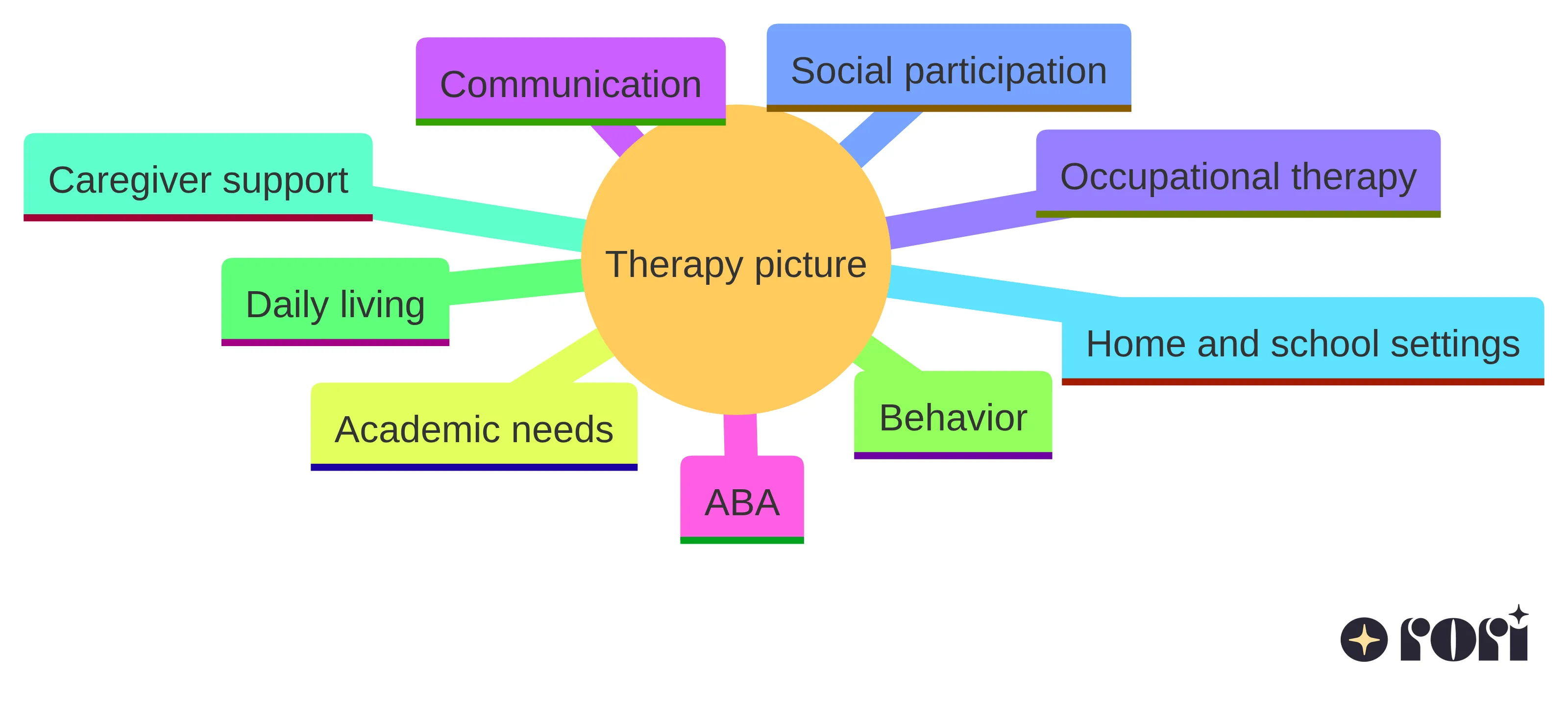
Compare service roles and access paths
Use this comparison as a starting point for discussing service roles, not as a ranking:
| Comparison point | Occupational therapy | ABA for children |
|---|---|---|
| Common emphasis described in the available guidance | Often targets daily living skills | Often focuses on behavior |
| Goal and setting question | Which daily activity or routine is the service intended to address? | Which behavior-related goal is the service intended to address? |
| Participation question | Who would participate in planning or delivery? | How would providers, the child, peers, and parents participate? |
| Access question | Which evaluation, authorization, or insurer questions remain? | Which evaluation, authorization, or insurer questions remain? |
Do not turn the table into a treatment recommendation. Its purpose is to show which explanation is still missing: goal, setting, participation, or access.
Use the comparison record for each service you discuss. Keep three parts together:
- The child’s priority and the setting in which it matters.
- The service’s stated role, including who would plan, deliver, or participate in the work.
- The access status: what has been answered, what requires a pediatric provider, and what requires insurer verification.
This format keeps a clinical description from standing in for a coverage answer. It also lets you compare occupational therapy, ABA, or another discussed support by the explanation offered for your child’s needs rather than by the therapy label alone.
Keep separate notes for the goal, the service, and the unanswered question. A goal might be participation in a daily routine; the service discussion might describe occupational therapy or ABA; the unanswered question might be how that work would transfer to home or school.
This separation prevents a familiar therapy label from doing too much work in your decision. It also gives you a precise question to take to a qualified professional when the initial explanation is too general.
When two options seem relevant, use the record to test whether they address the same problem or different parts of it. Start with the child’s priority in plain language, then specify the task or situation: for example, a daily-living routine, a behavior-related concern, communication, social participation, an academic need, or caregiver support. The available guidance describes occupational therapy as often targeting daily living and ABA for children as often focusing on behavior; those descriptions are starting points for questions, not conclusions about what your child needs.
Next, write the setting beside the priority. A concern at home may call for different information than one observed at school, even when the broad label is similar. Ask which setting the proposed service is intended to address, whose observations will inform the discussion, and whether the goal can be explained in terms of an everyday routine. This does not decide clinical fit; it identifies the information a qualified professional must consider.
Finally, mark the route for the unanswered question. Ask a pediatric provider about screening, timely diagnosis, or prompt access when those remain open. Ask the service professional to explain the proposed role, participants, and goals. Ask the insurer about plan requirements, authorization, limitations, exclusions, and possible costs. Keeping those routes separate prevents a referral conversation from being treated as a treatment recommendation or an insurer response from being treated as clinical guidance.
A comparison record is most useful when it ends with a next question rather than a ranking. For each option, record the priority and setting, the role the service is being asked to play, what information is still missing, and who can answer it. If two options address different priorities, compare how the overall care conversation would keep those priorities visible. If they address the same priority, ask each professional to explain the distinct contribution rather than assuming that the labels can be combined or substituted. This gives you a cross-modality discussion to take to professionals without turning a worksheet into an individualized treatment plan.
Route each question to the right decision-maker
The next question depends on what the comparison record does not yet answer. Use the care conversation for the proposed goal, setting, participants, and information needed to discuss the service. Use your pediatric provider for clinical questions that remain open, and use your insurer for plan requirements, authorization, and cost questions.
When ABA is being considered, ask how providers, children, peers, and parents would participate. When another service is being considered, ask the same basic questions about its role and delivery without assuming that the answers will be identical.
Ask parallel questions for each service under discussion:
- What information is needed before the service’s role can be discussed?
- Which child priority and setting would the proposed work address?
- Who would participate in planning, supervision, and delivery?
- How would family observations and priorities enter the conversation?
- What questions belong with my pediatric provider or insurer?
The answers give each service a defined place in the comparison record. They do not require a parent to choose a modality before a qualified professional reviews the child’s situation.
Your child’s goals, needs, and response to treatment should shape any proposed ABA dosage. Ask how the proposed ABA dosage reflects your child’s goals, needs, and response to treatment.
A proposed schedule should therefore be explained as part of the plan rather than treated as a standard answer. Ask what the schedule is intended to support, how your child’s response would inform future decisions, and who would discuss changes with you. Keep the question focused on the reasoning behind the plan, not on obtaining a predetermined number of hours.
A useful explanation should connect the proposed goals to the settings where they matter and identify who would participate in the work. If the explanation stays at the level of a general service description, ask for a concrete example of how the plan would address one of your child’s priorities.
You can leave the conversation with an open question. It is reasonable to ask what information is still needed before a professional can discuss fit, goals, or delivery in more detail.
Before treating a service explanation as complete, use a four-part check:
- Target: Is the child’s priority stated clearly enough to discuss, rather than described only by a therapy label?
- Setting: Does the explanation identify whether the concern relates to home, school, or another daily setting?
- Participants: Does it explain who would contribute observations, planning, supervision, or delivery?
- Route: Does it identify whether the remaining question belongs with a qualified clinical professional, a pediatric provider, or the insurer?
Use the same check for occupational therapy, ABA, or another service under discussion. This makes descriptions comparable without treating any modality as universally appropriate. It also helps distinguish missing information from a negative conclusion. If the target is broad, ask for a more specific goal. If the setting is absent, ask where the proposed work is intended to matter. If participants are unclear, ask who would be responsible for explaining the plan and receiving family observations. If access details are missing, ask the insurer about plan requirements rather than inferring coverage from the service description.
The check changes the decision from “Which therapy is best?” to “Which questions have been answered, and which decision-maker can answer the rest?” Mark each part as answered or unclear after a conversation. An unclear item is a reason for a follow-up question, not a reason to make a diagnosis, select a treatment plan independently, or assume an insurance result. When the clinical explanation is sufficiently specific but coverage remains unresolved, move that question to the insurer. When coverage information is available but the service role is unclear, return to the qualified professional for clarification.
Compare participation across settings
Participation is a comparison point, not an assumption about what every service requires. Ask what you would be expected to observe, practice, or discuss, and how that role would relate to the child’s goals and settings.
When ABA is under consideration, ask whether parent or caregiver training follows a systematic, individualized curriculum. For any service, record whether the answer explains the family role clearly enough to compare it with the role described for another option.
Home and school information can make the planning conversation more specific. Ask which of your child’s social, academic, or behavioral needs the service is intended to address in each setting.
Ask which settings the plan is designed to address and how information from those settings would be considered. You can also ask whether the goals are written in language that makes sense in daily routines. The answer should help you understand how the proposed service relates to your child’s actual life rather than to an abstract description of therapy.
Treat intensity as a service-specific question
Intensity should be recorded as a service-specific detail, not used as a universal measure across modalities. For ABA, treatment intensity includes direct treatment hours per week and total duration. Ask how the proposed dosage reflects your child’s goals, needs, and response to treatment.
When comparing ABA with occupational therapy or another service, record the purpose and schedule described for that service separately. The useful comparison is the explanation connecting time to the child’s needs, not one combined hour total.
A fixed number of hours should not be treated as the answer for every child. ABA treatment dosage varies with each client and should reflect treatment goals, specific client needs, and response to treatment.
Ask what the proposed dosage is intended to accomplish, how the plan would account for your child’s response, and who would revisit the schedule. If you are comparing providers, record the explanation behind each proposed schedule rather than comparing hour totals alone.
Use progress information to revisit the comparison
Progress review is the point at which a comparison record can be updated. For each service, ask what information would be discussed, who would explain it, how family observations would enter the conversation, and what questions remain about goals or schedule.
For ABA, individualized treatment generally requires comparatively high levels of case supervision. Note who supervises the case and how concerns reach that person, without treating supervision or progress review as a promise about an outcome.
ABA supervision deserves direct attention because individualized treatment generally requires comparatively high levels of case supervision. Ask who supervises the case, how supervision relates to the goals, and how the supervising professional communicates with you and the people delivering treatment.
Ask how concerns are brought forward and how the team decides whether a strategy still fits. A clear supervision conversation should identify responsibility for reviewing the plan rather than leaving you unsure who to contact.
We use data-driven decision-making in ABA therapy. That approach gives you a useful question to ask: what information would the care team use when discussing progress, goals, or changes to the plan?
Ask how information would be explained to you in ordinary language and how your observations would fit into the review. Data should support a conversation about your child’s goals and response; it should not replace your opportunity to describe what you see at home or in other settings.
Separate a provider’s offering from an insurance decision
Our offering can be discussed alongside your policy terms; it does not determine how your policy applies.
Your insurance decision depends on the terms and requirements that apply to your specific policy. We recommend closely examining your specific policy to understand coverage for autism assessments, including limitations or exclusions.
Ask your insurer which requirements apply to assessment and treatment, whether authorization is needed, what costs may remain your responsibility, and which documentation or provider conditions matter. Treat each answer as a plan-specific question rather than assuming that a general description of insurance-covered care determines your coverage.
Coverage questions become easier to organize when you separate them into three parts:
- Assessment: What does your plan require before an autism assessment or related service?
- Treatment: What requirements apply to ABA therapy, including authorization or other plan rules?
- Cost: What deductibles, copayments, coinsurance, exclusions, or other responsibilities may apply under your policy?
Use your insurer for the coverage determination and ask the provider what information is needed to discuss a possible care pathway. Do not schedule around an assumed benefit amount or assumed eligibility.
Write down the name of the insurer or plan representative, the questions you asked, and any reference or authorization details the representative provides. Then keep provider questions separate from insurer answers. A provider can discuss a possible care pathway, but your insurer determines how the terms of your policy apply.
This record gives you a clear list of unresolved items before you make scheduling or financial decisions. It also helps you avoid treating a general statement about covered care as an individualized coverage determination.
Verify access after comparing service roles
Verify coverage after identifying the service role you want to discuss. Coverage depends on the insurer, plan, applicable requirements, and individual verification; it should not be used as a substitute for comparing clinical goals and settings.
Ask the insurer:
- What does my plan require for an autism assessment?
- Are there limitations or exclusions I should understand?
- What requirements apply to ABA treatment or another proposed service?
- Is authorization required before treatment begins?
- What costs could remain my responsibility?
A provider conversation can help identify questions, but the insurer must clarify the plan’s terms, eligibility, and payment.
Bring the comparison record to the next conversation. Note the child’s priority, the setting involved, the service role being discussed, the family questions that remain, and the coverage questions that require insurer verification.
For practical access, ask what information is needed before an initial consultation or evaluation discussion, who should provide records, how scheduling is discussed, and which authorization steps could affect the process. Take service and clinical questions to the appropriate professional, and use the insurer’s response to mark what is verified and what still needs clarification.
Use a consultation to choose the next step
Your next therapy decision can be a focused conversation rather than a commitment to one label. Bring your child’s priorities, the settings where support may matter, and questions about personalization, family participation, intensity, progress review, supervision, and insurance.
A useful conversation should help you understand what a proposed service is meant to address, how the plan would fit your child, and what remains undecided. Qualified professionals should determine individual clinical suitability, while your insurer should answer plan-specific coverage questions.
If you are in San Jose and are exploring whether ABA may fit your child’s needs, contact Rori Care to discuss possible care options.
Questions to clarify before exploring ABA care
What should I consider when comparing autism therapy options for my child?
Focus on your child’s specific needs and goals, the type of support required, and how different therapies address those needs. Consider factors like the professional’s qualifications, the therapy’s focus, and how progress will be measured.
How can I prepare for a consultation about my child's therapy needs?
Before the consultation, write down your child’s priorities, the settings where support is needed, and specific questions about personalization, family involvement, and insurance coverage.
What role does ABA therapy play in autism care?
ABA therapy is one approach that focuses on behavior modification and can be part of a broader treatment plan that includes other therapies addressing communication, social skills, and daily living.
How does insurance coverage work for autism therapy?
Insurance coverage for autism therapy varies by policy. It’s important to closely examine your specific policy to understand coverage for assessments and treatments, including any limitations or exclusions.
What questions should I ask about the intensity of ABA therapy?
Inquire about the proposed number of direct treatment hours per week, the total duration of treatment, and how these relate to your child’s specific goals and needs.
How can I ensure that the therapy plan is tailored to my child's unique needs?
Ask how the proposed therapy will address your child’s specific goals, the role of different professionals in the plan, and how progress will be monitored and adjusted based on your child’s response.