

Introduction
Improving social skills in children with Autism Spectrum Disorder (ASD) can feel like a rollercoaster ride – challenging at times, but oh-so-rewarding! 🎢 One fantastic tool that can really make a difference is role-playing. It’s not just about acting; it’s about creating tailored strategies that engage our little ones in meaningful ways. By simulating real-life interactions, kids can boost their communication skills and gain confidence in navigating social situations.
But here’s a question for you: how can caregivers and therapists effectively implement these strategies to make the biggest impact? 🤔 Let’s dive into the nuances of role-playing together! By exploring essential techniques, we can uncover ways to foster growth and connection, paving the way for lasting social success. So, let’s explore this journey together!
Rori Care – ABA Therapy: Personalized Role-Playing Strategies for Social Skills Development
At Rori Behavioral Innovations, we believe in the as a core part of our ABA therapy. By taking the time to understand each young person’s unique needs, our clinicians create engaging scenarios that focus on . Think about it: starting conversations, picking up on social cues, and practicing turn-taking are all vital skills that can make a world of difference!
This tailored approach not only grabs the attention of young people but also helps them grasp the nuances of social interactions. Learning becomes both effective and enjoyable! In fact, studies show that participating in simulations can by up to 40%. That’s a !
And it doesn’t stop there. Regular involvement in these interactive activities leads to . Research indicates that as many as 70% of youngsters benefit from consistent practice. Rori Behavioral Innovations is committed to fostering meaningful relationships and equipping young individuals with the skills they need to thrive by incorporating into therapy.
Let’s explore this journey together! We’re here to !

Creating a Safe and Positive Environment for Role-Playing Activities
Creating a secure and encouraging atmosphere is so important for helping kids with autism get the most out of interactive activities. By setting clear expectations and using , we can really boost their engagement and motivation. Did you know that studies show can significantly enhance ? In fact, about 88% of youngsters in show improvements in their communication and interaction skills!
Making sure the play area is free from distractions helps kids focus on the activity at hand. Plus, open dialogue and encouragement make them feel safe and supported. This kind of not only builds trust but also inspires young ones to take , which is crucial for .
By blending to improve in children with ASD, parents and therapists can create a that promotes social development. Let’s explore this together and see how we can make a difference!

Selecting Scenarios to Target Specific Social Skills
Choosing the right situations for acting out is essential when applying to improve in children with ASD. Think about focused scenarios like:
- Greeting friends
- Sharing toys
- Resolving conflicts
These really help therapists address each child’s unique challenges. It’s not just about having fun; each simulation session is purposeful and aligns with the child’s .
Research shows that to improve in children with ASD can significantly boost , reciprocity, and joint attention, with effect sizes ranging from 0.28 to 0.60. By honing in on , parents and therapists can create that foster growth and . Plus, when caregivers get involved in these sessions, it can make the strategies even more effective. For instance, parents can practice these scenarios at home, reinforcing the skills learned during therapy.
This is essential for implementing to improve in children with ASD, maximizing the benefits of interactive scenarios in development. Let’s explore this together! We’re here to !

Incorporating Role Reversal and Modeling in Role-Playing
Incorporating role reversal and modeling into can really boost their effectiveness! , which helps them build empathy and understand different perspectives. This approach not only strengthens emotional connections but also nurtures .
On the other hand, for kids to imitate. By practicing both roles in a scenario, they can grasp the nuances of interactions better. This leads to and a greater awareness of others.
Research shows that effective strategies for using role-playing to improve in children with ASD, particularly when combined with demonstration, can lead to significant improvements in . Therapists have noticed that not only enhance the learning experience but also help young ones with more confidence and ease.
Let’s explore this together! If you’re looking for ways to support your child’s , these methods might just be what you need!

Using Feedback and Reinforcement to Enhance Role-Playing Outcomes
To truly maximize the impact of , providing is essential! After each session, therapists can shine a light on what went well and gently point out areas for improvement. Think about adding some – like a little verbal praise or even some . This can really encourage kids to jump in and .
This mix of feedback and reinforcement not only but also in real-life situations. Research shows that can enhance engagement, leading to better social interactions and communication skills. And let’s be honest, are extremely important for individuals on the autism spectrum. So, let’s explore this together and see how we can support our little ones in their journey!

Facilitating Reflection and Debriefing After Role-Playing
Reflecting and debriefing after is crucial for reinforcing to improve , ADHD, and Social Communication Disorders. During these sessions, young participants get to share their feelings about the role-play, talk about what they learned, and think about how they might handle similar situations in the future. This kind of reflection not only but also helps them internalize effective strategies for using that they practiced during the activity.
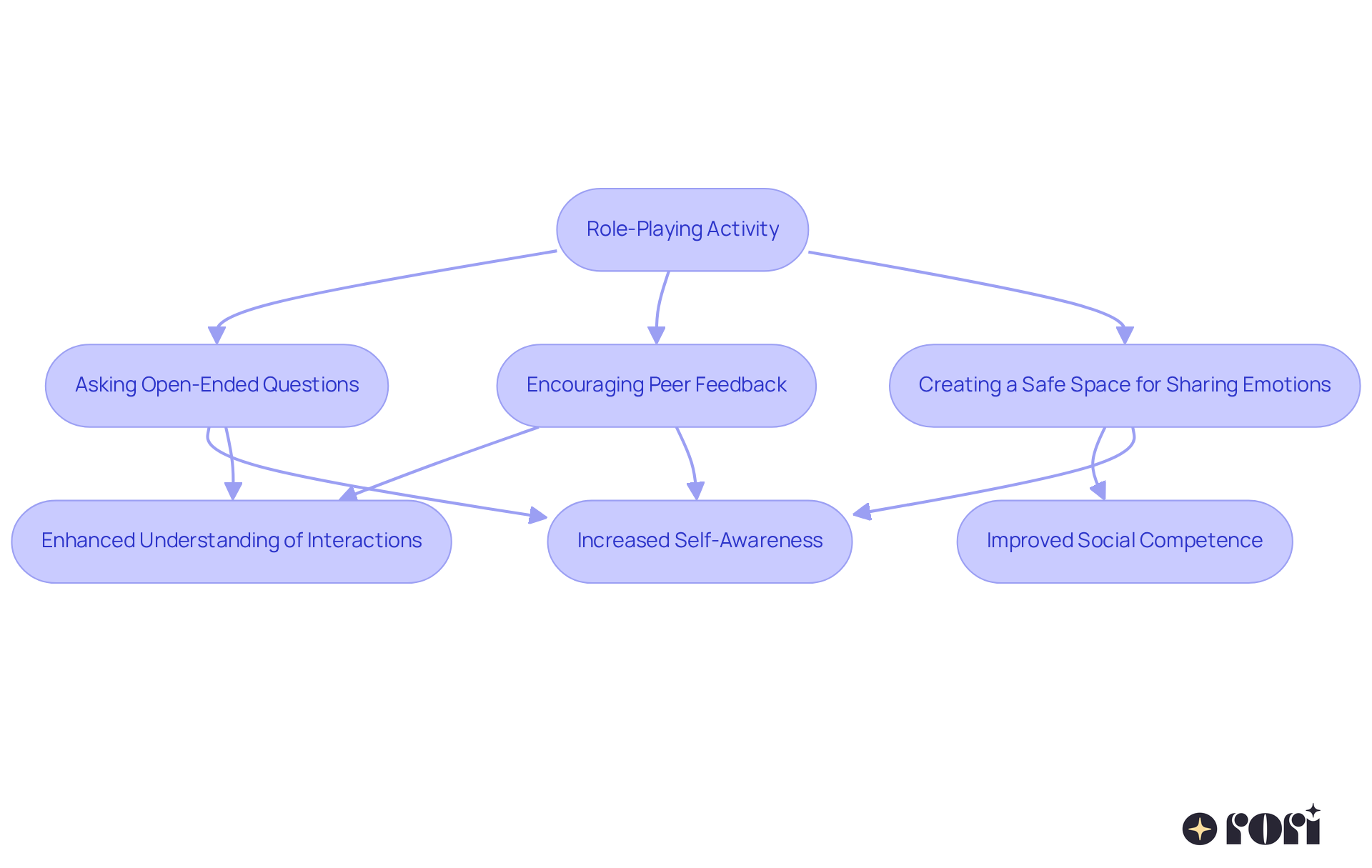
Therapists trained in group therapy focused on interpersonal skills utilize in children with ASD, playing a key role in guiding these youngsters through the reflective process. They help enhance understanding of interactions and empower kids to use these skills in real-life situations. Some to improve include:
- Asking open-ended questions
- Encouraging peer feedback
- Creating a safe space for sharing emotions
All of these contribute to a richer learning experience.
Research shows that can significantly improve , with effect sizes ranging from 0.29 to 0.37. This leads to and emotional regulation. As Ashley Johnson points out, “Examples of the types of guiding reflection questions include: Eyes – Represents something new that you saw in yourself or someone else.” This method not only encourages emotional expression but also strengthens the skills gained during character simulation.
Let’s explore this together! By , we can help our kids thrive in their social interactions.
Integrating Technology to Enhance Role-Playing Practices
Incorporating technology into to improve in children with ASD can really boost engagement and learning. Think about it: create experiences that feel just like real-life interactions. Studies show that VR can significantly improve interpersonal skills, especially for kids with high-functioning autism (HFA). It allows them to practice in a safe space.
These tech tools also provide that help kids understand and participate better, catering to different learning styles. By using these innovative resources, therapists can implement effective strategies for using , creating fun and dynamic environments that enhance learning.
, led by trained therapists, can really help and interactions among peers. This approach fosters better connections and . It’s especially beneficial for kids with Autism Spectrum Disorders, ADHD, Communication Disorders, and Anxiety Disorders, paving the way for greater independence in social situations.
And let’s not forget about ! It plays a crucial role in supporting these efforts, giving parents the tools and knowledge they need to help their children develop at home. Let’s explore this together and see how we can make a difference!

Empowering Families Through Parent-Led Role-Playing
Helping families through is so important for encouraging growth in kids with autism spectrum disorder (ASD). When parents learn to support to in children with ASD at home, they can significantly enhance the skills their children acquire during therapy sessions. Engaging in these activities together creates a warm environment where kids can practice their social skills in real-life situations. This teamwork not only strengthens the bond between parent and child but also significantly boosts the child’s confidence and interaction skills.
Research shows that kids whose parents actively participate in their make remarkable progress in communication and social skills. This highlights just how impactful can be! By using structured interactive exercises, parents can employ to in children with ASD, model appropriate behaviors, provide positive reinforcement, and create chances for their kids to practice taking turns and having conversations.
This . Studies indicate that lead to and overall development. So, let’s explore this together! can make a world of difference!

Collaborative Role-Playing in Social Skills Groups
At Rori Care, in skill development groups offer a fantastic chance for youngsters to sharpen their skills in a fun and lively environment. With the guidance of skilled therapists, these sessions focus on within a group, helping kids .
Imagine your child participating in small teams, engaging in simulations that mimic real-life situations like group discussions or cooperative games. This hands-on approach not only boosts their interpersonal skills but also fosters among peers. It’s all about creating a from one another, forge lasting friendships, and grow their .
This program incorporates effective strategies for using to , ADHD, Social Communication Disorders, and Anxiety Disorders. As a parent, you can play a vital role in your child’s development by encouraging them to join these group activities and reinforcing the skills they learn at home. Let’s explore this together! Your support can !

Utilizing Visual Supports to Enhance Role-Playing Understanding
Incorporating visual aids during can really boost young learners’ understanding and engagement! 🌟 Picture cards, stories, and role-play scripts offer clear snapshots of interactions, helping kids grasp the nuances of . These visual tools not only keep things organized but also create a welcoming learning environment, allowing children to focus on building their without feeling overwhelmed.
Research shows that , making them a must-have for connecting understanding with real-life application. At Rori Care, therapists have noticed that . They help children navigate complex interactions with greater confidence and clarity.
Plus, focused on , led by skilled therapists, really boosts how individuals communicate and interact in a group setting. This approach fosters and competence. It’s especially beneficial for kids with Autism Spectrum Disorders, ADHD, Social Communication Disorders, and Anxiety Disorders, as it incorporates and boost their confidence. Let’s explore this together and see how we can support our little ones on their journey!

Conclusion
The power of role-playing in helping children with Autism Spectrum Disorder (ASD) develop social skills is truly remarkable! By using tailored and interactive strategies, therapists can create fun scenarios that not only grab kids’ attention but also help them build essential interpersonal skills. This personalized approach has shown great success, with studies revealing significant improvements in communication and interaction abilities among children.
Throughout this article, we’ve highlighted some key strategies:
- Creating a safe and positive environment is crucial.
- Selecting targeted scenarios.
- Using techniques like role reversal and modeling.
- Integrating feedback, reflection, and technology to enhance the learning experience.
These strategies allow kids to practice and internalize these skills in real-life situations. And let’s not forget the vital role parents and caregivers play in reinforcing these strategies and nurturing meaningful connections.
In conclusion, improving social skills in children with ASD through role-playing is a team effort! It takes commitment from therapists, families, and the children themselves. By embracing these effective strategies and fostering a supportive environment, we can make significant progress together. Let’s recognize the potential of role-playing not just as a therapeutic tool, but as a way to empower children and families, paving the way for better social interactions and a brighter future. Engaging in these practices can truly make a world of difference, and the time to start is now! Let’s explore this journey together!
Frequently Asked Questions
What is Rori Care’s approach to ABA therapy for social skills development?
Rori Care utilizes personalized interactive strategies in ABA therapy, focusing on understanding each young person’s unique needs and creating engaging scenarios to develop essential interpersonal skills such as starting conversations, picking up on social cues, and practicing turn-taking.
How effective are role-playing simulations in improving social skills for children with autism?
Studies indicate that participating in role-playing simulations can boost interaction skills in children with autism by up to 40%, leading to significant improvements in their overall development.
What are the benefits of regular involvement in interactive activities for children with autism?
Regular participation in interactive activities can lead to remarkable improvements in behavior and communication skills, with research showing that as many as 70% of youngsters benefit from consistent practice.
How does Rori Behavioral Innovations create a safe environment for role-playing activities?
Rori Behavioral Innovations creates a secure and encouraging atmosphere by setting clear expectations, using positive reinforcement, minimizing distractions, and promoting open dialogue and encouragement to build trust and inspire young individuals to take social risks.
What specific social skills can be targeted through role-playing scenarios?
Specific social skills that can be targeted include greeting friends, sharing toys, and resolving conflicts. Each scenario is designed to address the unique challenges of the child and align with their therapeutic goals.
How can caregivers enhance the effectiveness of role-playing strategies in therapy?
Caregivers can enhance the effectiveness of role-playing strategies by practicing these scenarios at home, reinforcing the skills learned during therapy and collaborating with therapists to maximize the benefits of interactive scenarios.
List of Sources
- Rori Care – ABA Therapy: Personalized Role-Playing Strategies for Social Skills Development
- The effectiveness of applied behavior analysis program training on enhancing autistic children’s emotional-social skills – PMC (https://pmc.ncbi.nlm.nih.gov/articles/PMC11487924)
- The Numbers Don’t Lie: Revealing Autism Therapy Statistics | Above and Beyond Therapy (https://abtaba.com/blog/autism-therapy-statistics)
- How Scripting and Role-Playing Enhance ABA Therapy Outcomes – Up & Up ABA (https://upandupaba.com/faqs-resources/how-scripting-and-role-playing-enhance-aba-therapy-outcomes)
- How to Use Role-Playing in ABA Therapy for Skill Development | Discovery ABA (https://discoveryaba.com/aba-therapy/how-to-use-role-playing-in-aba-therapy-for-skill-development)
- Success Rates of ABA Therapy | Advanced Autism Services (https://advancedautism.com/post/success-rates-of-aba-therapy)
- Creating a Safe and Positive Environment for Role-Playing Activities
- Autism Therapy: Key Statistics (https://ambitionsaba.com/resources/autism-therapy-statistics)
- ABA Therapy Impact (https://goldenstepsaba.com/resources/aba-therapy-impact)
- Autism Therapy Statistics | Discovery ABA (https://discoveryaba.com/aba-therapy/autism-therapy-statistics)
- The Impact of ABA Therapy on the Social Development of Children with Autism (https://buildingblockstherapy.org/blog/the-impact-of-aba-therapy-on-the-social-development-of-children-with-autism)
- Impact of Applied Behavior Analysis on Autistic Children Target Behaviors: A Replication Using Repeated Measures – PMC (https://pmc.ncbi.nlm.nih.gov/articles/PMC10907966)
- Selecting Scenarios to Target Specific Social Skills
- Checking your browser – reCAPTCHA (https://pmc.ncbi.nlm.nih.gov/articles/PMC11918677)
- Social Skills Training for Autism Spectrum Disorder: a Meta-analysis of In-person and Technological Interventions – PMC (https://pmc.ncbi.nlm.nih.gov/articles/PMC7670840)
- Autism Statistics & Facts: How Many People Have Autism? (https://thetreetop.com/statistics/autism-prevalence)
- Data and Statistics on Autism Spectrum Disorder (https://cdc.gov/autism/data-research)
- 10 Role-Play Scenarios for Autism Social Skills – Guiding Growth (https://guidinggrowth.app/10-role-play-scenarios-for-autism-social-skills)
- Incorporating Role Reversal and Modeling in Role-Playing
- Evaluating the effectiveness of a reverse inclusion Social Skills intervention for children on the Autism Spectrum | Request PDF (https://researchgate.net/publication/360078415_Evaluating_the_effectiveness_of_a_reverse_inclusion_Social_Skills_intervention_for_children_on_the_Autism_Spectrum)
- The Impact of ABA Therapy on Social Skills Development (https://goldenstepsaba.com/resources/the-impact-of-aba-therapy-on-social-skills-development)
- The Benefits of Applied Behavior Analysis for Social Skills Training (https://supportivecareaba.com/statistics/the-benefits-of-applied-behavior-analysis-for-social-skills-training)
- Using Feedback and Reinforcement to Enhance Role-Playing Outcomes
- Success Rates of ABA Therapy | Advanced Autism Services (https://advancedautism.com/post/success-rates-of-aba-therapy)
- The Role of Positive Reinforcement in ABA Therapy for Children with Autism (https://yellowbusaba.com/post/the-role-of-positive-reinforcement-in-aba-therapy-for-children-with-autism)
- Positive Reinforcement and ABA Therapy (https://goldenstepsaba.com/resources/positive-reinforcement-in-aba-therapy)
- How to Use Role-Playing in ABA Therapy for Skill Development | Discovery ABA (https://discoveryaba.com/aba-therapy/how-to-use-role-playing-in-aba-therapy-for-skill-development?8936781b_page=13)
- Facilitating Reflection and Debriefing After Role-Playing
- Efficacy of social skills group intervention among children with mild autism spectrum disorder – PMC (https://pmc.ncbi.nlm.nih.gov/articles/PMC11222909)
- 35 Best Therapy Quotes to Inspire and Motivate Others (https://positivepsychology.com/best-therapy-quotes)
- Effects of Feedback and Reflection on Communication Skills Training for Occupational Therapy Students (https://research.aota.org/ajot/article/79/4/7904205060/27206/Effects-of-Feedback-and-Reflection-on)
- The Power of Reflection for Educator Professional Development (https://schoolsims.com/blog/the-power-of-reflection-for-educator-professional-development)
- Role of Reflection (https://brocku.ca/pedagogical-innovation/resources/experiential-education/role-of-reflection)
- Integrating Technology to Enhance Role-Playing Practices
- The Role of Technology-Based Therapies for Children with Autism | Advanced Autism Services (https://advancedautism.com/post/the-role-of-technology-based-therapies-for-children-with-autism)
- Effectiveness of Virtual Reality Social Skills Training for Students with Autism and Social Difficulties Observed Through Behavior and Brain Waves (https://mdpi.com/2076-3417/15/9/4600)
- Effectiveness of Virtual Reality Technology Interventions in Improving the Social Skills of Children and Adolescents With Autism: Systematic Review – PMC (https://pmc.ncbi.nlm.nih.gov/articles/PMC11840372)
- The Role of Virtual Reality in Autism Therapy: Recent Advancements (https://autismspectrumnews.org/the-role-of-virtual-reality-in-autism-therapy-recent-advancements)
- The Role of Technology in Autism Therapy (https://ambitionsaba.com/resources/using-technology-in-autism-therapy)
- Empowering Families Through Parent-Led Role-Playing
- The Role of Parents in ABA Therapy Success (https://yellowbusaba.com/post/the-role-of-parents-in-aba-therapy-success)
- The Role of Parent-Led Practice in Strengthening ABA Therapy Outcomes | Intellistars – ABA Therapy (https://intellistarsaba.com/blog/the-role-of-parent-led-practice-in-strengthening-aba-therapy-outcomes)
- The Role of Parent Involvement in Autism Therapy Success | Advanced Autism Services (https://advancedautism.com/post/the-role-of-parent-involvement-in-autism-therapy-success)
- The Power of Parent Involvement in ABA Therapy Outcomes: Maximizing Success Through Family Engagement – RightWay ABA (https://rightwayaba.com/parent-involvement-in-aba-therapy-outcomes)
- Parental Involvement: Academic Success Statistics (https://positiveaction.net/blog/impact-of-parental-involvement)
- Collaborative Role-Playing in Social Skills Groups
- 35 Quotes about Communication to Inspire Collaboration (https://vibe.us/blog/35-quotes-about-communication?srsltid=AfmBOoqcM_hCFSTX2Av7zopqGpRLCgBbyTPBFS_pXJv0APppyd-nSyU9)
- Benefits of Group Therapy for Children with Autism (https://goldenstepsaba.com/resources/benefits-of-group-therapy-for-children-with-autism)
- The Benefits of Group ABA Therapy for Social Skills Development (https://supportivecareaba.com/statistics/the-benefits-of-group-aba-therapy-for-social-skills-development)
- The Role of Role-Playing in Developing Social Skills in ABA Therapy for Autism (https://buildingblockstherapy.org/blog/the-role-of-role-playing-in-developing-social-skills-in-aba-therapy-for-autism)
- Utilizing Visual Supports to Enhance Role-Playing Understanding
- Visual Schedules for Children with Autism | Links (https://linksaba.com/visual-schedules-for-children-with-autism)
- The use of visual schedules to increase academic-related on-task behaviors of individuals with autism: a literature review (https://tandfonline.com/doi/full/10.1080/20473869.2024.2402124)
- Visual Supports to Increase Conversation Engagement for Preschoolers With Autism Spectrum Disorder During Mealtimes: An Initial Investigation – PMC (https://pmc.ncbi.nlm.nih.gov/articles/PMC11527399)
- The Role of Visual Supports in Enhancing Learning for Autism | Advanced Autism Services (https://advancedautism.com/post/the-role-of-visual-supports-in-enhancing-learning-for-autism)
- Using Visual Aids in Autism (https://supportivecareaba.com/statistics/using-visual-aids-in-autism)