

Start with a verification decision, not a provider promise
Choosing ABA therapy near San Jose when you use Medicaid or Medi-Cal requires more than finding a nearby organization that uses the word “covered.” Your decision should document separate answers about plan fit, provider status, assessment, authorization, availability, and what you may have to pay.
We provide personalized, insurance-covered ABA therapy for children with autism at our Oakland and San Jose centers. That business fact describes insurance-covered care; it does not guarantee that your specific Medi-Cal plan accepts our services, authorizes treatment, or leaves you with no out-of-pocket responsibility.
This guide gives you a written verification path instead of a single yes-or-no answer. First identify the coverage pathway, then check the organization and billing details, then confirm the intake steps with both the provider and your plan.
Separate Medicaid entitlement from practical access
Federal Medicaid EPSDT requirements entitle eligible children to medically necessary section 1905(a) services for autism-related care. That entitlement is a starting point for understanding potential access, not a determination that a particular ABA service, provider, schedule, or treatment plan will be approved for your child.
Medicaid implementation for autism services can vary by state because states shape how services are structured, funded, and regulated. Medicaid waivers also vary by state and may cover services such as ABA for people on the autism spectrum, so the coverage route in California must be checked rather than inferred from another state or another family’s experience.
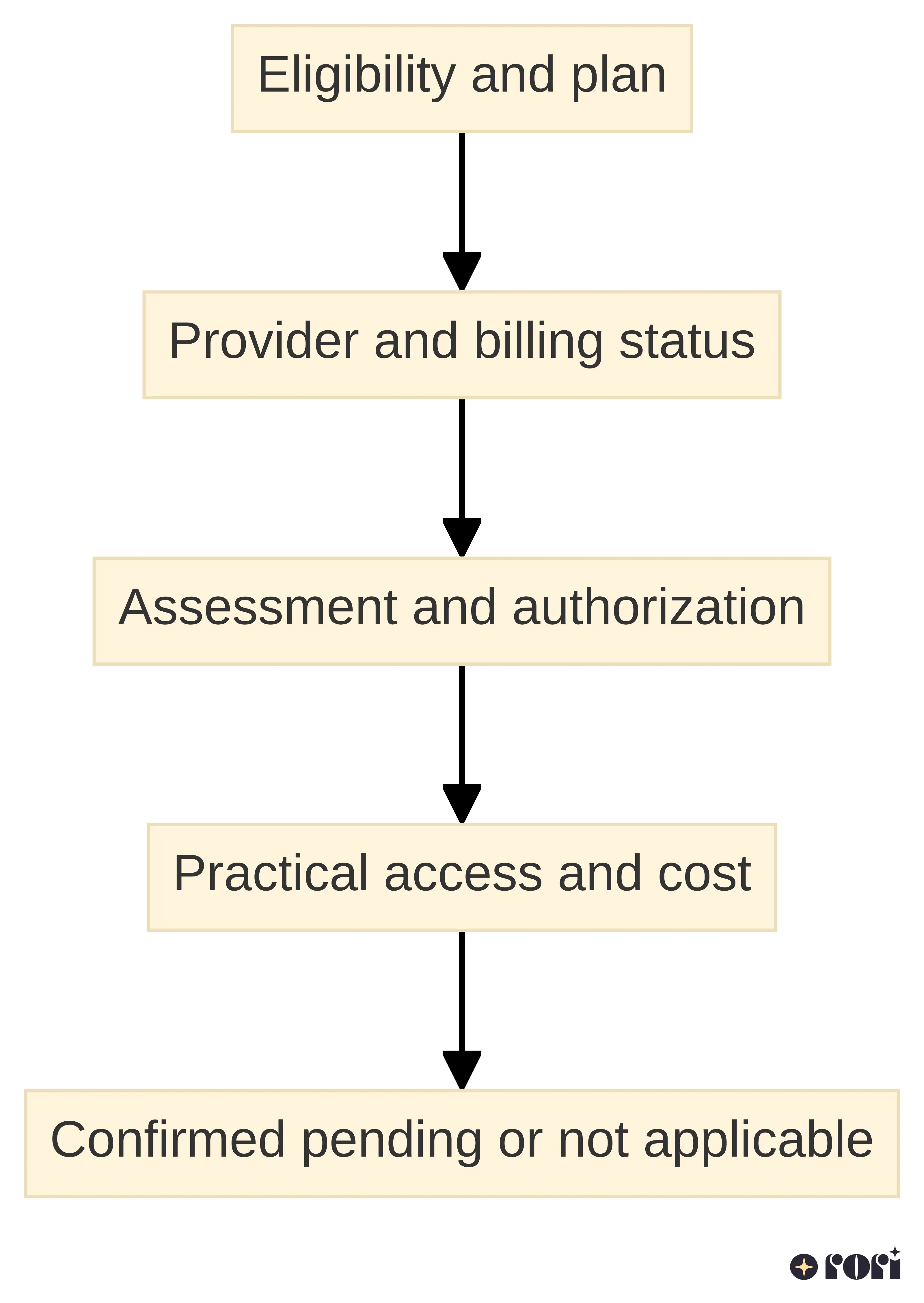
The phrase “accepts Medicaid” should lead to four separate checkpoints:
- Eligibility and plan: Is your child enrolled in the applicable Medi-Cal plan, and does the plan recognize the service being requested?
- Provider and billing status: Is the organization able to bill the relevant program, and does it participate in your specific plan or network?
- Assessment and authorization: What evaluation, treatment plan, referral, or prior approval does the plan require before services begin?
- Practical access and cost: Does the provider have a suitable opening, and what amount could remain your responsibility?
Mark each checkpoint as confirmed, pending, or not applicable. Do not convert one confirmed answer into four.
Your coverage record should include the plan name, the phone number used, the date of each call, the representative’s name or reference number when available, and the exact answer about ABA services. A clear record helps you compare answers without depending on memory.
Build a San Jose comparison record
To create a starting list, ask your Medi-Cal plan whether it can identify ABA providers near San Jose for the service you want to discuss, and ask each named organization whether it handles inquiries for that service. You can also record providers you are already considering, including Rori Care’s San Jose center, without treating a location or a business statement as proof of plan participation. For every name, write the organization, San Jose location, service being discussed, plan name, and the person or department that answers. Mark the name as a candidate, not a confirmed option, until the provider and plan give answers that apply to your child’s coverage. If the plan cannot identify a provider, ask which department handles autism-related or behavioral health services and record the referral or reference number. Then apply the same comparison fields to each candidate: service setting, assessment route, authorization contact, availability, and possible member responsibility. This produces a short, documented starting list while keeping location, coverage, intake, schedule, and cost as separate questions. Use the same fields for every option so a nearby location does not overshadow unanswered coverage or intake questions.
Your comparison record should include one entry for each organization and these fields:
- Location: city, neighborhood, travel distance, and whether the location works for your regular schedule.
- Service description: the age range, service setting, assessment process, and type of ABA support the organization says it provides.
- Coverage contact: the plan names the organization says it can bill or participate with, stated in the provider’s own answer.
- Intake contact: the person or department handling the first inquiry and the documents they request.
- Authorization path: whether the provider or your plan explains who submits the request and what must be supplied.
- Availability: the next assessment opening, treatment opening, or waitlist status, if the provider gives one.
- Cost question: the estimate or explanation provided for deductibles, copayments, coinsurance, or other possible charges.
- Open items: every answer that still requires confirmation from the plan or provider.
A nearby address does not answer whether the organization can serve your plan or your child’s needs. Record distance as one field, then keep coverage, intake, schedule, and cost as separate fields.
Your call log should capture the same information after every conversation:
- Write the organization or plan name and the date.
- Copy the answer to each question in plain language.
- Label the answer confirmed, pending, or unclear.
- Note the next person you need to contact and the question that person must answer.
- Keep documents, reference numbers, and written messages with the same entry.
The immediate purpose of this log is comparison. It lets you see which option has documented answers and which option still depends on an assumption.
Verify the provider’s California Medi-Cal status
California’s Qualified Autism Service provider process creates one administrative checkpoint for an ABA organization. An eligible California ABA group or for-profit organization may enroll as a QAS provider organization if it meets the applicable program, enrollment, and attestation requirements.
California QAS provider organizations enroll as Healthcare Businesses in the PAVE portal rather than selecting the Group or Mixed Group application options. The Healthcare Business application reports the QAS providers, professionals, and paraprofessionals for whom the organization will bill behavioral health treatment services.
Since November 17, 2025, California QAS providers and community-based organizations may use a qualification-attestation process for behavioral health treatment personnel, subject to notice-and-confer requirements. Organizations using that process must maintain a current list of supervised behavioral health treatment providers and make it available to the California Department of Health Care Services upon request and for state or federal audits.
Your provider-status questions should identify the administrative path that applies to the services being discussed:
- Is the organization enrolled or eligible to enroll as the type of California QAS provider that applies to its structure?
- Which organization or healthcare business will bill for the requested behavioral health treatment?
- Which professionals and paraprofessionals will be included in that billing arrangement?
- If the organization relies on qualification attestation, who maintains the supervised provider list?
- Can the organization explain what remains to be confirmed with your specific Medi-Cal plan?
QAS enrollment information does not by itself prove that your plan will authorize a service or that an opening is available. Keep provider status and plan participation as separate lines in your record.
Ask the provider to identify the billing and care pathway
The billing entity matters because the organization, the supervising professional, and the people delivering behavioral health treatment may appear in different parts of the care and billing pathway. California’s QAS Healthcare Business application includes the providers, professionals, and paraprofessionals for whom the organization will bill.
Your provider conversation should identify each step in order rather than rely on a general coverage label. Ask:
- Who receives the first inquiry about your child?
- Who reviews the information needed for an assessment?
- Which organization bills the plan for the assessment and for later services?
- Which professional supervises the treatment plan, if treatment is authorized?
- Who submits documents or authorization requests to the plan?
- Which steps must you complete, and which steps does the provider handle?
- When should you contact the plan directly?
Write down the name of each responsible party. If the provider tells you to call the plan, copy the exact question you should ask so the two conversations address the same service.
A clear pathway does not promise approval. It tells you where each decision occurs and prevents you from treating an intake conversation as a coverage determination.
Your document question should ask what information the provider needs before reviewing your child’s situation, using the provider’s stated intake process. Record whether the request concerns an existing diagnosis, an assessment, plan information, referral information, or another document. Do not assume that sending one document completes the plan’s requirements.
Confirm plan rules before scheduling
Your plan’s rules control the practical coverage question. Federal Medicaid policy provides the entitlement described above, while state implementation can vary; a Florida insurance guide also describes different prior-authorization rules among plans and says treatment plans and assessments may still be essential documentation even when prior authorization is not required. That Florida example is not a California rule, but it shows why you need an answer from your own plan.
Your plan call should cover these questions before you schedule an assessment:
- Is my child’s current enrollment active for the date of service I am asking about?
- Does this plan cover the ABA-related service being requested for an eligible child?
- Is the organization in network or otherwise recognized for this service under my plan?
- Does the assessment require a referral, prior authorization, or a particular diagnosis or documentation package?
- Does treatment require a separate authorization after the assessment?
- Who submits the authorization request, and how can I track it?
- What rules apply to the service setting and schedule being requested?
- What copayment, deductible, coinsurance, or other member responsibility could apply?
- Which plan document or representative can provide the answer in writing?
Use the exact service name given by the provider when you speak with the plan. If the representative cannot answer, ask which department handles behavioral health treatment or autism-related services and record the transfer.
Your comparison record should save the plan’s answer beside the provider’s answer, not in a separate mental checklist. A provider can describe its billing process, while the plan decides how the service is handled under your enrollment and benefits. Both answers belong in the same comparison record.
Your notes should not say “covered” unless they also record what that word means: covered by which plan, for which service, under which authorization, with what member responsibility, and for what period. If any part is unanswered, label the item pending.
Keep assessment, authorization, and availability separate
Assessment, treatment authorization, and availability are three different checkpoints. An assessment concerns information about your child; authorization concerns the plan’s decision about a requested service; availability concerns whether the provider can offer an opening that fits the situation.
Your assessment questions should clarify the first appointment:
- Is the first appointment an intake, a diagnostic assessment, or another type of evaluation?
- Who conducts it, and what information should you bring?
- Is the assessment billed separately from later ABA services?
- Does the provider accept an existing diagnosis or require additional evaluation?
- What decision follows the assessment, and who explains it to you?
Use the provider’s precise description in your notes. Do not label every first appointment an ABA treatment start.
Your authorization questions should identify which documents support the request, who submits them, whether a separate approval is needed after assessment, and how an approval or denial is communicated. A Florida insurance guide describes plans with different prior-authorization requirements and identifies treatment plans and assessments as potentially essential documentation; California requirements must be confirmed through your own plan and provider.
Your availability questions should address the opening that actually applies to your child’s requested service, not only the next phone consultation. Ask whether the answer is an assessment opening, a treatment opening, or a waitlist position; whether the schedule is fixed or subject to confirmation; and when you should contact the provider again if the status changes.
Your stage record should keep a separate line for each checkpoint. A useful entry might read: assessment—question answered; authorization—plan response pending; availability—provider has not confirmed a treatment opening; cost—member responsibility pending. This format keeps one completed step from disguising three unresolved ones.
Use a call-and-document checklist to choose
Your call record should be prepared before you contact providers or your plan. Gather the information you can use consistently, then leave space for answers rather than filling gaps with assumptions.
Record:
- your child’s first name or an intake reference, using the privacy process the organization provides;
- the Medi-Cal plan name and member information requested by the plan;
- your San Jose location and practical travel limits;
- whether your child has an existing diagnosis or is awaiting assessment;
- the service question you want answered;
- the date, phone number, representative, and reference number for each call.
This provider checklist can structure each conversation:
- What ABA-related services does your organization describe for children in my situation?
- Which organization receives the referral and bills for the service?
- What California QAS or Medi-Cal enrollment information can you identify for the billing organization?
- Which professionals and paraprofessionals are part of the billing and supervision pathway?
- What information is needed for the assessment?
- Who contacts the plan about authorization?
- Is the answer you are giving me about assessment, treatment authorization, or availability?
- What amount might I need to discuss with the plan before services begin?
- What remains unconfirmed?
California’s QAS enrollment materials distinguish the provider organization from the people for whom it bills and describe qualification-list responsibilities for organizations using the attestation process. Those distinctions make the billing and supervision questions worth recording separately.
This plan checklist can follow the provider’s service description:
- Is the child’s coverage active for the relevant service date?
- Does the plan cover this service for an eligible child under the applicable pathway?
- Is this organization recognized for the service under the plan?
- Does the assessment need a referral or authorization?
- Does treatment need a separate authorization?
- Which documents are required, and who submits them?
- What member responsibility could apply?
- How will the plan communicate its decision?
- What reference number records this answer?
Do not import a Florida plan’s authorization rule into a California decision. Use the out-of-state example only as a reason to ask your own plan directly.
Your decision record should give every item one status at the end of each call:
- Confirmed: the responsible organization gave a direct answer that applies to your child’s plan or intake step.
- Pending: someone must provide a document, authorization response, opening, or cost answer.
- Unclear: the answer used broad wording such as “usually covered” without identifying the plan, service, or condition.
- Not applicable: the responsible organization explained why the question does not apply.
Treat confirmed items as documented checkpoints, not as a promise about future treatment. Choose an option only after you know which questions remain open and who must answer them.
This concise opening can keep the conversation focused: “I am looking for ABA services for my child near San Jose and need to understand the Medi-Cal plan, assessment, authorization, availability, and possible member cost. Which part of that process can you confirm, and who should answer the rest?” The script gives you a clear handoff without asking for an outcome that the person on the call may not determine.
Take the next step without assuming coverage
A suitable San Jose ABA option is the one whose practical fit you can document: the provider pathway is identified, the plan’s coverage and authorization questions have answers, the assessment step is clear, availability is stated separately, and potential member responsibility is understood or explicitly pending.
Start with one provider and your Medi-Cal plan, then complete the same call record for each option you compare. Ask a qualified professional to decide individual clinical suitability for your child, and ask your plan and provider to decide the coverage, authorization, scheduling, and cost details that apply to your situation.
Questions parents may still have before contacting an ABA provider
What should I confirm about my Medi-Cal plan before seeking ABA therapy?
You should verify your child’s enrollment status, whether the plan covers the specific ABA service, if the provider is in-network, and what documentation is required for assessment and treatment authorization.
How can I find out if a nearby ABA provider accepts my Medi-Cal plan?
Contact the provider directly to ask if they are enrolled with your specific Medi-Cal plan and can bill for the services you need.
What information do I need to gather when contacting providers about ABA therapy?
Prepare to provide your child’s name, your Medi-Cal plan details, any existing diagnosis, and specific questions about assessment, authorization, and potential costs.
What are the key checkpoints to consider when verifying Medicaid coverage for ABA therapy?
Check eligibility and plan details, provider and billing status, assessment and authorization requirements, and practical access including availability and potential costs.
What questions should I ask a provider during my initial contact about ABA therapy?
Inquire about the services offered, who handles billing, what documents are needed for assessment, and how authorization requests are submitted.
How does Medicaid coverage for ABA therapy vary by state?
Medicaid implementation for autism services can differ by state, affecting how services are structured, funded, and regulated, so it’s important to check local requirements.
What should I document during my calls with providers and my Medi-Cal plan?
Keep a record of the date, the name of the representative, the answers received, and any reference numbers, labeling each response as confirmed, pending, or unclear.